Shumbhamkari kali : The Supreme Consciousness of Life and Longing

What is your career plan?

The Colorless Midnight: Sri Ramakrishna’s Journey

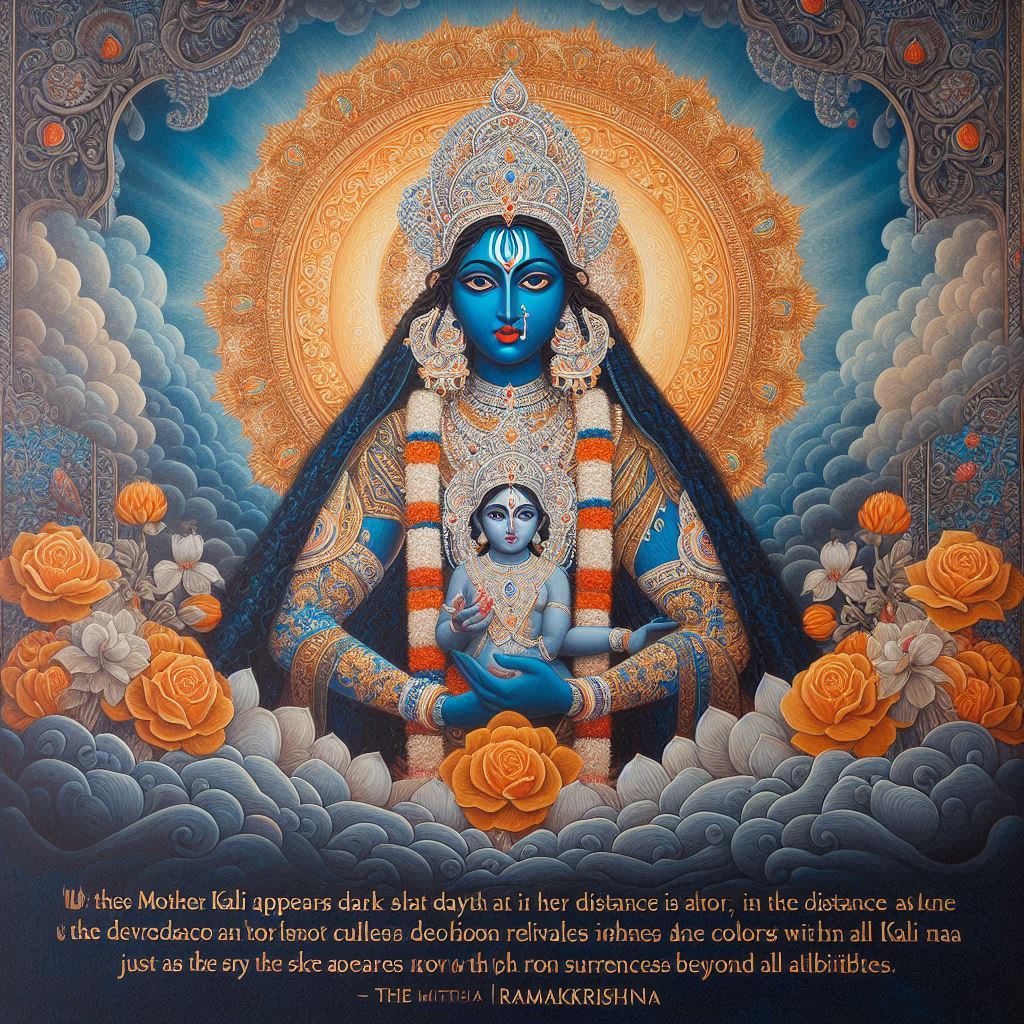
Kali Maa is more than a fierce deity, She is the embodiment of Ultimate Reality, Brahman itself. Though many see maa only as the goddess of destruction, She is also the loving Universal Mother, worshipped in countless forms. Sri Ramakrishna Paramahamsa, with tears streaming down his face, would often declare that his beloved Bhavatarini Kali of Dakshineswar was none other than the Supreme Brahman in motherly form. His divine visions and profound devotion led him to proclaim with childlike simplicity: “What the Vedas call Brahman, I call Mother.”

Though Tantra was widely practiced in Bengal during his time, Sri Ramakrishna cautioned against its misinterpretations. He emphasized pure Bhakti, selfless devotion as the surest path to Mother Kali’s embrace. For him, She existed beyond all dualities, being both the formless Absolute and the manifest universe, both Brahman and Maya simultaneously.

Sri Ramakrishna experienced Kali Maa in Her various aspects: as Maha Kali, the primordial power before creation, as gentle Syama Kali, who accepts worship in homes, as Raksha Kali, the divine protectress in times of danger, and as Smasana Kali, the fierce goddess of the cremation grounds who destroys all illusions.

His most illuminating teaching was that Mother Kali appears dark only from a distance, but in the intimate embrace of devotion, She reveals Herself as colorless beyond all attributes. Just as the sky appears blue from afar yet has no color when one is immersed within it. Sri Ramakrishna taught that to truly know Kali Maa, one must surrender completely at Her lotus feet. She is not merely a symbol but the living presence of love, power, and absolute truth. Through his life and ecstatic visions, he demonstrated that Mother Kali’s grace flows most abundantly to those who approach Her with the innocent trust of a child calling for its mother.

The Supreme Consciousness of Life.

Kali Maa is the MahaPrana (great life energy) that flows through everything. She represents our deepest wish to live forever, which isn’t just human arrogance, but a fundamental part of our soul’s connection to supreme consciousness.

Kali Maa embodies our most profound longing, to love everything and feel connected to all of life’s supreme consciousness. She is the hidden force behind our desires, always pushing us to seek something more meaningful. When we feel unhappy or restless with what we have, it’s Kali Maa’s ascending force working to expand our understanding and take us beyond our current limits. Her energy is like a gentle but powerful current of that moves us towards deeper experiences. She helps us see that there’s always something more beautiful and profound waiting to be discovered, encouraging us to grow, transform, and reach for a higher understanding of life’s supreme consciousness.

Make positivity your power

What was the last live performance you saw?

Raise your spiritual power.

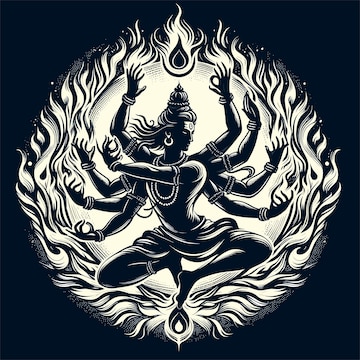
In the heart of the charnel grounds, where darkness and decay reigned, there stood a sanctuary. It was a realm where the shadows of mortality danced with the flickering flames of existence, and within this realm, there was a figure whose name echoed through the ages.  Lord Shiva, the Destroyer.

Lord Shiva’s form was ethereal, a dance of smoke and fire that seemed to defy the very laws of nature. His serpentine locks flowed like a river of obsidian, and his eyes, like the fires of a thousand suns, bore into the souls of all who dared to look upon him. Around his neck hung a garland of skulls, a macabre reminder of the impermanence of life, and in his hands, he held the trident that represented the cosmic balance between creation, preservation, and destruction.

The ganas who surrounded him were no ordinary beings. They were the ugra bhuta, the fierce spirits that embodied the darker aspects of existence. They were the embodiment of fear, rage, and chaos, and yet, they were the very essence of Lord Shiva’s power. They danced and sang in a frenzy, their figures a whirl of shadows and flames, as they paid homage to their master. In this forsaken place, where the echoes of suffering were a constant reminder of the ephemerality of life, Lord Shiva was known to bestow his blessings upon those who sought him. Even the smallest act of devotion could sway the balance in one’s favor, for Lord Shiva was known to be both compassionate and merciless.

Speak like you pray

The eternal feminine flows through Maa’s side, nurturing life with gentle radiance at creation’s dawn. The cosmic masculine pulses through Shiva’s form, dissolving worlds with thunderous power at time’s end. Maa embodies the flowing rivers of compassion, Her eyes pools of boundless mercy for all beings. Shiva manifests the steadfast mountains of justice, His gaze the piercing flame that burns illusion.

The universe blossoms from Maa’s laughter, petals of existence unfurling in joyous abundance. The cosmos returns to seed within Shiva’s solemn breath, cycles completing in perfect dissolution. Maa’s hands bestow blessings of abundance, sustaining creatures through the wheel of becoming. Shiva’s palms hold the drum of time’s rhythm, marking the beat to which all existence must dance. Maa is Shakti, the primal energy flowing through every particle of being.
Shiva is the unchanging consciousness within which all transformations occur.

The divine mother cradles creation in Her loving embrace, nourishing all with tender care. The cosmic father oversees the grand design, maintaining dharma through eternal wisdom. Maa dances in delight with the captivating beauty at the face of creation which springs forth from them. Shiva’s dance of destruction is in fury and the cosmos subsides back in them. SHE is the mother of this world and He is the Father. In their sacred union, opposites find harmony, neither complete without the other. In their divine wholeness, duality dissolves into the perfect balance of being.

Why Astrology 🤔

Write about your approach to budgeting.

It is a branch of Vedic astrology that predicts events that occur globally.
Helpful in understanding important events such as wars, epidemics, economic crises, regime changes, etc.

Basis of Mundane Astrology

Horoscope of Countries –
Analysis of the horoscope of the day a nation was established

Eclipse –
What will be the effect of solar and lunar eclipse in the country and abroad?

Transit Yoga-
When a big planet changes its zodiac sign, what will be the effect on the world?

Solar Year Horoscope –

What will be the position of the king (power) and the public every year?

Quadrilateral Horoscope –
Prediction in detail by dividing the year into four parts.


Major Planets and their Influence:

Sun –
influences the king, power, administration.

Moon –
influences the public, mood, climate change.

Mars –
denotes war, aggression, military activities.

Mercury –
Planet associated with business, economy, education.

Jupiter
influences the law, religion and the justice system.

Venus –
The planet associated with art, film, entertainment and financial sector.

Saturn –
Recession, poverty, difficulties and influences judicial decisions.

Rahu-Ketu –
Mysterious events, conspiracies, pandemics and factors of global change.


Impact of Major Planetary Transits on India 2025:

1. Saturn Transit in Pisces (29th March 2025):

Political and Social Impact:
Saturn’s entry into Pisces can increase political instability and social tension in the country. The differences between the opposition and the government may deepen, which may lead to a sense of discontent among the public.


Natural Disasters:
During this period, the chances of earthquakes, floods, and other natural calamities may increase, which may lead to loss of life and property.


2. Jupiter Transit in Gemini (14th May 2025):

Economy and Business: Jupiter’s transit in Gemini indicates advancement in the technical and communication fields. India can make significant progress in the technological sector, which will improve the economy.


Climate Change:

During this transit, abnormal temperature rise and climate change events may occur, which will affect agriculture and human life


3. Rahu and Ketu Transit (18th May 2025):

Technical and Military Field:

Rahu’s transit in Aquarius can bring India advancement in technical and military fields. Significant achievements are possible in the field of space research and defense.


Domestic Industry and Health:

Ketu’s transit in Leo signifies the slowdown in domestic industries and the possibility of new health problems or epidemics

These will help calm your mind and bring balance to your emotions.

What relationships have a positive impact on you?

Our surroundings & I

Negative energies or energies are those forces that are not made for this world but still reside here in a supernatural form. Since they are not in harmony with nature, they are harmful to human life and its energy, but this effect is not universal. Some people quickly come under the influence of such negative energies. Due to mental and emotional weaknesses, a person can pull negative energies towards him Many types of bad habits in lifestyle, such as spending time in negative places or with people, weaken the energy of the person. Its main effect is on our mental health, so we need to know about it. Weakening of the aura can be the main reason for a person to come under the influence of negative forces

I see so many people struggling with such overwhelming emotions, especially at an age when life should be full of hope and possibilities. Usually, I don’t respond to messages that focus on such negativity, and I won’t reply to each of you personally this time either. I feel the need to share something that can genuinely help you overcome these feelings of despair.

I assure you, it can make a difference.


This remedy is not just a suggestion it’s something I’ve seen work for many individuals who have tried it, along with certain astrological practices. It can bring about a positive change in your life, but only if you are willing to take the first step. If you truly want to heal, follow this remedy with faith and commitment. I assure you, it can make a difference.

1. Sharp writing.

Take a notebook or diary and start writing down everything on your mind. Whatever is troubling you….your fears, guilt, pain, or anything you can’t share with anyone, just pour it out. Write every single day. Don’t worry about how it looks or sounds….this is just for you. Write at least two pages daily.

2. Start filling up.

When your diary starts filling up, start reading it. Begin with a few pages…don’t rush. Allow yourself to feel everything as you read….if you cry, let it out. If you feel angry, let yourself feel it. Keep reading and re-reading until the emotions lose their grip on you.

3. What are you doing??

Keep this diary safe. Hide it safely in a cupboard, a drawer, or any place where no one else can access it. This is your safe space.

4. Step 4.

When you feel that the words no longer hurt you and seem like just ink on paper, it’s time to let go. Burn the diary. Tear the pages one by one and safely burn them. Let the flames take away all the pain and negativity.

5.  useful !!

Alongside this, start practicing meditation, Trataka (focused gazing), Yoga Nidra (deep relaxation), and cleansing techniques from Ayurveda(षट्कर्म).
To avoid negativity, it is very important to adopt a positive attitude, do regular meditation and yoga, and follow a balanced lifestyle. According to spirituality, everything is a form of energy, and the human aura is also a form of energy. Those whose aura is weak quickly come under the influence of negative energy. Mental, emotional, and spiritual weakness is the main cause. Also, psychological, spiritual, and external factors can also be responsible for this.  A mind full of fear and stress attracts negative energies. Mental exhaustion and negative thinking weaken a person’s energy, making them more vulnerable to external negative influences

Strengthen an energy

Spiritual Weakness Not practicing regular meditation, prayer, or positive energy can weaken a person’s spiritual protection, making him more vulnerable to external negative energies. A lack of knowledge of negative energies and their nature can force a person to attract them unknowingly. Engaging in spirits or supernatural activities without safeguards can be extremely risky. Factors that hinder spiritual energy, such as impurity of place, old negative events, or unfulfilled spirits, can affect the individual.  Places filled with negative energy, such as controversial, deserted, or accidental areas, can affect the person quickly. Spending time with negative people and physical exhaustion weakens mental and spiritual energy, which can lead to negative energies. Our energy (aura) protects us from external negative influences. But if it becomes weak, the person becomes more sensitive. An imbalance of the seven chakras in the body can cause mental, physical, and spiritual weakness

Remember, this is a journey, and it’s not always easy. Some days you won’t feel like writing or reading, but fight through it. Push yourself. You are stronger than you think. This is your battle, and you can win it. When you’ve completed this process written, read, and burned your diary, message me. That’s when I’ll reply to you personally. Healing is a step-by-step process, but trust me, you can come out of the darkness. Just take the first step. Adopt a positive attitude. Meditate, do yoga, pray, and chant mantras. Use Rudraksha, or Raksha Kavach, to strengthen the energy. Light a lamp of incense regularly in the house. Eat a balanced diet, sleep well, and exercise. Surround yourself with positive people and stay away from negative places. Be sure to read

Major Stories of Hayagriva Avatar: Restoration of the Vedas

What are your favorite physical activities or exercises?

।। सूर्य आत्मा जगतस्तस्थुषश्च।।

The month of Margashirsh: The Era of Bhagavad Gita Revelation

Margashirsh is the ninth month of the Hindu lunar calendar, falling between November and December. It is also known as Agrahayana and holds immense spiritual significance in Sanatan Dharma. Margashirsh is the month when Bhagwan Shree Krishna imparted the eternal wisdom of the Bhagavad Gita to Arjun on the battlefield of Kurukshetra during the Mahabharat.

In the Bhagavad Gita (10.35), Shree Krishn says,

“मासानां मार्गशीर्षोऽहमृतूनां कुसुमाकरः ”

“Among months, I am Margashirsh.” This emphasizes the month’s supreme importance as a time for Dharmik’s growth and reflection. Historically, Margashirsh marked the beginning of the harvest cycle in the Ancient Bharatvarsh, making it a time of gratitude and prayer for abundance.

Grant victory Aditya Hridaya Stotram: the power to eliminate all enemies.

आदित्य हृदयं पुण्यं सर्वशत्रु विनाशनम्
जयावहं जपेन्नित्यम् अक्षय्यं परमं शिवम्

Aditya Hridaya Strotram is advised by Agastya Muni to Shri Rama to defeat Ravana. Stotra is mentioned in Yudha Kandam of Srimad Ramayanam. Shri Rama was very fatigued before the war & Agastya Muni gave Aditya Hridayam as Updesham, dedicated to Surya Deva, who granted victory to all. Agastya Muni enlightens Rama saying Stotra has the power to eliminate all enemies &. And will be victorious. Rama prayed to Surya and felt energetic to fight with Ravana. Evil vanishes from life who keeps Sun in Heart. Sun is the soul of all that is dynamic & static.

Hayagriva Avatar: The worshiped as the god of knowledge and wisdom


Devi Bhagavata Purana (Book 1, Chapter 9)


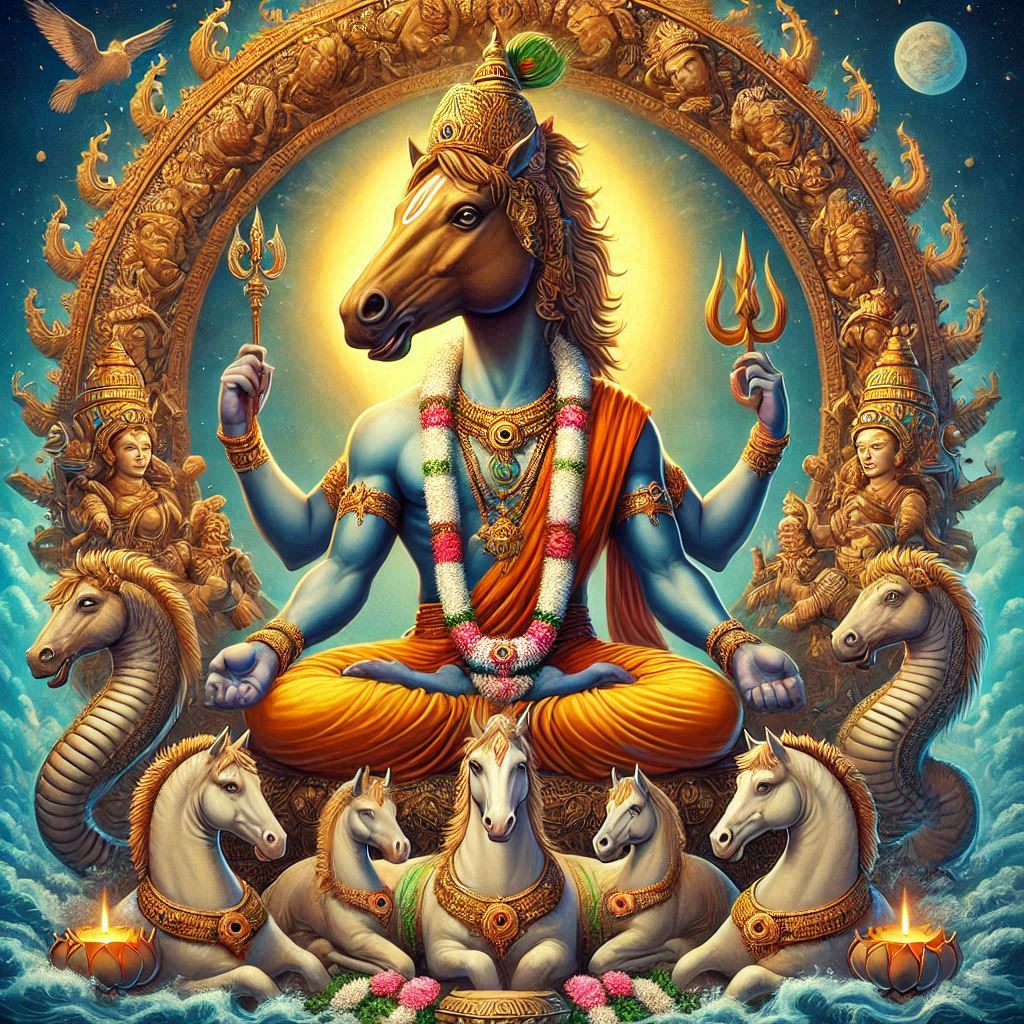
The Hayagriva Avatar of Lord Vishnu is a lesser-known yet significant incarnation. Hayagriva is depicted as a horse-headed deity, with the body of a human, representing wisdom, knowledge, and the preservation of the Vedas. Significance of the Hayagriva Avatar:The Hayagriva incarnation is often worshiped as the god of knowledge and wisdom, as his form represents clarity of thought and intellect. In various traditions, Hayagriva is revered for restoring the sacred Vedas that had been stolen, symbolizing the protection of spiritual knowledge. The demons Madhu and Kaitabha steal the Vedas from Brahma while he is asleep, causing chaos in the universe. Brahma prays to Lord Vishnu for help. In response, Vishnu assumes the form of Hayagriva, the horse-headed avatar, battles the demons, and restores the stolen Vedas to Brahma. Purana Reference:  Mahabharata (Shanti Parva, Chapter 348) In both sources, Vishnu’s Hayagriva form is highlighted as the protector of the Vedas, symbolizing the triumph of wisdom over ignorance and chaos. The Story of Hayagriva and Vishnu’s Meditation (Skanda Purana)In this story, Vishnu assumes the Hayagriva form to perform severe penance. During the end of the Kali Yuga. When darkness and ignorance dominate, the gods pray for Vishnu’s intervention. Vishnu, as Hayagriva, meditates to restore cosmic order, and his energy and wisdom ensure the continuation of dharma.

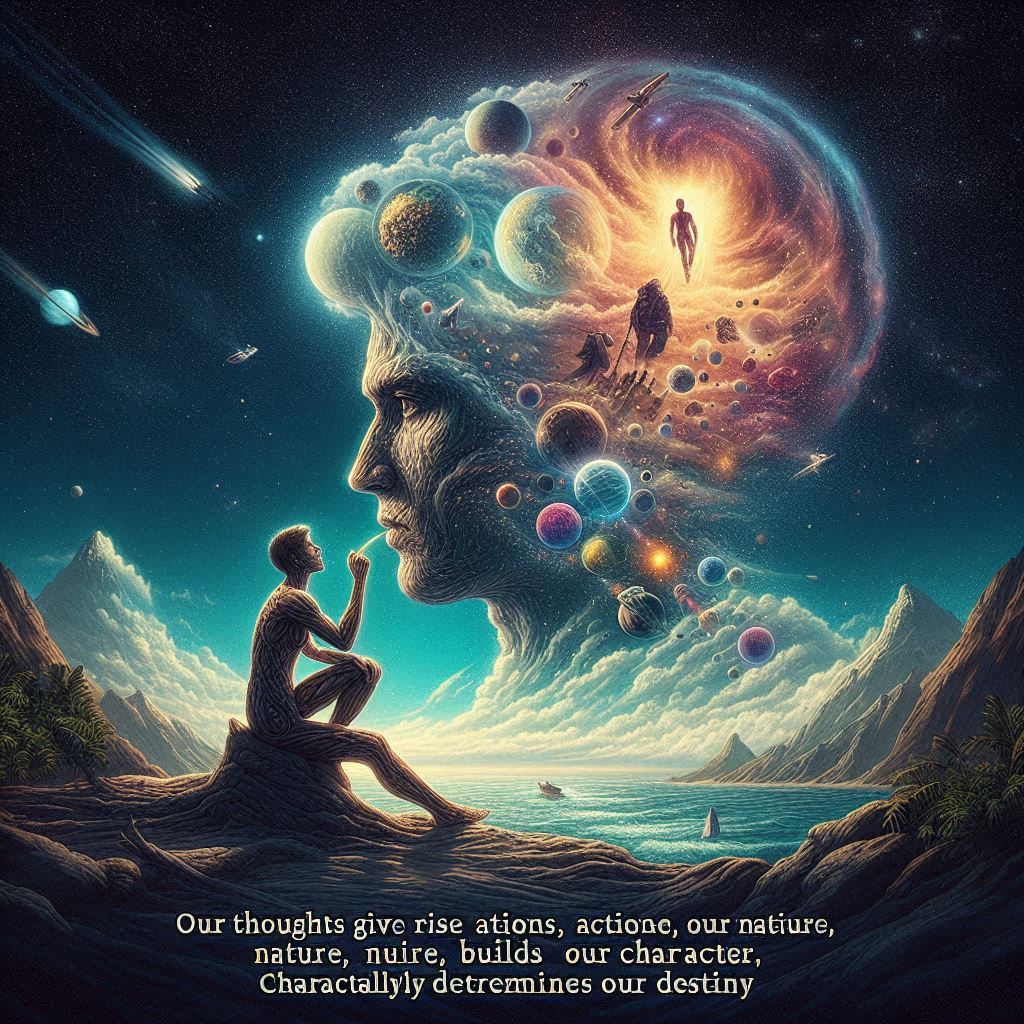
Thoughts and the Emergence of Destiny

What is your favorite form of physical exercise?

Journey from Thought to Destiny:

Journey from Thought to Destiny:
Our thoughts give rise to actions, actions shape our nature, nature builds our character, and character ultimately determines our destiny. This thought emphasizes that every stage of our life begins with our thoughts. When we hold a thought in our minds, it transforms into our actions. Our actions shape our nature, which in turn builds our character. Ultimately, our character determines our destiny or fate.

“The Power of Bhagwan Satyanarayana” is a Story from the Upanishads.
Once upon a time, there was a Brahmin who regularly worshipped Bhagwan Satyanarayana. He performed his rituals with devotion and kept his thoughts pure and sacred. One day, a sage asked him why he worshipped with such devotion and regularity.

The Brahmin replied, My thoughts are pure, which makes my actions pure as well. When I perform righteous actions, my nature becomes pure. And when my nature is pure, my character becomes noble. This improves my destiny, bringing me peace and prosperity. The sage said, Your understanding is in alignment with what is described in the Upanishads. Our thoughts guide our lives. Therefore, we must always keep our thoughts pure and positive. Thus, through his worship and the purity of his thoughts, the Brahmin not only improved his own life but also imparted a message to society that it is our thoughts that shape our destiny.

“Let your thoughts be the seeds of purity, your actions the blossoms of righteousness, your nature the fragrance of virtue, and your character the fruit of destiny.” This captures the essence of how our inner world shapes our outer reality. By nurturing pure thoughts, we lay the foundation for a life of integrity, peace, and fulfillment.

Central upnishad

1. ऋगवेद (Rig Veda) : प्रज्ञानं ब्रह्म

Pragnanam Brahm –
Brahm is intelligence, is a Defining aphorism (Lakshana Vakya)

2. यजुर्वेद (Yajur Veda) : अहं ब्रह्मास्मि

Aham Brahm Asmi –
I am Brahm, is an Experiential aphorism (Anubhava Vakya)

3. सामवेद (Sama Veda) : तत्त्वमसि

Tat Tvam Asi –
That you are, is a Teaching aphorism (Upadesha Vakya)

Need overall !

What could you try for the first time?

Lentent hit :

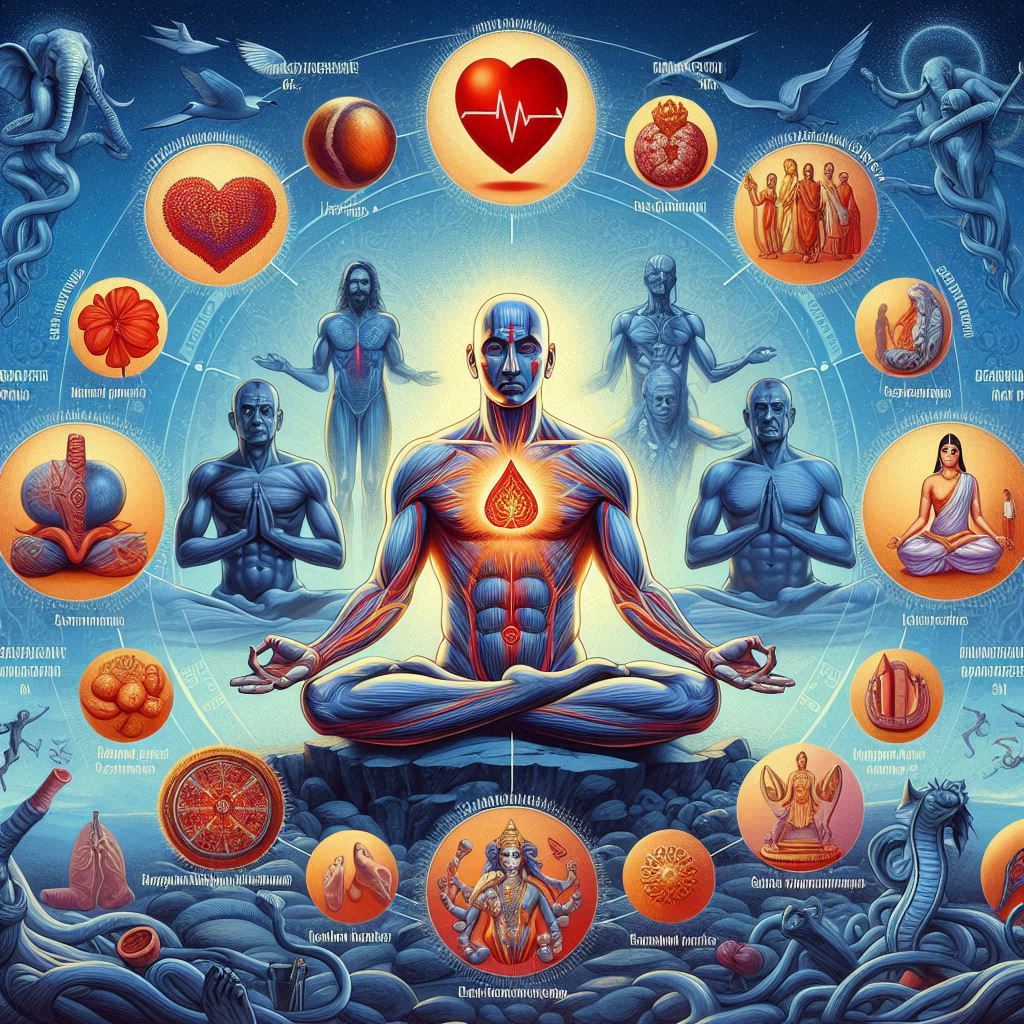
Due to stressful life in modern society, human beings are vulnerable to deadly diseases like high blood pressure, heart disease and cancer. Many diseases are destroyed by lifestyle improvement. Along with this, there is another easy solution, which does not have any side effects. You just need to do it regularly. This easy solution is the Gayatri Mantra, which has been tried for centuries. And nowadays it has also been put to the test of science.

1. If this mantra is read in any position i.e. while sitting, lying down or standing, then one gets equal benefit to

2. The mantra begins with the word Om- Pull the word Om as long as you can, without taking a breath. Draw the words “o” and “m” separately long.

3. After this, read or speak the remaining mantra as fast as you can with the correct pronunciation. Repeat the OM process every time. Keep repeating Om and Mantra continuously for five minutes.

4. Do this process every two hours for a month. In this way, do the awakening of a normal person 8 times in 16 hours. A total of 40 minutes are to be given in 24 hours.

5. After one month, the beneficial effect of this process will be seen. Now continue this process by doing it four times in 24 hours.

6. It is necessary to chant this mantra for five minutes at the time of getting up in the morning and at bedtime. After this, keep reciting this mantra regularly by fixing a fixed time only twice.

आत्मानं विद्धि”

Vasana Daha Tantra is a powerful spiritual practice rooted in the ancient wisdom of Bharat that aims to burn away the latent impressions (vasanas) accumulated from past experiences, desires, and karmic patterns. The term “Vasana” refers to the deep-seated tendencies and subconscious impressions that influence our thoughts, emotions, and actions. “Daha” means burning or purification, and “Tantra” signifies a structured method or practice. In essence, Vasana Daha Tantra is the process of purging or transforming these deep-rooted impressions, leading to liberation from mental and emotional conditioning, ultimately bringing one closer to spiritual enlightenment.

Process of Vasana Daha Tantra:


1. योगस्थ: कुरु कर्माणि =  Self- realisation:

The first step involves deep introspection and awareness of one’s thoughts, desires, and behaviors. Through meditation and mindfulness, you identify the underlying patterns and attachments that are obstructing spiritual growth. As the Bhagavad Gita states, “योगस्थ: कुरु कर्माणि” — remain established in yoga while performing actions, staying aware of the forces at play.

2. आत्मानं विद्धि = Acknowledge and Accept:

Once the asanas are identified, the next step is to fully acknowledge their presence without judgment. Accept that these impressions are part of the karmic cycle, and they need to be transformed, not resisted. The acceptance phase draws from the Upanishadic wisdom, “आत्मानं विद्धि” (Know thyself), recognizing the self in all its layers.

3. Purification through Reflection :

This step involves deep contemplation on the harmful or binding nature of these vasanas. By reflecting on their impermanence and the suffering they cause, the seeker gradually detaches from their influence. In this phase, spiritual texts like the “Shvetashvatara Upanishad” guide the seeker to view desires as fleeting and not inherent to the true self.

4.सर्वे कर्माखिलं पार्थ ज्ञाने परिसमाप्यते”=  Soul of Visualization:

A key technique of Vasana Daha Tantra is meditative visualization, where one mentally visualizes the vasanas burning in the fire of wisdom. The fire represents spiritual knowledge, often referred to as “Jnana Agni” (fire of knowledge). As stated in the Mundaka Upanishad, all actions are dissolved in the fire of wisdom.

5. तंत्र: Ritualistic Dissolution :

Engage in a ritual where you symbolically burn these impressions. This can involve the chanting of mantras, such as the powerful “Om Agnaye Namah” (Salutations to the fire element), while mentally offering the vasanas into an inner fire. This act strengthens the internal process of release and purification.

6. Affirmation of Liberation :  

 After the process of dissolution, affirm your liberation from the past tendencies. Repeat mantras like “सोऽहं” (I am That), affirming the unity of self with the divine consciousness. It reinforces the realization that you are beyond desires and karmic impressions.

7. तत्त्वमसि :  Feel the infinite :

The final stage is integrating this newfound freedom into daily life. You move forward with a clearer mind and a lighter heart, no longer governed by old vasanas. The Chandogya Upanishad says, real, I  remind you that the true self is infinite, pure, and free from conditioning.

Vasana Daha Tantra is a transformative spiritual practice that combines deep introspection, meditation, mantra, and ritual to dissolve the karmic impressions that bind us to the cycle of birth, death, and rebirth. By purifying these asanas, one can attain clarity, freedom, and a deeper connection to the divine. This method empowers the seeker to transcend habitual patterns and step into a higher state of consciousness, aligning with the true self eternal, blissful, and free.

Life is a divine workplace.

What principles define how you live?

Whya burnout??

Life is like a vast ocean, in which we are all travelers and God is our guide. During this amazing journey, there are sometimes strong thunderstorms and storms that challenge us. Sometimes, we have to face difficulties and troubles in life, while sometimes, some stages of life come close to us and go away. But in this journey, there will be wood and simplicity; if we consider our life only as a house of sorrows, then it is not right. We can fulfill some supply of this life with money, but the ignorance within us makes us fool, getting rid of it is the true attainment. The enjoyment of accumulated karma remains in life. When we are caught in the vortex of ignorance and emotion, and there is only despair and emptiness in every direction, at that time, it is very important to calm our minds. This is the time for us to close our eyes, calm our minds, and meditate. When we close our eyes and breathe within, we try to calm the mind; after this, when we open our eyes more slowly, we feel that an invisible finger is holding our hopes. It is this finger of the name of the Lord that gradually leads us through our sorrows and difficulties in life. This name bestows us with spiritual strength and patience, which helps us to face difficulties and cross the journey of life successfully

Wherever we go in life, our memories, our deeds, and our experiences are connected. Every person travels this journey in his way. Some people give up in fear of small difficulties, while some people face the biggest problems with patience and courage. The experience of happiness and sorrow is also transient; No one person remains the same for very long under the influence of an event. The duration of each event is limited; It becomes old when a new event occurs. It is not possible to stop the continuity of life; This is the speed of life, and at this speed, every coming event is sure to come

We all should do something in our life journey that will serve as a guide for the coming generations. With this thinking, we can emerge from the darkness of selfishness, greed, evil, anger, arrogance, and ignorance. We should keep in mind that our actions and our thinking have an impact not only on our lives but also on future generations. When we practice goodness in our lives, we not only make our lives meaningful but also present a role model for others. Thus, this journey of life teaches us that we have the Lord’s name, His grace, and the power of our deeds. It reminds us that we should make our life an ideal, an inspiration source, not only to make our life successful but to guide others as well. With this spirit, we can achieve not only personal success in our lives but leave a positive legacy for society and generations to come.

The 11 RUDRA

If you could host a dinner and anyone you invite was sure to come, who would you invite?

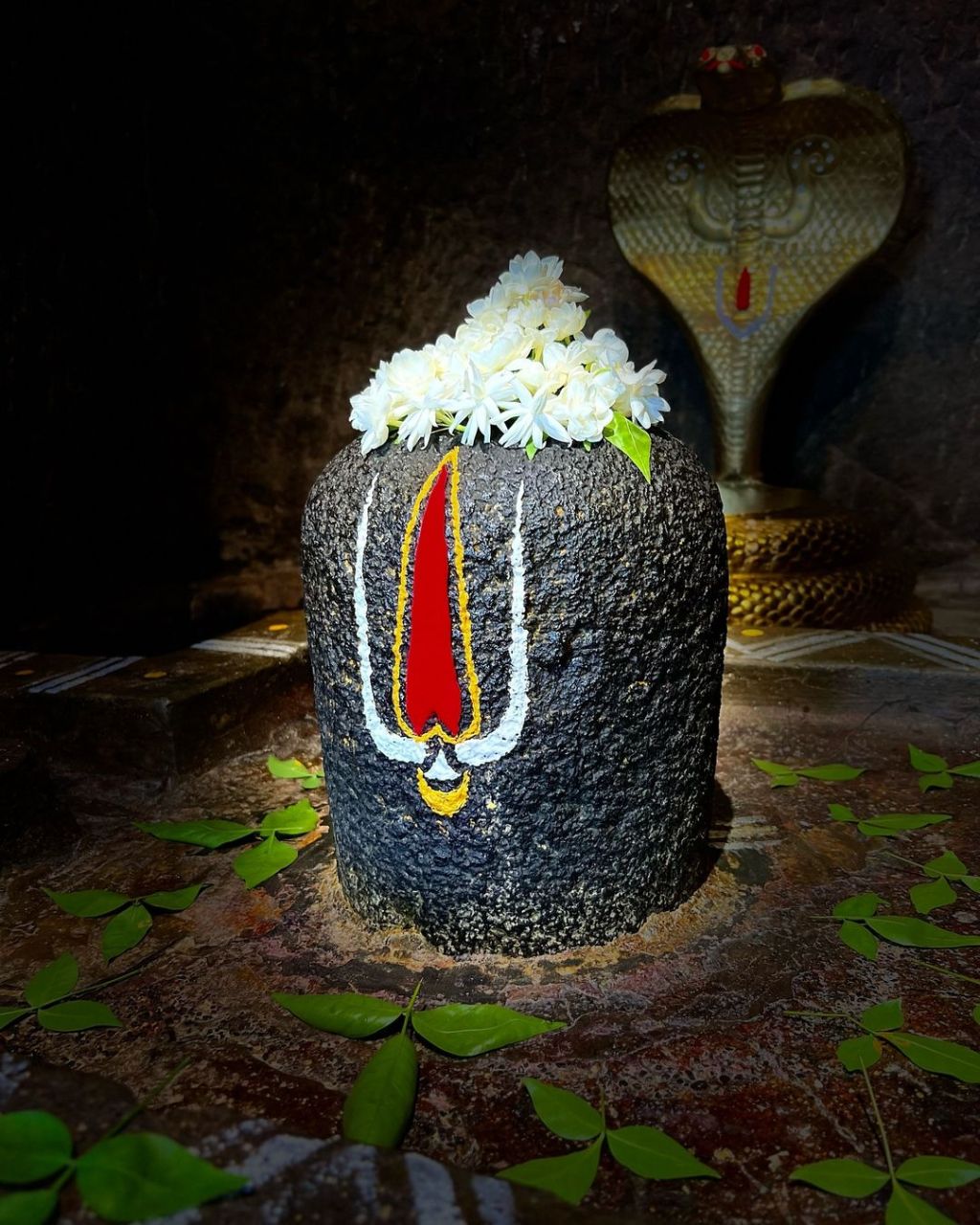
Worship of SHIVA

Many mantras in the Veda directly mention Shiva, like the following from the Rig Veda-

कैलासशिखरे रम्ये शंकरस्य शुभे गृहे ।
देवतास्तत्र मोदन्ि तन्मे मनः शिवसंकल्पमस्तु ।।

“On the charming peak of Kailasha mountain is the home of the Peace-creator Shivawhere all Gods ultimately rejoice. May my heart always rejoice with shiva thoughts.”

In the Rigveda, Bhagawan Shiva is referred to as Rudra, who is described as a powerful and benevolent deity. The Rigveda describes Rudra as the god of hunting and the protector of cattle. It also mentions his association with the bow, the arrow, and the storm, which symbolize his power and his ability to destroy evil.
The Yajurveda, another Veda in Hindu scripture, mentions Bhagawan Shiva as a god who is capable of destroying evil and ignorance. It also describes him as a god of fertility and as the one who bestows long life and prosperity. In the Atharvaveda, Shiva is described as the god of medicine and healing, who can cure physical and mental diseases. This Veda also mentions the importance of the worship of Shiva and the various rituals associated with his worship.


अजं शाश्वतं कारणं कारणानां
शिवं केवलं भासकं भासकानाम्
तुरीयं तमःपारमाद्यन्तहीनं
प्रपद्ये परं पावनं द्वैतहीनम्

The one who is beyond birth, the permanent one, the one who is the cause of the causes, the one who illuminates the whole Universe, the one beyond the three states, without beginning and end, the Destroyer of ignorance and struggle, the one beyond all duality, I offer my obeisance to him, the purest. Bhagawan Shiva has more than 1500 names and each name denotes a form so we can say he has thousands of forms

Significance of Rudra Avatar-

1) Kapali
2) Pingal
3) Bheem
4) Virupaksha
5) Vilohit
6) Shastra
7) Ajapaad
8) Ahirbudhnya
9) Shambhu
10) Chand
11) Bhav.

You know SHIVA


God resides within our body, in the cavity of the heart. This God is eternal. The Supreme Soul, who is one and infinite, is the Master of this physical body of ours, and this entire earth resides within His body. This God who circulates within the earth cannot be recognized by the earth itself. This shows that the elements of the physical world (such as the earth) are unable to understand the true nature of the soul.
Water, fire, air, space, mind, intellect, ego, mind, letters, and death, God is located in all of them and is the origin of all these

अन्तःशरीर निहितो गुहायामज एको नित्यमस्य पृथिवी शरीरं यः पृथिवीमन्तरे संचरन् यं पृथिवी न वेद ।
यस्यापः शरीरं योऽपोऽन्तरे संचरन् यमापो न विदुः ।
यस्य तेजः शरीर यस्तेजोऽन्त संचरन्यं तेजो न वेद ।
यस्य वायुः शरीरं यो वायुमन्तरे संचरन् यं वायुनं वेद ।
यस्याकाशः शरीरं च आकाशमन्तरे संचरन् यमाकाशो न वेद ।
यस्य मनः शरीरं यो मनोऽन्तरे संचरन्यं मनो न वेद ।
यस्य बुद्धिः शरीरं यो बु
द्धिमन्तरे संचरन् बुद्धिर्न वेद ।
यस्याहंकारः शरीरं योऽहंकारमन्तरे संचरन् यमहंकारो न वेद।
यस्य चित्तं शरीरं यश्चित्तमन्तरे संचरन् यं ।
चित्तं न वेद ।
यस्याव्यक्तं शरीरं योऽव्यक्तमन्तरे संचरन् यमव्यक्तं न वेद ।
यस्याक्षरं शरीर योऽक्षरमन्तरे संचरन् यमक्षरं न वेद ।
यस्य मृत्युः शरीरं यो मृत्युमन्तरे संचरन्यं मृत्युर्न वेद ।
स एष सर्वभूतान्तरात्माऽपहतपाप्मा दिव्यो देव एको नारायणः।
अहं ममेति यो भावो देहाक्षादावनात्मनि।
अध्यासोऽयं निरस्तव्यो विदुषा ब्रह्मनिष्ठया ॥

This God is the conscience of all living beings and He is free from all sins, divine and only Narayana.  The sense of “ego” (ego and affection) that appears in the body and senses is false. This false intention must be eliminated through the knowledge of Brahman and the stillness of the soul. The wise man who has faith in Brahman. This verse inspires us to understand the true nature of the soul and the divine and encourages us to look beyond the material elements of this world. The omnipresence of God and His unknowability teach us that true divinity and knowledge can only be attained through the soul.
This verse presents the essence of Vedanta philosophy, which describes the unity of the soul and the divine, their omnipresence and ignorance. It teaches us that the elements of the material world are unable to understand the true nature of the soul and that true knowledge can be attained only through the purification of the so

The conciseness upgrade.

What does “having it all” mean to you? Is it attainable?

Knowledge of wisdom: The Asthavakra Gita :

कथं ज्ञानमवाप्नोति कथं मुक्तिर्भविष्यति।
वैराग्यं च कथं प्राप्तमेतद्ब्रूहि मम प्रभो॥

This verse, taken from the Ashtavakra Gita, poses important questions of the spiritual journey. It explores the path of knowledge, salvation, and detachment. To fully understand this, we need to delve deeper into the context of the Ashtavakra Gita and the story of Sage Ashtavakra, whose teachings highlight these spiritual endeavors

Knowledge of wisdom:

Ashtavakra Gita is a dialogue between Rishi Ashtavakra and King Janaka. It is a major treatise of the Advaita Vedanta tradition, which emphasizes the oneness of the soul and Brahman. The questions asked in the shloka reflect King Janaka’s deep spiritual understanding and desire to transcend the material and many forms of life

Sage Ashtavakra: Early Life and Cursed Deformities.

Ashtavakra, known for his intelligence and spiritual insight, was the son of Rishi Kahod and his wife Sujata. In the womb itself, he corrected his father by listening to his Veda recitation, as a result of which Kahod cursed him, causing Ashtavakra to be born with eight deformities. Despite this, Ashtavakra became a child of an extremely intelligent and spiritual nature. His mother Sujata taught him the scriptures and gave him a deep understanding of spiritual truth

कथं ज्ञानमवाप्नोति :

Knowledge is the recognition of the reality of the soul, which is attained not by external means but by self-observation, meditation, and the guidance of the enlightened master

कथं मुक्तिर्भविष्यति :

Liberation is liberation from the cycle of birth and death and the realization of oneness with the soul with Bramha.

वैराग्यं च कथं प्राप्तम :

Quietness differs from desires and material things, which are achieved through self-discipline, meditation, and spiritual understanding

Enlightenment is possible with self-observation, meditation, and the guidance of a knowledgeable Guru. Spiritual practices, moral life and enrichment of virtues pave the way for liberation. Disinterest can be achieved by developing a sense of contentment and satisfaction in the present. This verse guides us towards self-realization, inner peace, and the pursuit of ultimate freedom. The teachings of Ashtavakra inspire us to transcend the illusions of the material world and towards the attainment of true knowledge

As per Ramcharitmanas

सो सुखु करमु धरमु जरि जाऊ ।
जहँ न राम पद पंकज भाऊ ॥
जोगु कुजोगु ग्यानु अग्यानू ।
जहँ नहिं राम पेम परधानू ॥”

This couplet embodies the devotion and love of Lord Ramchandra, which highlights the importance of true religion and spiritual practice. It is an inspirational couplet that makes us understand the importance of truth, love, and spiritual practice. To achieve true happiness, we must remain single. It tells us that to achieve joy and happiness in life, we must walk the path of truth and justice. That is, to accept simplicity in life. Today we use and waste many things, which causes great harm to Mother Nature, it is an injustice, so simplicity is very important in life. It is in God’s love that the soul finds joy and true satisfaction. There is true happiness in knowledge, which is in the love of God
Teaches us the importance of truth, love, and spiritual practice. It reminds us of the importance of following the path of righteousness, attaining enlightenment, and being absorbed in the love of God. This emotional and spiritual couplet inspires us to the true path of search for truth, the importance of love, and joy