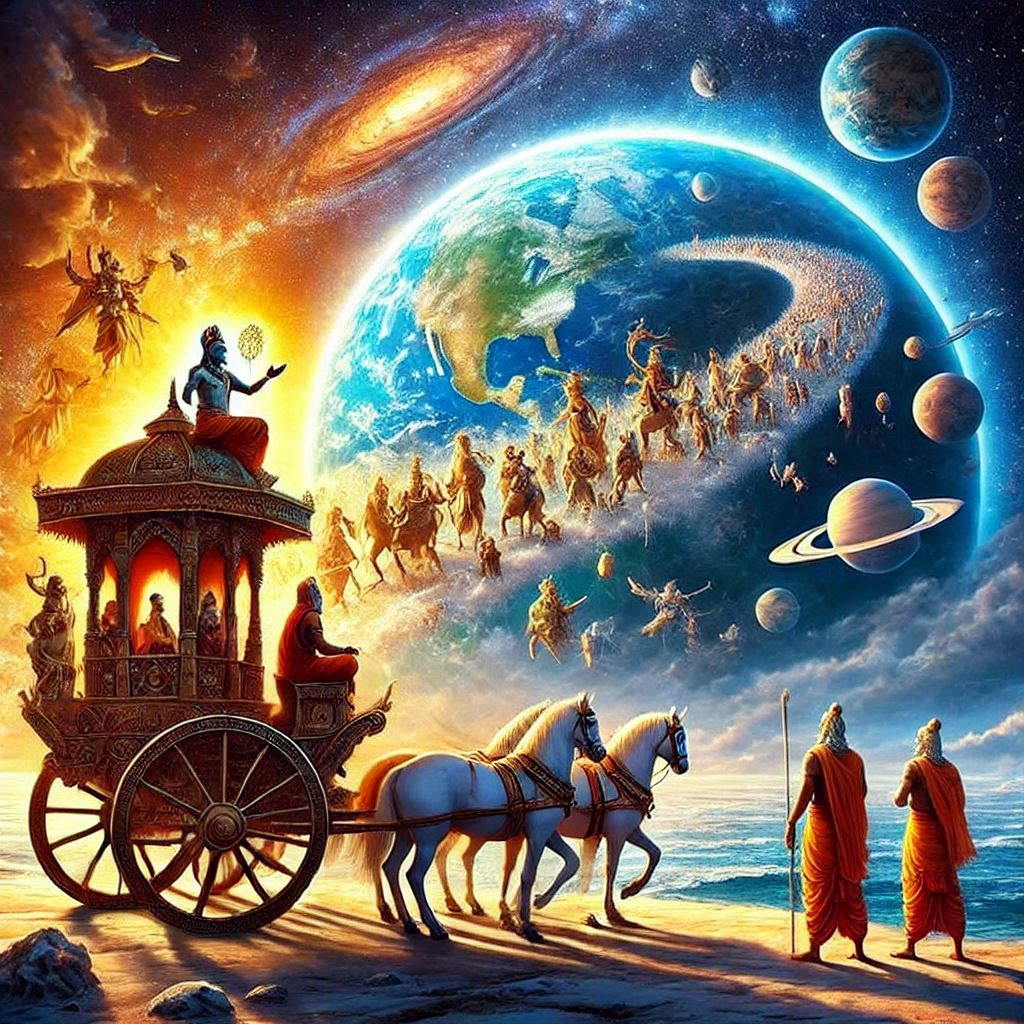
A distinct era of cosmic evolution: Mystic of Sanatan knowledge.

Describe a man who has positively impacted your life.

Believe it or not!!!

It is described in the Mahabharata that Sanjaya, the charioteer of Dhritarashtra, was bestowed with divine vision so that he could describe the events of the war to him. But, even before the question of war began, Dhritarashtra asked him to describe what the world looked like from space

यथा हि पुरुषः पश्येदादर्शे मुखमात्मनः।

एवं सुदर्शनद्वीपो दृश्यते चन्द्रमण्डले।

द्विरंशे पिप्पलस्तत्र द्विरंशे च शशो महान्।।

Just as a man looks at his face in a mirror, this island (earth) appears in the mainstream. It has two parts of pipal (peepal leaves) and two parts of the great hash (rabbit). Based on this verse, Saint Ramanujacharya made a map, but seeing some leaves and a rabbit, the world made fun of it. Much later, when the picture was turned upside down, reality came out


In the Jai Samhita, geography is described in detail from the 12th verse of the sixth chapter of Bhishma Parva to the 37th verse of the 13th chapter.
Sanjaya says to Dhritarashtra:

सुदर्शनं प्रवाक्ष्यामि द्वीपं ते कुरुनन्दन।

द्विरांशे पिप्पलस्तत्र द्विरांशे च शशो महान्

Inside this circle, two parts of this wheel look like rabbits and two parts look like the leaves of the peepal tree

The Cycle of Creation & Destruction: The Power of 4

1. Satya Yuga:

Good and evil existed in two separate worlds: Devlok and Asurlok.

2. Treta Yuga:

Good and evil lived in the same world, exemplified by Shri Ram and Ravan.

3. Dwapara Yuga:

Good and evil were found within the same families: the Pandavas and Kauravas.

4. Kali Yuga:

Good and evil have become the same person, highlighting the complex nature of morality in this age.


🔸Satya Yuga: The era of purity.

🔸Treta Yuga: The era of righteousness.

🔸Dwapara Yuga: The era of heroism.

🔸Kali Yuga: The era of trials and tribulations.

These cycles shape humanity and the universe, guiding us through the eternal dance of life and time.

One thought on “A distinct era of cosmic evolution: Mystic of Sanatan knowledge.

  1. Dance of Kali is a profound and symbolic representation of divine energy and cosmic rhythm in Indian culture. This dance form holds immense religious significance and embodies the essence of Goddess Kali, a revered deity in Hindu mythology. Known for its intensity and deeply spiritual undertones, the Dance of Kali is a vibrant expression of devotion, power, and transformation.https://www.indianetzone.com/dance_kali

    Like

Leave a reply to IndiaNetzone Cancel reply