If you had to give up one word that you use regularly, what would it be?
Surya: The Cosmic Beehive and the Forgotten Wisdom of Our Ancestors
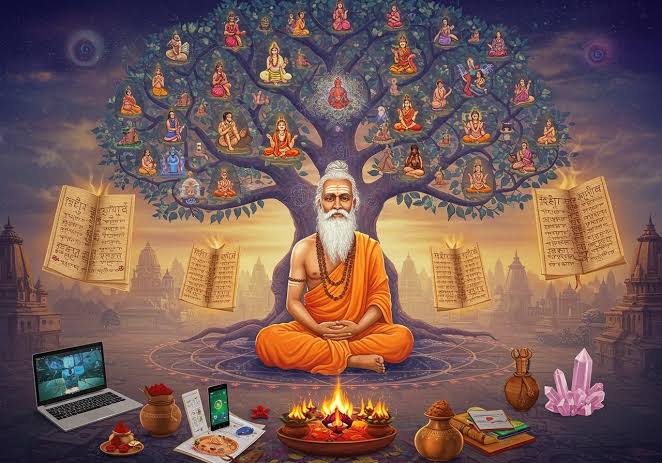
Human existence is directly connected to the word “Savita” (Savitu). Within this connection lies the very purpose of our birth. The expansion of consciousness within us is infinite, and the most essential truth is this: returning to light is our original nature. This light exists in the form of knowledge and energy. The expansion of consciousness is what leads us toward wholeness, and the simplest link between knowledge and energy is found in Savita.
To live in harmony with nature, to accept it, is sattva-jnana—true knowledge. The radiant manifestation of this knowledge and light is Surya (the Sun). The common meaning of Savita is indeed the Sun.
The Sun appears to us directly. It is both a symbol and a blazing representation of that Supreme Divine which pervades all, moving and unmoving. In the language of spirituality, Savita is the luminous, radiant principle—the creator, sustainer, and dissolver of the universe. Its power is infinite, manifesting in countless forms, and this radiant power is what we call Savita.
In this awareness, the divine is meditated upon and remembered so that its divine energies may be drawn into us. Just as through a voice call we connect instantly with someone, in the same way remembrance and invocation connect us with the divine powers. If we wish to receive the energy of God, we must consciously remember and attune ourselves to that force. That is why sadhana (spiritual practice) and dhyana (meditation) have been established as essential disciplines—not mere customs, but practices with profound scientific significance.
These practices provide the mind with direction, ensuring we walk the path of success.
Awakening the Inner Mind
The subconscious mind is always awake; it is a reservoir of unlimited energy. The purpose of spiritual science lies in giving direction to this mind. When this mind is concentrated on a particular sound, rhythm, or focal point, its latent powers awaken.
For this reason, the spiritual world prescribes the use of mantras to focus the mind. Among all, the Gayatri Mantra is the supreme Vedic mantra—the Mahamantra. It has the power to awaken energy centers within the body and to connect us to the infinite power of the cosmos.
Gayatri is the sacred channel that connects us with Savita, the Supreme Radiant One. Through this mantra, one invokes the divine brilliance of Savita. The practitioner ignites the flame of prayer and surrenders to Savita, drawing into themselves spiritual, intellectual, physical, and even material energy. This completeness makes life beautiful and prosperous.
With this divine radiance, one walks life’s path with positivity, clarity, and divine purpose.
Savita in the Vedas and Upanishads
The Vedic mantras repeatedly affirm Savita as the source of creation and dissolution, of truth and energy:
“Savita is the origin of everything that exists and the eternal source of energy.” (Krishna Yajurveda)
“The face of truth is hidden by a golden vessel; the being within the Sun is that very Purusha, and I am He.” (Maitri Upanishad 6.35)
“Meditate upon the Supreme within the solar orb.” (Shaunaka tradition)
“From the Sun are beings born, by the Sun are they sustained, and in the Sun they dissolve.” (Suryopanishad)
The eternal hum of Om reverberates within the Sun—a fact acknowledged by modern NASA research, yet written thousands of years ago in the Vedas.
The Gopatha Brahmana further affirms: “The Sun, the Moon, the vital breath, and even lightning—all are Savita.”
The food that sustains life, produced by the Sun’s energy through plants, is Amrit, divine nectar. Thus the Sun not only gives energy but also shapes our very thoughts, as food becomes the foundation of consciousness.
Surya as the Visible Divine
For Sanatana Dharma, Surya is the visible form of Savita, the Supreme Consciousness. The hymns of the Rigveda, Yajurveda, Samaveda, and Atharvaveda acknowledge this blazing orb as the representation of Brahma, Vishnu, and Mahesh—the trinity of creation, preservation, and dissolution.
Meditation on the Sun awakens the energy centers within the human body. This is why Surya Namaskar (salutations to the Sun) has been practiced—to express gratitude to Savita and to attune with its power.
Savita’s energy reminds every human:
“You are my child. You are luminous. You are radiant. You are not alone.”
Ancient Wisdom, Modern Science
The Rigveda describes the Sun’s surface as resembling a beehive. Thousands of years later, with the world’s largest telescope—the Daniel K. Inouye Solar Telescope in Hawaii—scientists captured images of the Sun’s surface. For the first time, humanity witnessed patterns of golden, honeycomb-like structures, expanding and contracting across the Sun’s fiery surface.
These cells, each the size of Texas, release immense heat at their cores. Every 14 seconds, a violent turbulence occurs on the Sun’s surface. Researchers celebrated this as humanity’s greatest leap in solar observation.
But the Vedas had already described it. The imagery of the beehive in the Rigveda is a timeless testimony—modern science only confirms what ancient rishis revealed.
The Eternal Message of Savita
From creation to dissolution, from the nourishment of plants to the breath within humans, all life depends on Savita. The Sun is not merely a star—it is the visible, radiant face of the Divine, the eternal reminder that truth is light, and light is life.
The challenge for us today is to move beyond borrowed narratives and awaken to the wisdom our ancestors left for us. Thoughts are medicine. Pure thoughts uplift us, fuel us, and make us creators of our own destiny.
By embracing Savita—the infinite source of light, knowledge, and consciousness—we align ourselves with the eternal rhythm of the cosmos.
The Sun is Savita. Savita is the Divine. And within each of us, that same radiance lives, waiting to be awakened.
When Modern Science Confirms the Ancient
In the vast expanse of human civilization, the Sun has always been more than just a celestial body—it is life itself. For millennia, our sages perceived Aditya not merely as a burning sphere of fire but as a cosmic mystery holding truths far beyond ordinary human perception.
The Vedic Way of Understanding Mantras
In Vedic wisdom, every mantra carries three layers of meaning:
Adhidaivika (Divine/Universal plane)
Adhibhautika (Physical/Natural plane)
Adhyatmika (Inner/Spiritual plane)
This triadic vision reveals how deeply our rishis understood the interconnectedness of existence. They believed that whatever is present in the universe is also reflected within the human body—the body is, in fact, the blueprint of the cosmos. Whoever deciphers the secrets within, touches the mysteries of galaxies spread across infinite space.
Insights from the Upanishads
The Chandogya Upanishad offers a beautiful metaphor:
> “The Sun (Aditya) is like a beehive, and its rays are the bees.”
(Chandogya Upanishad, 3.1)
It further describes the Sun as entirely golden, radiating life and knowledge. This imagery was not poetic fancy—it was a profound scientific and spiritual realization, revealed through the inner meditations of our sages.
Recently, international headlines celebrated a breakthrough in solar research, describing it as humanity’s “greatest leap in studying the Sun from Earth.” While modern scientists are undoubtedly making discoveries, one cannot ignore the uncanny alignment between their findings and descriptions preserved in Vedic texts thousands of years ago.
This raises a vital question: Are they discovering something new, or are they rediscovering what was already known to our ancestors?
The Forgotten Legacy
It often feels as though modern researchers are not always uncovering fresh truths but rephrasing age-old Vedic insights under their own names. If tomorrow’s science announces that “the Sun is like a beehive,” many would be astonished—yet our Upanishads declared the same ages ago.
The irony? The world reveres Indian knowledge and philosophy—while we, its heirs, often wait for validation from outside.
The Call of the Present
This is not about dismissing science. Science is the method of verification, and it is essential. But we must stop undermining the vast treasure of knowledge our ancestors left us. Instead of blindly following borrowed theories, let us return to the roots, re-examine the wisdom of the Vedas, Upanishads, and Shastras, and integrate them with modern inquiry.
In doing so, we will not only honor our rishis but also carve new milestones for humanity—built on both spiritual insight and scientific rigor.
The Sun is not merely a star; it is a teacher. Our ancestors recognized its mysteries through inner exploration, while modern science seeks it through external tools. The true progress lies in bridging both—science and spirituality, observation and intuition.
 Spirituality is Beyond Science
Leave a comment