
Have you ever broken a bone?
Miraculous effect of musical tones on health
In the Gandharva Veda (musicology), seven notes have been mentioned. The mixture of these seven notes has determined the nature of all ragas and raginis. There are various uses of vocal practice and naadananusandhana. They also strengthen the body and health. Know how the names of these seven vowels are Sa, Re, Ga, Ma, Pa, Dh, Ni
Sa – (Shadja) –
Arising from the association of these six places of nostrils, throat, palate, tongue, and teeth, it is called Shadja. It is also called Shadja because it is the basis of the origin of the other six vowels.
Its temperament is cold, color pink, and spot navel. Its god is fire. This tone suppresses bile diseases
Re – (Rishabh) –
When the air rising from the navel hits the throat and top and makes a sound, then that voice is called Re (Rishabh). Its nature is cool and dry, color mixed with green and yellow and the place is heartland. Its deity is Braha. This tone suppresses phlegm and bile diseases.
Ga – (Gandhra) –
When the air rising from the navel hits the throat and top and comes out with the odor of the nostrils, then it is called gandhara. Its nature is cold, color orange and the location is in the lungs. Its deity is Saraswati. It suppresses bile diseases
Ma (Madhyam) –
When the air raised from the navel hits the region and the heart and makes a sound in the middle part, then it is called a medium tone. Its nature is dry, with the colors pink and yellow mixed and placed gorge. Its nature is fickle. The deity of this voice is Mahadev.
It suppresses vata and kapha diseases
Pa (Pancham) –
This swarm is called Pancham because of touches these five places – the navel, your, heart, throat, and top. Being the fifth in the series of seven notes, it is also called the fifth. Its nature is enthusiastic, color red, and spot mouth. Its deity is called Lakshmi. It suppresses Kapha’s dominant diseases. Example: The voice of a cuckoo bird.
Dhā (Dhaivatā) –
The nature of this swara, which researches the previous five swaras, makes the mind both happy and indifferent. Its location is Talu and the deity is Ganesha. It suppresses bile diseases
Ni (Nishad) –
This voice suppresses all the notes with its intensity, hence it is called Nishad. Its nature is cold-dry, color black, and place nostrils. Its nature is passionate and exhilarating. Its deity is the sun. It suppresses rheumatoid diseases. Example: Elephant voice.
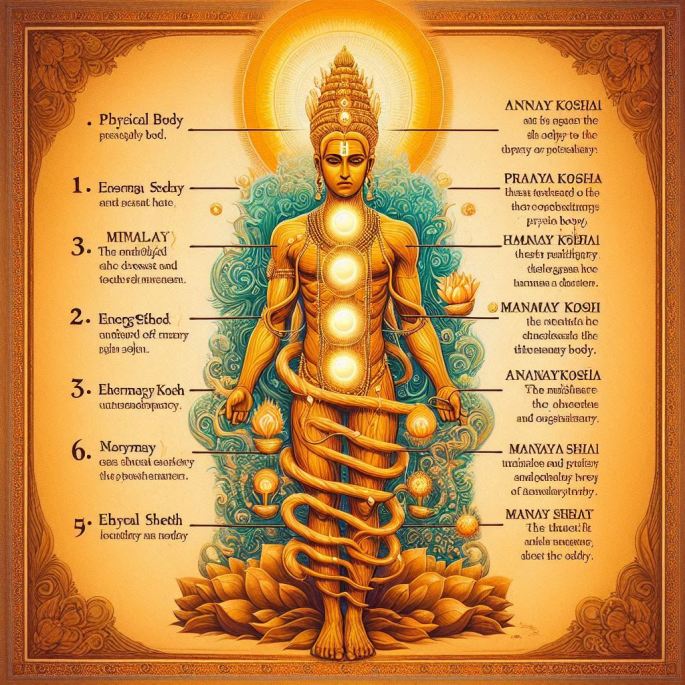
The Taittiriya Upanishad outlines five sheaths or levels
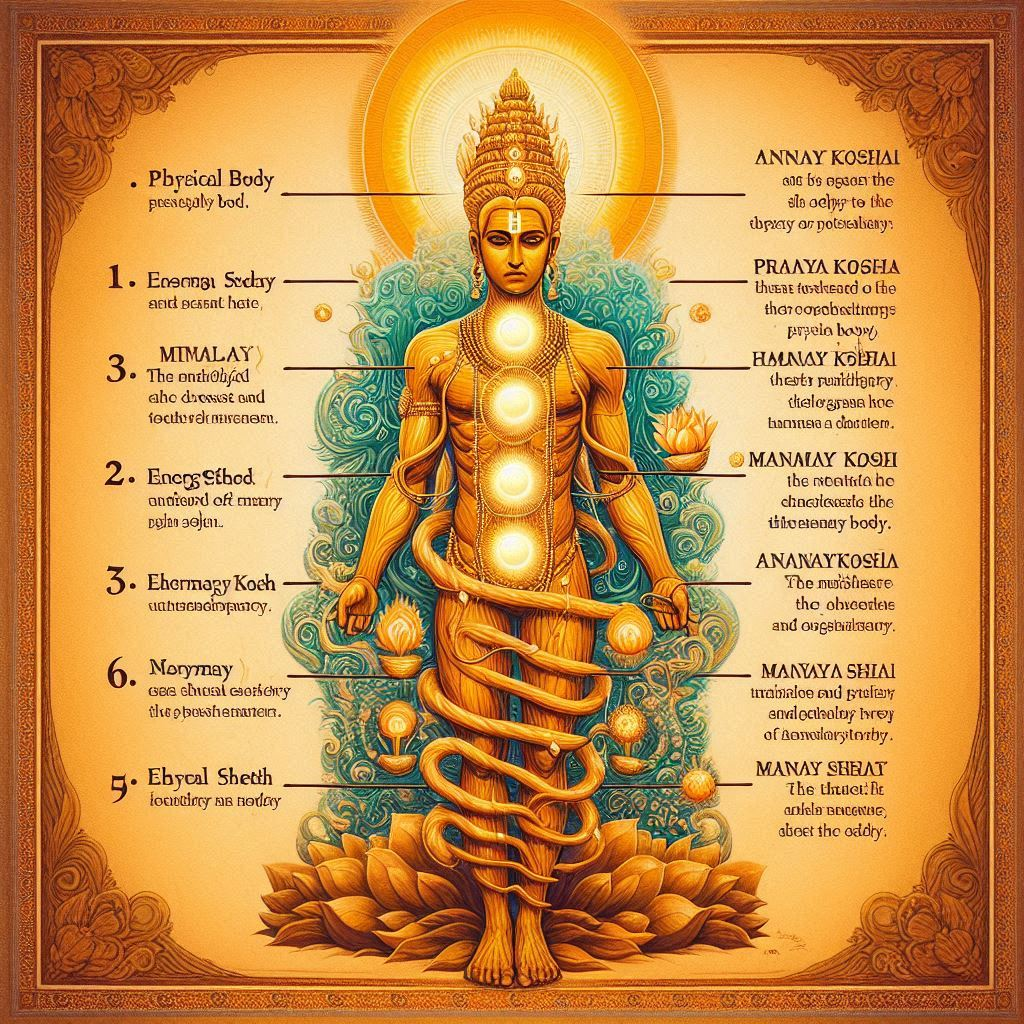
Certainly! The Taittiriya Upanishad outlines five sheaths or levels that encompass the individual’s self, progressing from the grossest to the most subtle:
1. Physical Body (Annamaya Kosha)
This is the outermost sheath, representing the physical body made up of food and matter.
2. Energy Sheath (Pranamaya Kosha):
This level comprises the vital life force (prana) that energizes and sustains the physical body.
3. Mental Sheath (Manomaya Kosha):
This sheath includes the mind and emotions, governing sensory perception and thought processes.
4. Intellect Sheath (Vijnanamaya Kosha):
This layer encompasses the intellect and wisdom, responsible for discernment and knowledge.
5. Emotion Sheath (Anandamaya Kosha):
This is the innermost sheath, associated with bliss and spiritual fulfillment.
Above these sheaths lies the true self or Atman.
The levels are increasingly subtle, with the emotion sheath placed higher than the intellect, highlighting the importance of emotional influence on meaning and understanding. Prana, the energy underlying physical and mental processes, is crucial and can be influenced by physical or mental inputs.
The energy state can manifest in three qualities:
1. Rajas (agitation)
2. Tamas (lethargy)
3. Sattva (balance).
Understanding these sheaths provides insight into the holistic nature of human existence, integrating physical, energetic, mental, intellectual, and emotional dimensions.
 Spirituality is beyond science
You must be logged in to post a comment.