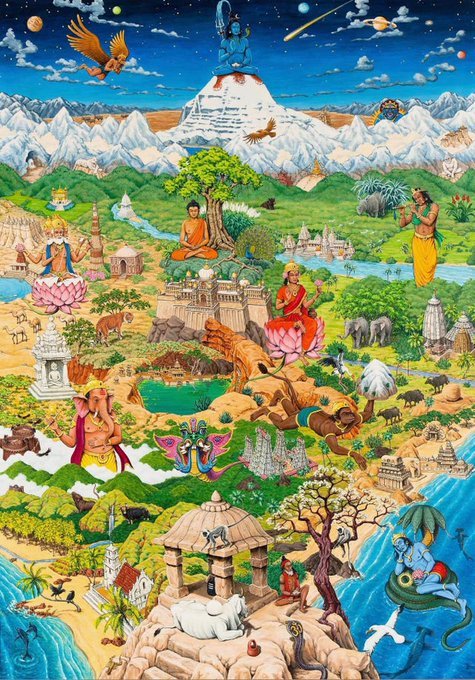
“On the charming peak of Kailasha mountain is the home of the Peace-creator Shivawhere all Gods ultimately rejoice. May my heart always rejoice with shiva thoughts.”
In the Rigveda, Bhagawan Shiva is referred to as Rudra, who is described as a powerful and benevolent deity. The Rigveda describes Rudra as the god of hunting and the protector of cattle. It also mentions his association with the bow, the arrow, and the storm, which symbolize his power and his ability to destroy evil. The Yajurveda, another Veda in Hindu scripture, mentions Bhagawan Shiva as a god who is capable of destroying evil and ignorance. It also describes him as a god of fertility and as the one who bestows long life and prosperity. In the Atharvaveda, Shiva is described as the god of medicine and healing, who can cure physical and mental diseases. This Veda also mentions the importance of the worship of Shiva and the various rituals associated with his worship.
The one who is beyond birth, the permanent one, the one who is the cause of the causes, the one who illuminates the whole Universe, the one beyond the three states, without beginning and end, the Destroyer of ignorance and struggle, the one beyond all duality, I offer my obeisance to him, the purest. Bhagawan Shiva has more than 1500 names and each name denotes a form so we can say he has thousands of forms
God resides within our body, in the cavity of the heart. This God is eternal. The Supreme Soul, who is one and infinite, is the Master of this physical body of ours, and this entire earth resides within His body. This God who circulates within the earth cannot be recognized by the earth itself. This shows that the elements of the physical world (such as the earth) are unable to understand the true nature of the soul. Water, fire, air, space, mind, intellect, ego, mind, letters, and death, God is located in all of them and is the origin of all these
अन्तःशरीर निहितो गुहायामज एको नित्यमस्य पृथिवी शरीरं यः पृथिवीमन्तरे संचरन् यं पृथिवी न वेद । यस्यापः शरीरं योऽपोऽन्तरे संचरन् यमापो न विदुः । यस्य तेजः शरीर यस्तेजोऽन्त संचरन्यं तेजो न वेद । यस्य वायुः शरीरं यो वायुमन्तरे संचरन् यं वायुनं वेद । यस्याकाशः शरीरं च आकाशमन्तरे संचरन् यमाकाशो न वेद । यस्य मनः शरीरं यो मनोऽन्तरे संचरन्यं मनो न वेद । यस्य बुद्धिः शरीरं यो बु द्धिमन्तरे संचरन् बुद्धिर्न वेद । यस्याहंकारः शरीरं योऽहंकारमन्तरे संचरन् यमहंकारो न वेद। यस्य चित्तं शरीरं यश्चित्तमन्तरे संचरन् यं । चित्तं न वेद । यस्याव्यक्तं शरीरं योऽव्यक्तमन्तरे संचरन् यमव्यक्तं न वेद । यस्याक्षरं शरीर योऽक्षरमन्तरे संचरन् यमक्षरं न वेद । यस्य मृत्युः शरीरं यो मृत्युमन्तरे संचरन्यं मृत्युर्न वेद । स एष सर्वभूतान्तरात्माऽपहतपाप्मा दिव्यो देव एको नारायणः। अहं ममेति यो भावो देहाक्षादावनात्मनि। अध्यासोऽयं निरस्तव्यो विदुषा ब्रह्मनिष्ठया ॥
This God is the conscience of all living beings and He is free from all sins, divine and only Narayana. The sense of “ego” (ego and affection) that appears in the body and senses is false. This false intention must be eliminated through the knowledge of Brahman and the stillness of the soul. The wise man who has faith in Brahman. This verse inspires us to understand the true nature of the soul and the divine and encourages us to look beyond the material elements of this world. The omnipresence of God and His unknowability teach us that true divinity and knowledge can only be attained through the soul. This verse presents the essence of Vedanta philosophy, which describes the unity of the soul and the divine, their omnipresence and ignorance. It teaches us that the elements of the material world are unable to understand the true nature of the soul and that true knowledge can be attained only through the purification of the so
If you could host a dinner and anyone you invite was sure to come, who would you invite?
Vasudhaiva Kutumbakam.
वसुधैव कुटुम्बकम्।
Indian culture has introduced the principle of the ‘family system’ to the whole world for centuries. which is not limited to mere animals. It includes every component of the variable-constant, inert-conscious nature. The harmony between human life and nature has been its motto, in which there has been a sense of being a part of nature that only as much as is necessary should be taken from it. Due to the creation of the universe from the basic elements like air, water, earth, fire, and sky, special attention has been paid to their purity and pollution-free in Indian philosophy and thinking. Our culture warns that environmental protection is possible only by maintaining natural balance, which can save us from present and future consequences. The respectable vision of coexistence with nature, harmony, and cordial motherhood is the law of Indian culture. Our ancient yogis lived in the forests and studied the thoughts of a higher level of life. We have neither had any conflict with nature nor our culture was created by ideas like conquering nature. Where there is a feeling of a victorious, controlled regulator, there will be a struggle. Gandhiji rightly said that nature has the means to fulfill the needs of all, but not to fulfill the desires. Indian culture prohibits longing so that the exploitation of nature can be stopped.
Throwing light on the Indian vision of the environment, the poet Tagore says that the forest and natural life in India gave a definite direction to human life, human life was in constant contact with the growth of natural life. He developed his consciousness from the surrounding land, he felt the connection between the spirit of the universe and the soul of man. This harmony between man and nature gave birth to peaceful and better ways of self-sacrificing the environment.
Indian culture has a special sense of environmental protection. Talking about living according to the laws of nature, Yajurveda says that looking at the beauty of the goddess of nature, and getting happiness from her, is the poetry of God in the embodiment. Atharvaveda says O Earth! All the small and big beings roaming on your earth, in which human beings are also included, have been born from the part of the Supreme Father, the Supreme Soul. May they get nourishment in the form of happiness from water, wind and solar energy.
According to Shrimad Bhagwat, we are all playing toys of God and a special purpose has been sent to make His creation beautiful. We are all brothers and sisters born of that one Supreme God, we are part and parcel of it. If this feeling continues, then there will be a spontaneous feeling towards nature and in such a situation there will be neither environmental pollution nor exploitation of nature.
Survey Bhavantu Sukhin.
Similarly, in Shanti Path, there is a sense of the importance of the environment as well as measures to avoid the terrible consequences caused by the wrath of nature. According to Shantipath, air should be a form of happiness for us. Parjanya Dev, who roars very well after drying up the sun, may also be happy for us and rain well. May the space world and the earth would be soothing. May water, medicines, and plants give peace, and may all the gods, Brahma, and everything else be peaceful. May the peace which is spread everywhere in the world, be available to all. May everyone experience equal peace?
In Vedic culture, which has divine faith in every component of the universe, the fundamental elements like earth, air, water, sky, moon, sun, etc., which prepare the environment, have been named deities. For the protection of these elements which nourish our body and life, it has been ordered to be devoted to body, mind, and wealth. Their purification, the sense of purity, and giving thanks are paramount.
The human body is a wonderful creation. This body is made up of five elements. Which is the origin of the Annamaya kosha from the earth element. Gravitational force is also the basis of this. The pranamaya kosha is made up of the air element. Considering the importance of the environment, there has been a law to remember the five elements in the morning. In the Vamana Purana, it is felt that the earth with its fragrance, water with its flow, fire with its radiance, space with its sound, and air with its tactile quality may also bless our mornings.
The hymn of Yajurveda also reveals the importance of the environment and says that for those who wish to accept moral limits, may this air be pleasant for them, and the water streams should be happy for them. Let the plants be happy for all of us living an ethical life. May the night be happy for us and let this morning be happy for us, O Creator! May the earth and heaven be happy for us. May the forest god be happy for us, and may the sun god be happy for us. It is clear from the passage of Vedic hymns that in ancient times, how much importance our sages used to give to nature and the environment. Nature nourishes life and a healthy environment is the basis of our existence, and the sages used to worship and worship nature in the form of a deity, calling it Parameshwari.
Environmental protection is an important campaign. In its direct form, the promotion of greenery, and purification of water sources, and in its indirect form the Yagya Abhiyan are innovative initiatives to balance nature and the environment, in which the voices of ancient sages are heard. Experience the part consciousness of the Supreme Lord in the various components of nature, then only a sensitive attitude towards animals and plants will be developed. It is our responsibility not only to use the various components of nature but also to conserve it. Leaving an aggressive attitude towards groundwater, forest, land, rivers, etc., pay attention to their development and behave with respect towards them. In this lies the solution formulas of nature and environmental protection, which our culture has been rendering since time immemorial




 Spirituality is beyond science
You must be logged in to post a comment.