
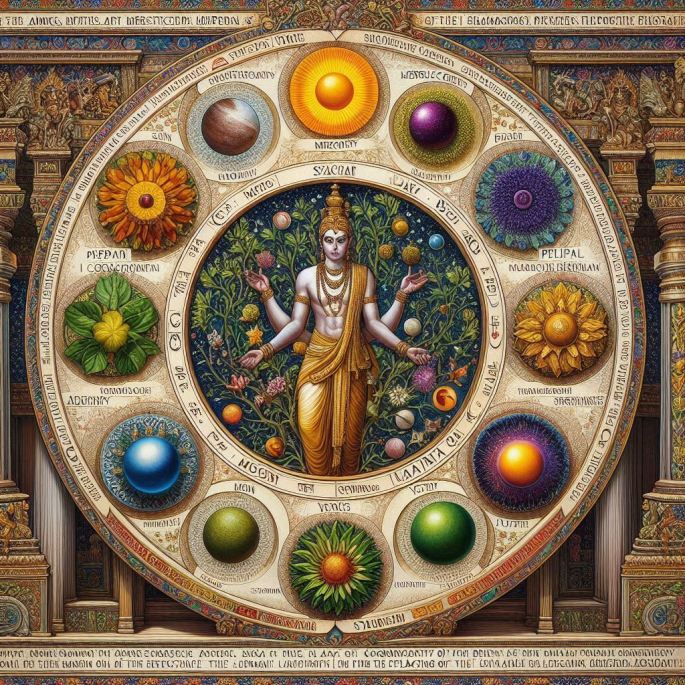
Navgrah: Aspects of planetary constellation science:

What makes a good neighbor?

Transforming lives

aspects of planetary constellation science: Navagrahas

The science of planetary constellations, which we know as astrology, is an ancient science that studies the planets, constellations, and other celestial bodies located in the universe and analyzes their effect on our lives. Its history is thousands of years old and this science has been practiced in different cultures such as India, Greece, China, and the Mayan civilization.


1. Planets :

Planets are celestial bodies that revolve around the sun. There are nine main planets in Indian astrology, which are called ‘Navagrahas’:

Sun

– Moon

– Mars

– Mercury

– Jupiter

– Venus

– Saturn

– Rahu

– Ketu

2. Nakshatra:

Constellations are groups of stars located in the sky that form specific shapes. There are a total of 27 nakshatras in Indian astrology, which are divided by the monthly path of the moon. Each nakshatra has a ruling planet and it has a special effect on a person’s horoscope.

The zodiac is divided into 12 zodiac signs, and each sign is a segment of 30 degrees. These amounts are:

– Aries

– Taurus

– Gemini

– Cancer

– Leo

– Virgo

– Libra

– Scorpio

– Sagittarius

– Capricorn

– Aquarius

– Pisces

4. Birth Chart:

The birth chart is the chart of the positions of planets and constellations based on the birth time and place of a person. This chart is used to forecast various aspects of a person’s life such as health, career, marriage, offspring, etc. The birth chart is divided into 12 houses, and each house represents a particular area of life.

5. Planetary Movements:

The transit of planets means the movement of planets and their entry into different zodiac signs. The transit has a major impact on a person’s horoscope and brings changes in a person’s life from time to time.


6. Dasha :

Dasha and Antardasha show the period of planetary influence. The major Dasha system in Indian astrology is ‘Vinshottari Dasha’, in which the dasha of each planet lasts for a certain period.

7. Scientific Attitude:

Though astrology has an important cultural and religious aspect, it is not considered according to the norms of science. The principles of astrology have no scientific basis and cannot be proved in science. Nevertheless, its relevance and popularity remain based on cultural and personal beliefs.


8. Types of Astrology:

– Vedic Astrology:
Astrology is prevalent in Indian tradition.

– Western Astrology:
Astrology is prevalent in Western countries.

– Chinese Astrology:
The Astrology System Prevalent in China.

– Mayan Astrology:
The astrological system developed by the Mayan civilization.

9. Remedy:

In astrology, various remedies have been prescribed to reduce the malefic effects of planets, such as wearing gemstones, chanting mantras, donating, fasting, worshiping, etc. These remedies are aimed at reducing the negative energy of the planets and promoting positive energy. That which is in the universe is also in the body. From this point of view, the planetary constellations of the universe also affect the body.
The pulse related to the right voice is said to be influenced by the lunar element, such is also the experience of the yogis that for the auspicious effect of the planetary constellations, other methods like Havan, Mantra, Upasana and Navratna Ashta Dhatu Dharan, etc. have been described in our religious texts.

They have also been described in the Vedas, the relation of the planet located in the universe to the body is as follows. In the body, the representative soul of the Sun, the mind of the moon, the blood of Mars, the speech of Mercury, the knowledge of Jupiter, the semen of Venus, and the happiness of Saturn are related to sorrow.  The effect of the planets in the universe reads on the body. If it is favorable to the month, it is good and if it is unfavorable, it has adverse effects on health and the body.  Therefore, by making scientific discoveries in Sanatan Dharma, the sages have given such methods according to which we can avoid their evil effects and get good effects.  Among the gemstones, the sun element in red ruby, the moon element in the pearl with white, yellow, and black light, the element of Mars in the coral, the element of Mercury in the green emerald, the element Jupiter in the topaz with a golden hue, the element of Venus in the white diamond and the element Saturn in the blue sapphire. Therefore, by wearing a gemstone compatible with the constellation related to that planet, it is described that by removing restlessness, illness, and disease related to it, strength and health can be obtained.


Similarly, in metals, gold, silver, copper, brass, bronze, mercury, and the elements of the Sun, Moon, Mars, Mercury, Jupiter, Venus, and Saturn reside. Which have auspicious effects.  Due to the presence of the sun element in gold, it provides strong energy and longevity. (Atharvaveda 16/261) That is why, along with other names of Surya, it also has a name Hiranya.

There is a Moon in silver, and hence, its name is also Chandranti.

Copper has the element, Mars,

Mercury is a fact of Shuk, hence his name is also Rasendra.

Similarly Mercury in brass, bronze, and iron,

Jupiter and Saturn remain the elements

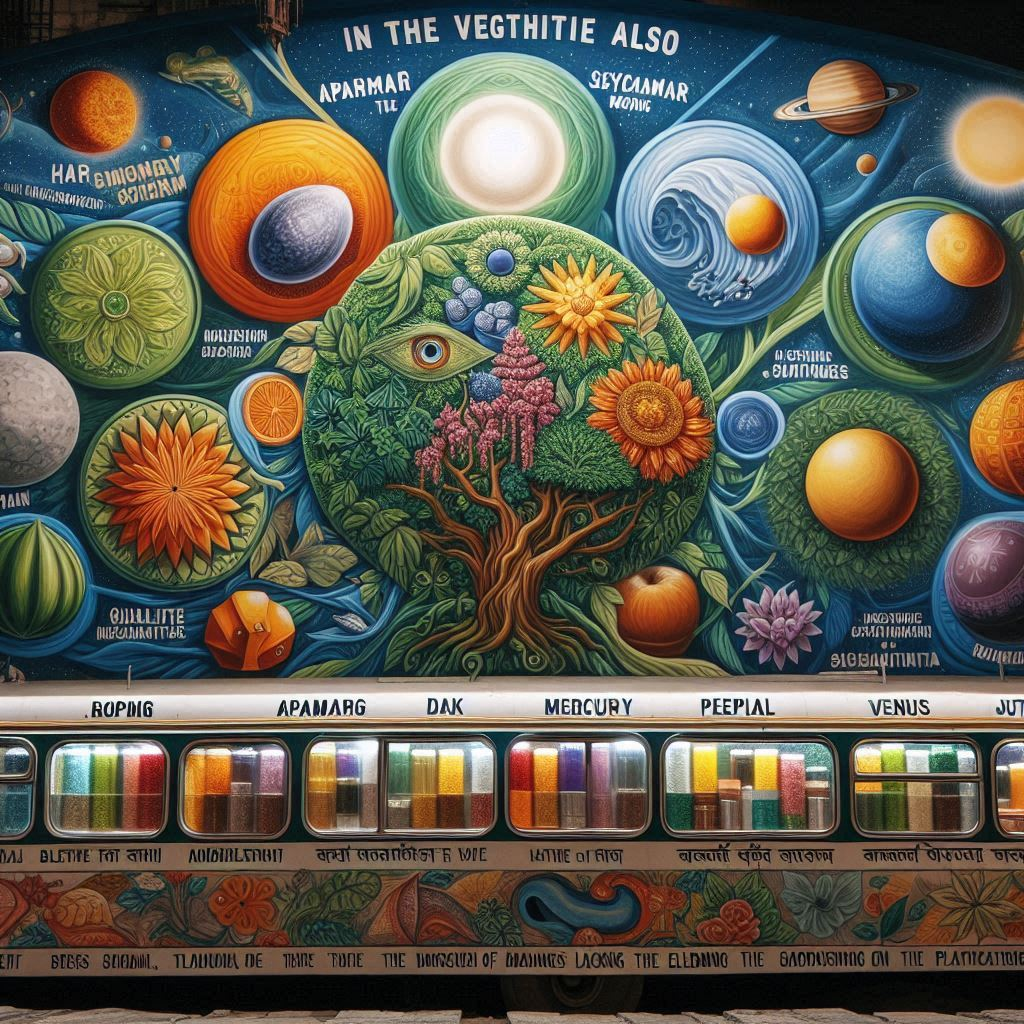
In this way, in vegetation also, Apamarg, Yak, Dak, Khair Sycamore, Peepal, and Kush have the qualities and influence of the Sun, Moon, Mars, Mercury, Jupiter, Venus, and Saturn. The same medicine is used for the fulfillment and compatibility of the element lacking in the body. By praying through the mantras of planet worship, we establish a relationship with them. In this way, based on gems, metals, medicines, and mantras, we can get the compatibility of the planets of the universe in the body, so the sages have considered it minutely and made it a part of religion for our welfare. The purpose of astrology is not only to predict but also to guide the individual towards self-knowledge and self-improvement. It is an ancient tradition that has helped determine the direction of people’s lives for centuries

THE COLOURS OF NAVGRAHA.


Colours of all Navgraha is mentioned in Bhavishya Puran Brahm Parva Chapter no 206.41–42 (श्वेतवर्ण स्मरेत्सोमं रक्तवर्ण कुजं स्मरेत् । सौम्यमष्टापदामं च गुरुं च पीतिवर्णकम् ॥४१ श‌ङ्खक्षीरनिनं श्वेतं काणं याञ्जनसन्निभम् । रजावर्तनिभं राहूं धूत्रं च विकचं स्मरेत्।:४२)


1) Chandrama (Moon) – White colored

2) Mangal (Mars) – Blood colored.

3) Budhá (Mercury) – Blood and dark colored.

4) Brahaspati (Jupiter) – Yellow coloured. 

5) Shukra (Venus) – Shankh or conch and Milk white colored.

6) Shani (Saturn) – Anjan like dark coloured.

7 & 8) Rahu and Ketu – Lajawart or Lapis lazuli blue colored.

9) Sun – The color of Suryadev is like the Japa (hibiscus) flower (Bhavishya Puran Brahm Parva 206.33 [जपावर्ण महातेजं ]).

Colors play a very important role in Sanatan Dharma. Many people wear clothes as per the color of Graha.