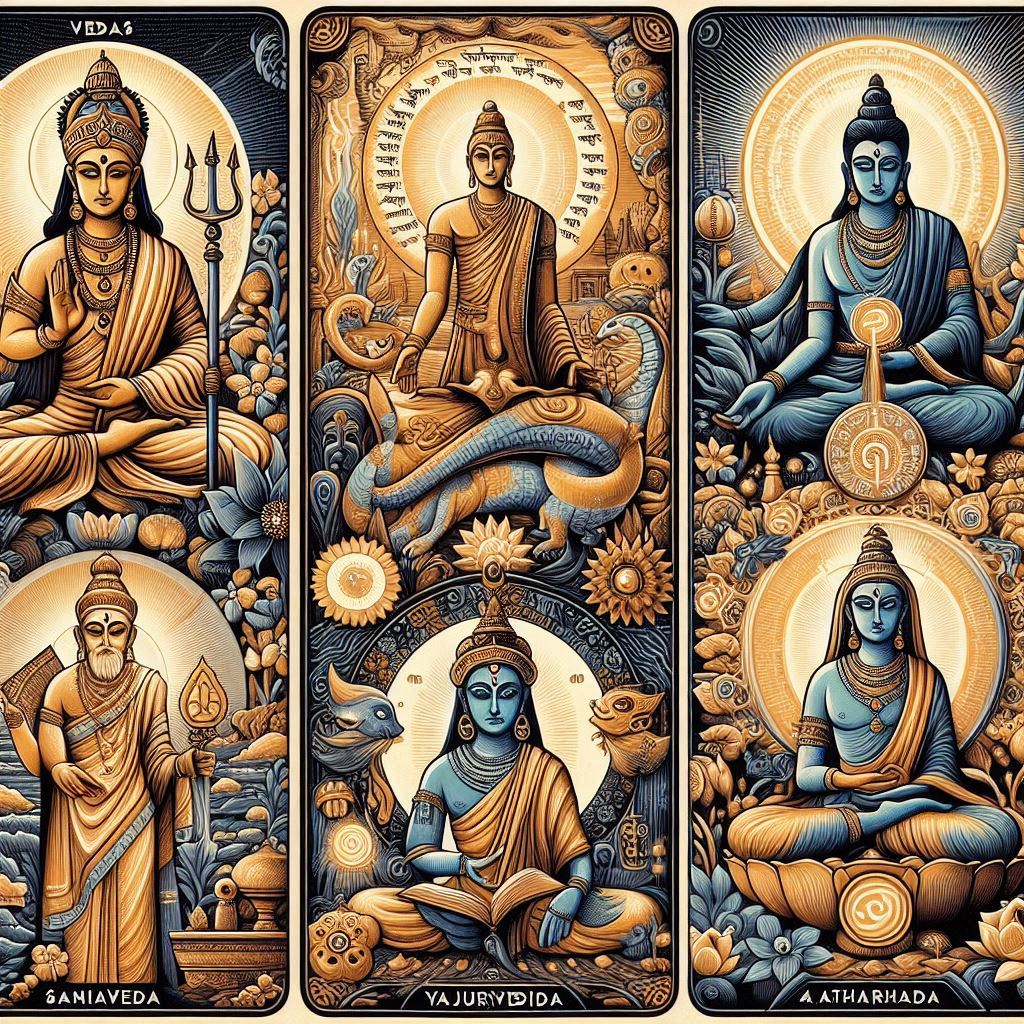
Sanatan scriptures.

What’s the biggest risk you’d like to take — but haven’t been able to?

Oldest religion texts.

There are four Vedas and 108 Upanishads in Sanatan Dharma. The Vedas are considered to be the oldest religious texts. The four Vedas are as follows:

1. Rigveda

2. Yajurveda

3. Samaveda

4. Atharvaveda

These Vedas, as well as the Upanishads, are considered an important part of the Vedic literature. Profound philosophical and spiritual topics have been discussed in the Upanishads. Vedas and Upanishads are profound and ancient texts of Sanatan Dharma, in which the philosophical and religious principles related to life, universe, and ultimate truth have been described in detail

VEDAS (1,00,000 verses)

Divided & Organized into 4 Vedas by
Krsna Dvaipayana (Vedavyasa)

Whya Vedas .

1. Vedas:

The Vedas are considered as the most ancient and main texts of Sanatan Dharma. The Vedas are considered by the sages as “shruti” (knowledge gained by hearing. These were compiled by Maharishi Ved Vyasa. The purpose of the Vedas is to guide the four major goals of human life (Dharma, Artha, Kama, Moksha. This is Sanatan meaning that which has been going on continuously since time immemorial is in the real form, this is eternal

The four Vedas are as follows:

Rig Veda:

This is the oldest Veda and consists mainly of a compilation of richas (mantras) in the form of praise of the gods. It has around 10,552 mantras, which are used in the worship of various deities, prayers, and yajnas.


🔸Rigveda (21+ Shakhas)

▪️Available 1 Shakha

▪️Lost 20+ Shakhas

▪️Samhita

▪️Brahmana

▪️Aranyaka


Yajurveda:

It describes mantras and methods for sacrifices and rituals. It is divided into two parts: Krishna Yajurveda and Shukla Yajurveda. It mainly deals with ritualistic and ritualistic activities

Yajurveda (101+ Shakhas)

▪️Available 3-4 Shakhas

▪️Lost 97+ Shakhas

▪️Samhita

▪️Brahmana

▪️Aranyaka


Samaveda:

In this Veda, some mantras of Rigveda have been presented in musical form. It is seen by linking it with devotion and music. The mantras of Samaveda are used to accompany music in sacrifices and rituals.

Samaveda (1000+ Shakhas)

▪️Available 3 Shakhas

▪️Lost 997+ Shakhas

▪️Samhita

▪️Brahmana

▪️Aranyaka


Atharvaveda:

This Veda is slightly different from the other three. It describes mantras and methods related to witchcraft, medicine, healing, and social life. There are many mantras in it that throw light on all aspects of a person’s life

Atharvaveda (9+ Shakhas)

▪️Available 2 Shakhas

▪️Lost 7+ Shakhas

▪️Samhita

▪️Brahmana

▪️Aranyaka

The 108 Upanishads:

The Upanishads are called the last part of the Vedas or “Vedanta”. Their purpose is to clarify the search for enlightenment, Brahman, Atma, and the ultimate truth. The Upanishads mainly describe spiritual, philosophical and meditative topics. The doctrines of Vedanta are based on the Upanishads. Although the number of Upanishads is considered to be 108, some of the major and ancient Upanishads are as follows:


1. Total Shakhas: 1180

▪️10-15 Available

▪️Brahmanas

▪️Available 19-20

▪️Lost 1,111+

2. Samhitas :

▪️Available 9-10

▪️Lost 1,121+

3. Upanishads :
▪️Available 108

▪️Lost 1,023+

4. Aranyakas

▪️Available 7

▪️Lost 1,124


1. Ishopanishad:

It mentions the unity of the universe and the soul and considers the impermanence of karma and life.


2. Kathopanishad:

It is based on the dialogue of Yama and Nachiketa, explaining the mysteries of soul, death and salvation.


3. Mandukya Upanishad:

It analyzes the forms of Om and its three sounds. This Upanishad is a major source of Advaita Vedanta.


4. Chandogya Upanishad:

This Upanishad is related to the Samaveda and discusses in detail the Atman, Brahman and the methods of meditation


5. Brihadaranyaka Upanishad:

This is the largest Upanishad and considers the importance of the soul, rebirth, Brahman and knowledge.

Importance of Vedas and Upanishads:

The Vedas and Upanishads are the foundation of Indian religious, philosophical and spiritual traditions. These texts provide guidance on every aspect of human life, such as:

Spirituality:
The ultimate purpose of life is the union of the soul with Brahman (moksha), which is explained in depth in the Upanishads


Religion:
Duties and religious conduct have been described in the Vedas.

Yoga:
The path to purification and salvation of the soul is shown through meditation and yoga.

Karma:
The principle of karma and its consequences have been explained in detail in the Vedas and Upanishads.
Vedas and Upanishads are not only religious texts but also show the philosophical and spiritual path to understand and find solutions to the complexities of human life