What are your favorite physical activities or exercises?
।। सूर्य आत्मा जगतस्तस्थुषश्च।।
The month of Margashirsh: The Era of Bhagavad Gita Revelation
Margashirsh is the ninth month of the Hindu lunar calendar, falling between November and December. It is also known as Agrahayana and holds immense spiritual significance in Sanatan Dharma. Margashirsh is the month when Bhagwan Shree Krishna imparted the eternal wisdom of the Bhagavad Gita to Arjun on the battlefield of Kurukshetra during the Mahabharat.
In the Bhagavad Gita (10.35), Shree Krishn says,
“मासानां मार्गशीर्षोऽहमृतूनां कुसुमाकरः ”
“Among months, I am Margashirsh.” This emphasizes the month’s supreme importance as a time for Dharmik’s growth and reflection. Historically, Margashirsh marked the beginning of the harvest cycle in the Ancient Bharatvarsh, making it a time of gratitude and prayer for abundance.
Grant victory Aditya Hridaya Stotram: the power to eliminate all enemies.
Aditya Hridaya Strotram is advised by Agastya Muni to Shri Rama to defeat Ravana. Stotra is mentioned in Yudha Kandam of Srimad Ramayanam. Shri Rama was very fatigued before the war & Agastya Muni gave Aditya Hridayam as Updesham, dedicated to Surya Deva, who granted victory to all. Agastya Muni enlightens Rama saying Stotra has the power to eliminate all enemies &. And will be victorious. Rama prayed to Surya and felt energetic to fight with Ravana. Evil vanishes from life who keeps Sun in Heart. Sun is the soul of all that is dynamic & static.
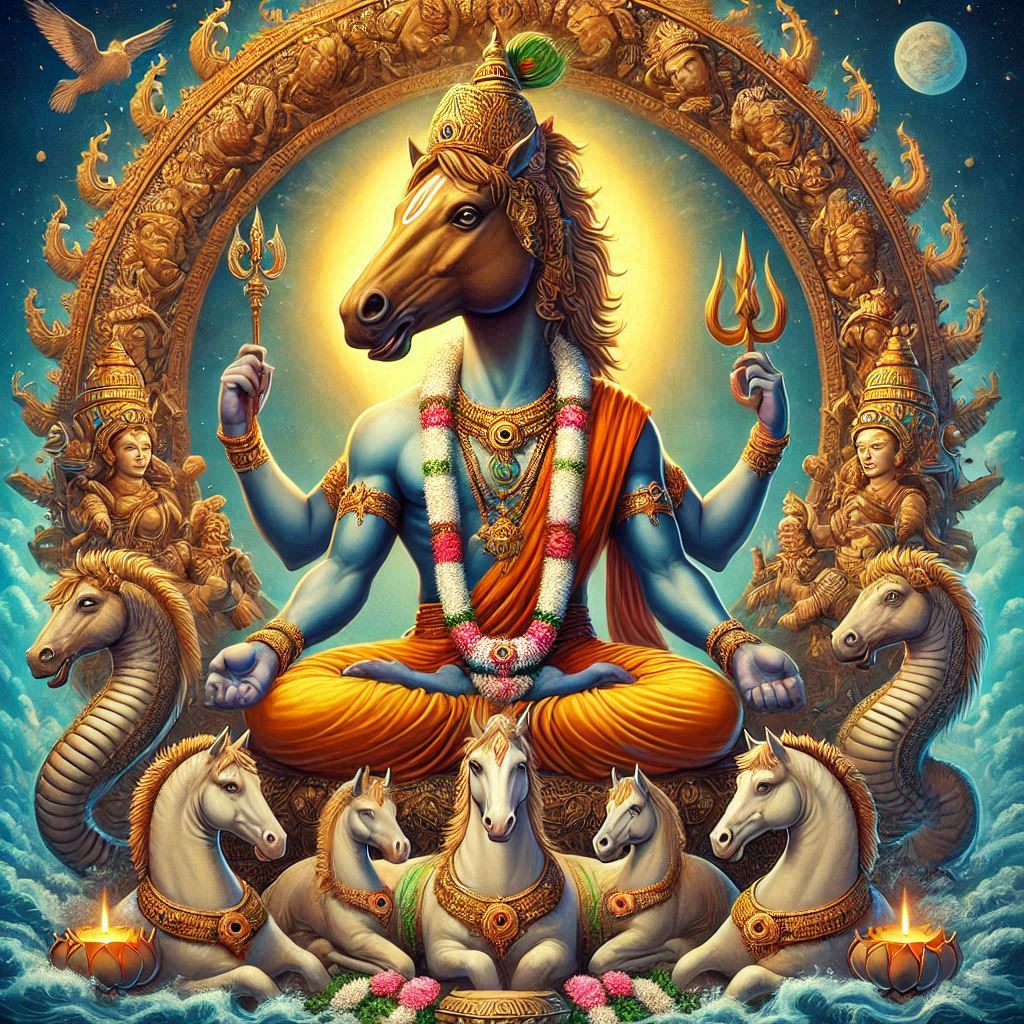
Hayagriva Avatar: The worshiped as the god of knowledge and wisdom
Devi Bhagavata Purana (Book 1, Chapter 9)
The Hayagriva Avatar of Lord Vishnu is a lesser-known yet significant incarnation. Hayagriva is depicted as a horse-headed deity, with the body of a human, representing wisdom, knowledge, and the preservation of the Vedas. Significance of the Hayagriva Avatar:The Hayagriva incarnation is often worshiped as the god of knowledge and wisdom, as his form represents clarity of thought and intellect. In various traditions, Hayagriva is revered for restoring the sacred Vedas that had been stolen, symbolizing the protection of spiritual knowledge. The demons Madhu and Kaitabha steal the Vedas from Brahma while he is asleep, causing chaos in the universe. Brahma prays to Lord Vishnu for help. In response, Vishnu assumes the form of Hayagriva, the horse-headed avatar, battles the demons, and restores the stolen Vedas to Brahma. Purana Reference: Mahabharata (Shanti Parva, Chapter 348) In both sources, Vishnu’s Hayagriva form is highlighted as the protector of the Vedas, symbolizing the triumph of wisdom over ignorance and chaos. The Story of Hayagriva and Vishnu’s Meditation (Skanda Purana)In this story, Vishnu assumes the Hayagriva form to perform severe penance. During the end of the Kali Yuga. When darkness and ignorance dominate, the gods pray for Vishnu’s intervention. Vishnu, as Hayagriva, meditates to restore cosmic order, and his energy and wisdom ensure the continuation of dharma.