How do you feel about cold weather?
Gravity in Vaisheshika Sutra
It’s fascinating to explore how ancient Indian philosophies and texts may have addressed concepts akin to modern gravitational theory long before Newton’s time. The Vaisheshika Sutra by Rishi Kanada is particularly intriguing as it predates Newton by over two millennia and contains verses that seem to describe gravitational principles.
1. The Nature of Objects Falling to the Earth:
The Vaisheshika Sutra mentions that objects tend to fall towards the earth due to an inherent property or force. This aligns with the idea that there is an attractive force between the earth and other objects, which we now identify as gravity. This recognition of a force causing objects to fall to the ground is a fundamental aspect of gravitational theory.
2. The Stability and Movement of Celestial Bodies:
The sutras also discuss how the stability and movement of celestial bodies are influenced by this attractive force. This can be seen as an early conceptualization of how gravity governs the motion of planets and other celestial entities, akin to the principles described by Kepler and Newton.
Verse 5.1.7:
Discusses how substances move downward due to an inherent force.
Verse 5.2.4:
Addresses the concept of attraction between substances, hinting at a force akin to gravity.
Interpretation and Comparison:
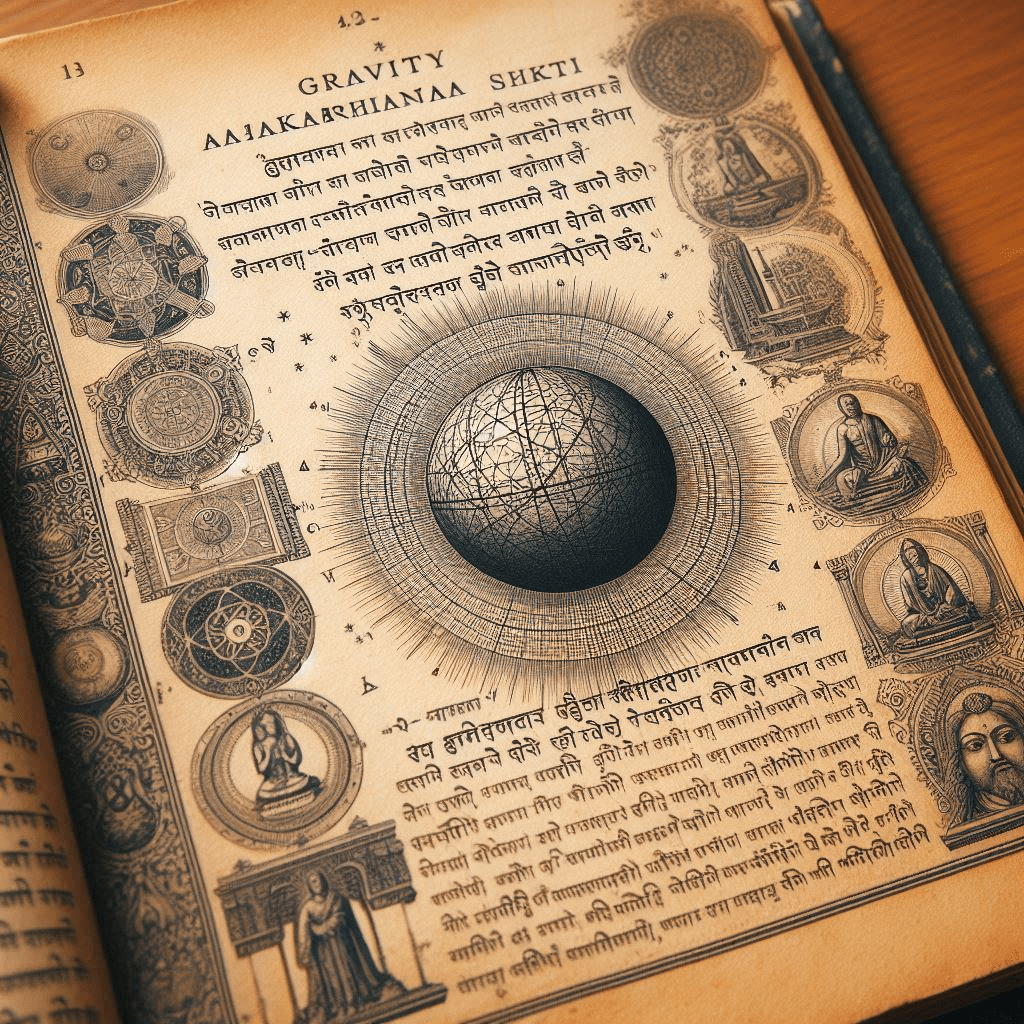
While these ancient texts don’t provide the mathematical formulations that Newton did, they demonstrate a conceptual understanding of gravity’s effects. This understanding is significant, showing that the idea of gravity as an attractive force was observed and noted by ancient Indian philosophers. In ancient Indian philosophy, the idea of “Gurutva Aakarshana Shakti” captures the essence of gravitational pull. The term “Gurutva” (mass) and “Aakarshana” (attractive pull) together indicate an awareness of the relationship between mass and the force it exerts, reflecting a sophisticated understanding of natural forces.
The exploration of gravitational concepts in ancient Indian texts like the Vaisheshika Sutra highlights a rich history of scientific thought in India. These early discussions on gravity illustrate how ancient scholars were keen observers of nature and sought to understand the forces governing the physical world. While Newton’s laws provided a detailed mathematical framework for gravity, it is remarkable to recognize that the fundamental ideas about gravitational forces were present in human thought long before his time.
आत्मकर्म हस्तसंयोगाश्च । (V.S. 5.1.6)
The action of the body and its members is also in conjunction with the hand.
संयोगभावे गुरुत्वात्पतनम (V.S. 5.1.7)
In the absence of conjunction falling results from Gravity.
Concept of air fall
नोदनाद्यभिषोः कर्म तत्कर्मकारिताच्च
संस्कारादुत्तरं तथोत्तरमुत्तरं च ।। (V.S 5.1.17)
The first action of arrow is from impulse; the next is resultant energy produced by the first action, and similarly the next next shloka-
संस्काराभावे गुरुत्वात्पतनम (V.S. 5.1.18)
In the absence of resultant/propulsive energy generated by the action, falling results from Gravity.
Rishi Varahamihira who is also supposed to be lived in the 5th century BCE, mentioned the
following shloka in his Surya Sidhanta, 12th chapter 32 shloka-
मध्ये समन्तादण्डस्य भूगोलो व्योम्नि तिष्ठति ।
बिभ्राणः परमां शक्तिं ब्रह्मणो धारणात्मिकाम् ॥
This verse conveys that the spherical Earth remains positioned at the center of the universe in space due to a special kind of energy that prevents it from falling away and helps it remain stable. The term ‘energy’ referred to in the previous shloka was further elaborated by Bhaskaracharya, a mathematician who lived in the 12th century AD. In his book Sidhanta Shiromani, Bhaskaracharya provided an explanation for this energy and named it “gurutvakarshan shakti.”
आकृष्टिशक्तिश्च महि तय यत्।
खष्ठं गुरु स्वभिमुखं स्वशक्त्या ॥
आकृष्यते तत्पततीव भाति।
समेसमन्तात् क्व पतत्वियं खे ॥
This verse explains that the energy present within the Earth is the power of attraction, known as “aakrushti shakti”, (according to the Bhaskaracharya). Due to this attractive force, the Earth pulls objects towards itself, and this power is inherent and natural to the Earth. As a result of this pull, every object on Earth appears to be falling downward. Bhaskaracharya did not stop there; he concludes the shloka with a question: where can this Earth fall down in space? This passage eloquently captures the profound understanding of gravity and celestial mechanics found in ancient Indian texts. Aryabhatta’s poetic reference in the Gitikapada likens the gravitational pull to the way smaller flowers are drawn towards the center of the Kadamba flower cluster, metaphorically depicting the force that ties everything to the Earth’s center.
Vadic mantra = Attributing stability of celestial body.
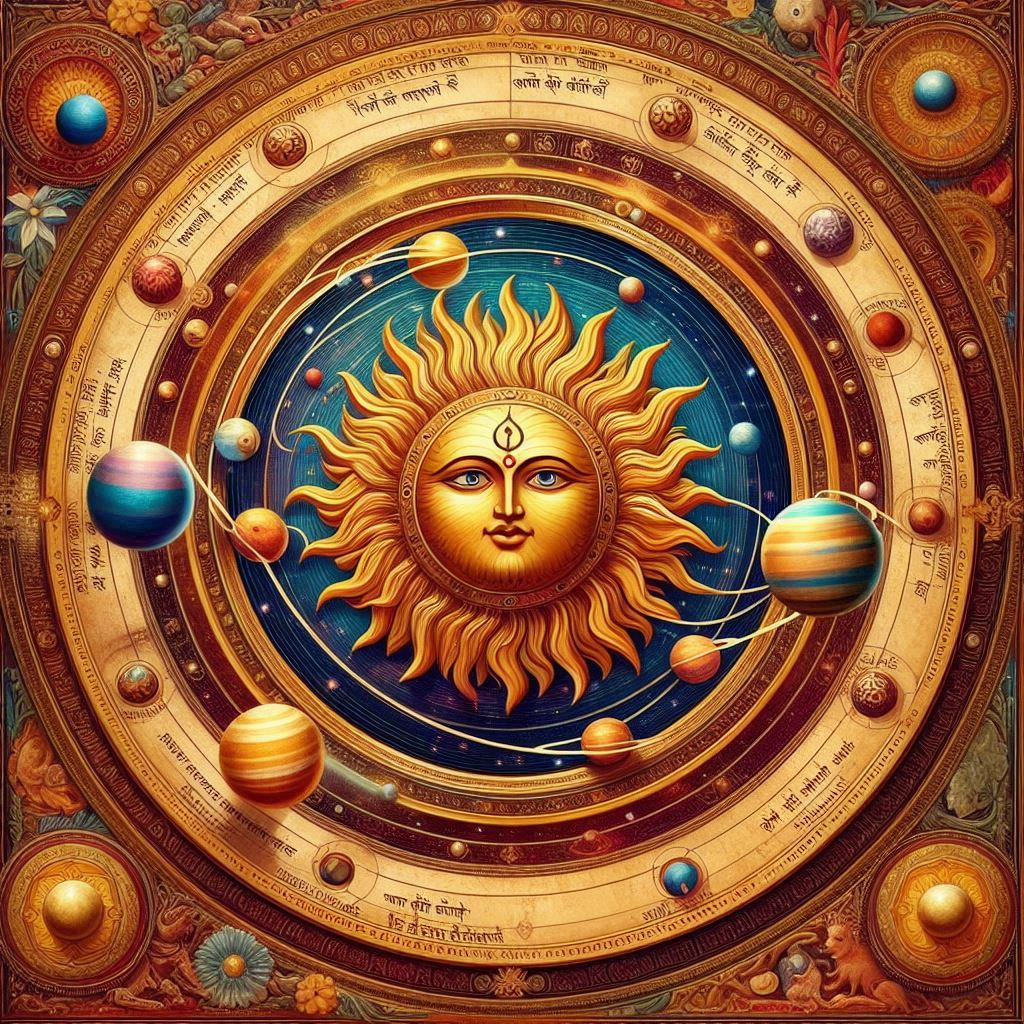
The cited Vedic mantras further elaborate on this concept, attributing the stability of celestial bodies and their movements to gravitational forces:
–Rigveda 8.12.28 and 8.12.30
यदा ते हर्यता हरी वावृधाते दिवेदिवे।
आदित् ते विश्वा भुवनानि येमिरे ।।
speak of the Sun’s radiant energy causing the planets to move in their orbits and remain stable due to the Sun’s attraction.
हिरण्यपाणि: सविता विचर्षणिरुभे द्यावापृथिवी अन्तरीयते।
अपामीवां बाधते वेति सूर्यमभि कृष्णेन रजसा द्यामृणोति॥
describes the Sun as holding the Earth and other heavenly bodies, preventing collisions through its attractive force.
According to Atharvaveda 4.11.1
अनड्वान् दाधार पृथिवीमुत द्यामनड्वान् दाधारोर्वन्तरिक्षम्।
अनड्वान् दाधार प्रदिश: षडुवीर्रनड्वान् विश्वंभुवनमाविवेश॥
uses the analogy of a bull pulling a cart to illustrate how the Sun controls the movements of planets.
The Taittiriya branch of Krishna Yajurveda
मित्रोदाधार पृथिवीमुतद्याम। मित्रः कृष्टी:।
emphasizes the Sun’s role in holding the Earth in space through its attractive power, with the term “Kristheeh” highlighting this force of attraction. These texts reflect a sophisticated grasp of gravitational principles, recognizing the Sun’s critical role in maintaining cosmic order. This ancient wisdom, although fragmented over time, underscores the depth of scientific thought in early Indian civilization.
 Spirituality is Beyond Science
Leave a comment