Thoughts and the Emergence of Destiny

What is your favorite form of physical exercise?

Journey from Thought to Destiny:

Journey from Thought to Destiny:
Our thoughts give rise to actions, actions shape our nature, nature builds our character, and character ultimately determines our destiny. This thought emphasizes that every stage of our life begins with our thoughts. When we hold a thought in our minds, it transforms into our actions. Our actions shape our nature, which in turn builds our character. Ultimately, our character determines our destiny or fate.

“The Power of Bhagwan Satyanarayana” is a Story from the Upanishads.
Once upon a time, there was a Brahmin who regularly worshipped Bhagwan Satyanarayana. He performed his rituals with devotion and kept his thoughts pure and sacred. One day, a sage asked him why he worshipped with such devotion and regularity.

The Brahmin replied, My thoughts are pure, which makes my actions pure as well. When I perform righteous actions, my nature becomes pure. And when my nature is pure, my character becomes noble. This improves my destiny, bringing me peace and prosperity. The sage said, Your understanding is in alignment with what is described in the Upanishads. Our thoughts guide our lives. Therefore, we must always keep our thoughts pure and positive. Thus, through his worship and the purity of his thoughts, the Brahmin not only improved his own life but also imparted a message to society that it is our thoughts that shape our destiny.

“Let your thoughts be the seeds of purity, your actions the blossoms of righteousness, your nature the fragrance of virtue, and your character the fruit of destiny.” This captures the essence of how our inner world shapes our outer reality. By nurturing pure thoughts, we lay the foundation for a life of integrity, peace, and fulfillment.

Central upnishad

1. ऋगवेद (Rig Veda) : प्रज्ञानं ब्रह्म

Pragnanam Brahm –
Brahm is intelligence, is a Defining aphorism (Lakshana Vakya)

2. यजुर्वेद (Yajur Veda) : अहं ब्रह्मास्मि

Aham Brahm Asmi –
I am Brahm, is an Experiential aphorism (Anubhava Vakya)

3. सामवेद (Sama Veda) : तत्त्वमसि

Tat Tvam Asi –
That you are, is a Teaching aphorism (Upadesha Vakya)

Immerse in your infinite knowledge.

What alternative career paths have you considered or are interested in?

Spirituality is beyond science.

Mother Nature has created this world 432 million years ago. There is a catastrophe of the same number of years. It has been 1,96,08,53,125 years since the creation was created. This is the time it has been since the Vedas were born. All the religious texts of the world are within 5000 years but the Vedas are the oldest. Other opinions also believe this. This is Sanatan’s unique heritage. Therefore, Sanatan is considered eternal

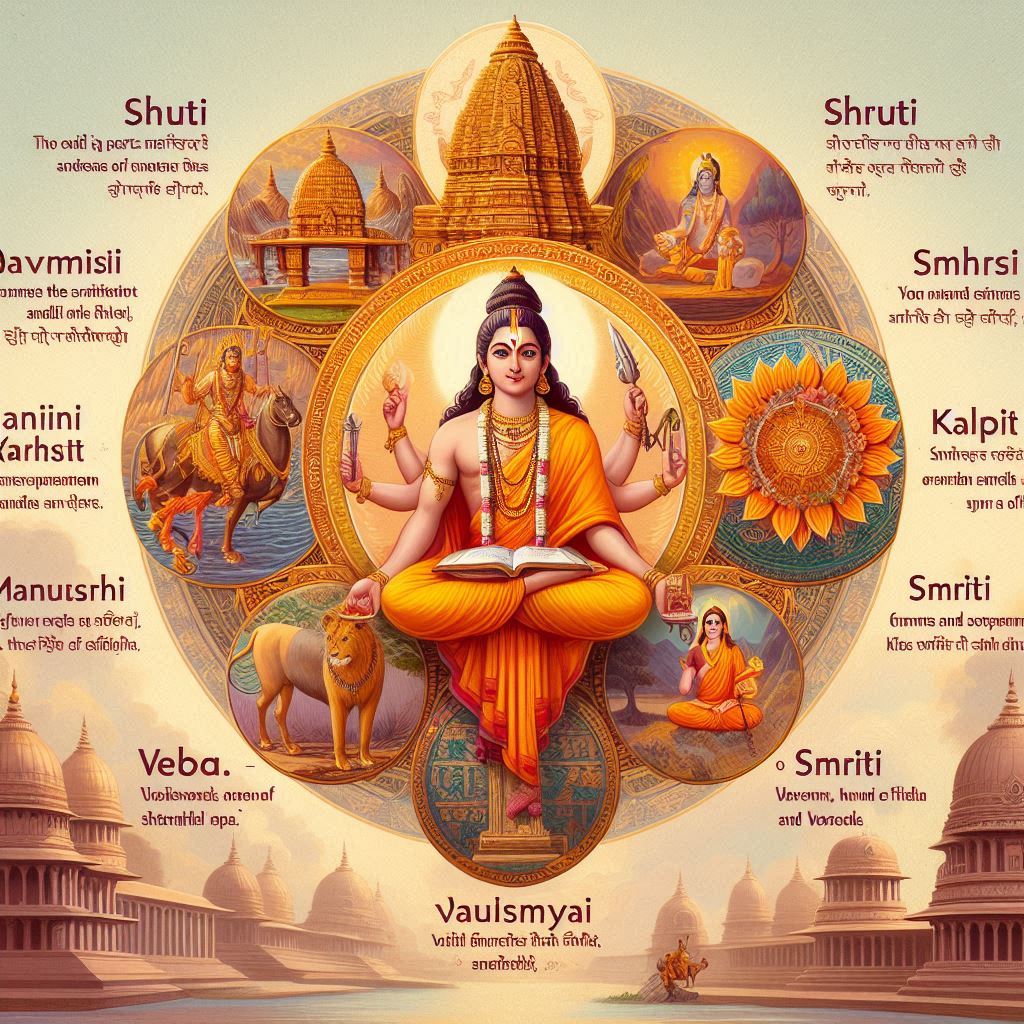
To understand Indian scriptures and Vedic knowledge, the scriptures are divided into two parts: Shruti and Smriti. Shruti includes the scriptures Vedas and Smriti includes books of history and interpretation of the Vedas, Manusmriti, Yajnavalkya Smriti, etc. The Vedas are the symbols of eternal and eternal truth. The Vedas have 6 अंग and 6 उपांग . Which helps in knowing the Vedas. The 6 limbs of the Vedas are Varna Shiksha, Panini Krita व्याकरण (Ashtadhyayi), Kalpa, Maharishi Yaska Krita Nirukta, Maharishi Pingal Krit Chhanda and Jyotish etc. This is explained to you in just a few words. This is to be understood

6 उपांग Philosophy:

(1) Yoga Darshan (Maharishi Patanjali)

(2) Sankhya Darshan (Maharishi Kapil)

(3) Nyaya Darshan (Maharishi Gautam)

(4) Vaisheshikadarshan (Maharishi Kanada)

(5) Mimamsa Darshan (Maharishi Jaimini)

(6) Vedanta Darshan (Maharishi Vyasa)

Although more than 100 Upanishads are found in the spiritual field of Indian culture, it is necessary to read 11 Upanishads before studying Vedanta philosophy. Those Upanishads are as follows –

1. ईशोपनिषद
2. केनोपनिषद
3. कठोपनिषद
4. प्रश्नोपनिषद
5. माण्डूक्योपनिषद
6. मुण्डकोपनिषद
7. ऐतरेयोपनिषद
8.  तैत्तिरीयोपनिषद
9.  बृहदारण्यकोपनिषद
10. छांदोग्योपनिषद
11. श्वेताश्वतरोपनिषद .

There are only 4 interpretation books of the Vedas – (Brahmin texts)

(1) Aitareya Brahmins

(2) Shatapatha Brahmins

(3) Tandya Brahmins

(4) Gopatha Brahmins.

Case-ending showing possession or relation

Is complete knowledge hidden in the Vedas?

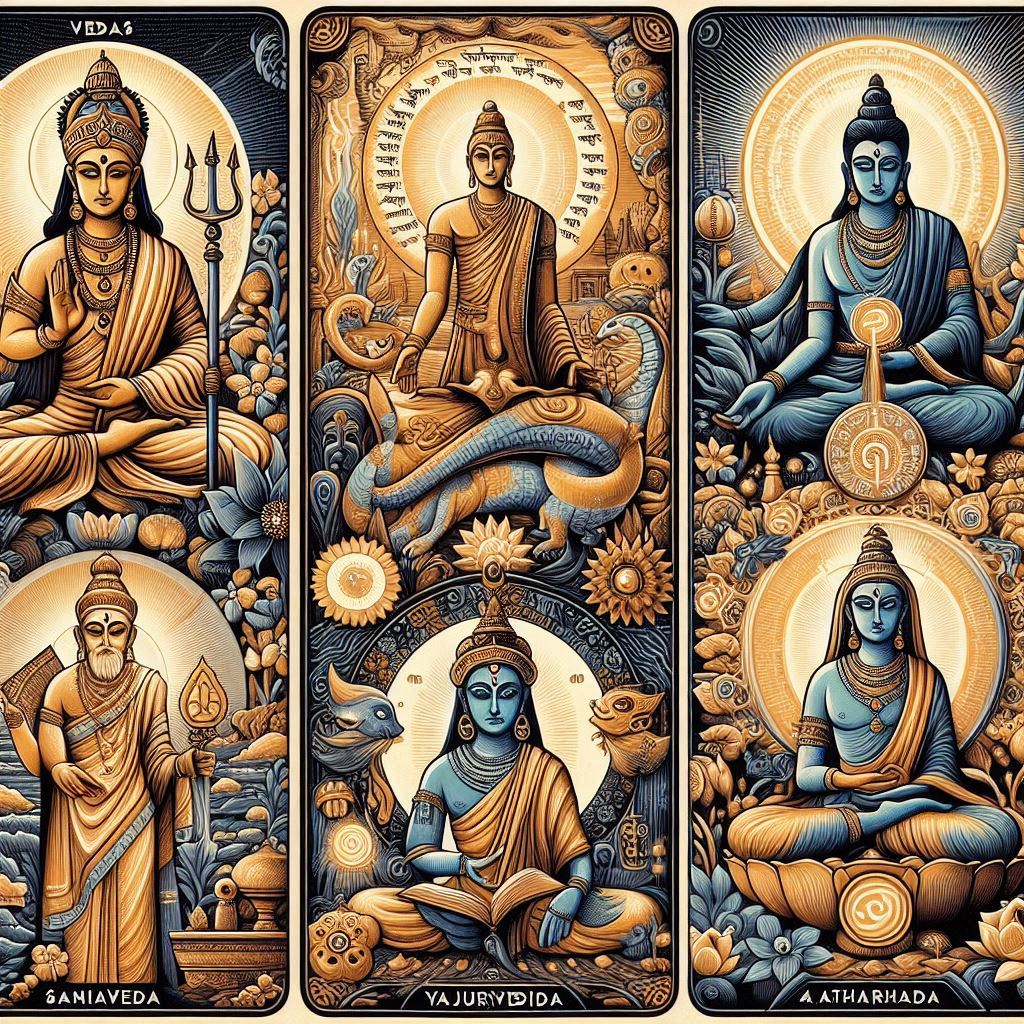
The Vedas are full of knowledge related to almost all subjects, like God, the universe, astrology, mathematics, chemistry, medicine, nature, astronomy, geography, religious rules, history, rites, customs, etc. The four Vedas are Rigveda, Yajurveda, Samaveda and Atharvaveda. There are only 4 upavedas. Ayurveda of Rigveda, Dhanurveda of Yajurveda, Gandharva Veda of Sama Veda and Atharva Veda

Rigveda:

ऋक means status and knowledge. It has a lot to do with geographical location and mantras invoking the deities. The hymns of the Rig Veda contain prayers, praise of the gods and descriptions of their position in Devlok. It also provides information on water therapy, air therapy, solar medicine, psychiatry and healing by Havan. The description of substances ranging from nature’s smallest atom to God is found in the Rigveda. It has 10522 mantras. The knowledge of Rigveda was received in the soul of Maharishi Agni

Yajurveda –

यजु means moving sky and action. Yajurveda contains the methods of sacrifice and the mantras used in sacrifices. We can understand the 16 rituals properly from Yajurveda. Apart from sacrifice, philosophy is described. Element knowledge means mystical knowledge. Knowledge of the universe, soul, God and matter. There are two branches of this Veda, Shukla and Krishna. There are 1075 mantras in Yajurveda. The knowledge of Yajurveda was received in the soul of Maharishi Vayu


Samaveda:

साम means transformation and music. Gentleness and worship. This Veda has a musical form of many hymns of the Rig Veda. It mentions about the gods Savita, Agni and Indra. It also makes references to classical music and dance. This Veda is considered to be the origin of music science. It has 1875 mantras. The knowledge of Samaveda was received in the soul of Maharishi Aditya

Atharva Veda:

अथर्व means vibration and Atharva means vibration. This Veda mentions mystical sciences, herbs, miracles and medicines of Ayurveda etc. It also provides knowledge of Indian tradition and astrology. By studying it, all doubts are solved and the vibration of the mind ends. It has 5977 mantras. The knowledge of Atharva Veda was received in the soul of Maharishi Angira.

6 limb of Sanatan.

To know the Indian Sanatan culture, it is very important to study 6 scriptures with the knowledge of the four Vedas.  So these 6 scriptures are also called the Upavedas of the Vedas i.e. philosophy . Our sages have created these 6 philosophies by incorporating the doctrines scattered everywhere in the Vedas, on the basis of which we can understand this divine knowledge accurately. These 6 Vedic philosophies are called theistic philosophies. These are our logics, by reading which the intellect of every human being opens and he never confuses and doubts about God, religion, unrighteousness, truth, falsehood etc. By reading these philosophical scriptures, all kinds of doubts are resolved automatically. These 6 philosophies are as follows:

(1) Nyayashastra: –

It has been composed by Gautam Muni. The subject of this scripture is mainly logic. This philosophy has been created with the purpose of separating truth and falsehood from the world spread around him through four types of evidence (direct, inference, simile and word.

(2) Vaisheshika Shastra: –

It has been composed by Kanad Muni. This scripture is about material knowledge. How to know the qualities and karma of the substances that God has created for us and use them? This is the subject of this scripture. (This is physics.)

3) Sankhya Shastra: –

It has been composed by Kapil Muni. Its main theme is how the creation originates from the most subtle particles of nature (Word, Touch, Form, Taste and Smell) from Sat, Raja, and Tama. How are all substances similar and characteristic? This scripture completely explains the difference between nature and soul.

(4) Yoga Shastra: –

It has been composed by Patanjali Muni. Its main topic is to tell the method of attaining salvation by following the eight limits (Yama, Niyama, Asana, Pranayama, Pratyahara, Dharana, Dhyana, Samadhi) by getting rid of all sorrows

5) Mimamsa:

It has been composed by Jaimini Muni. Its subject is that by following what kind of Vedic rituals and limitations, a person can become completely happy and can attain salvation, the goal of his life?

(6) Vedanta (Brahmasutra):

It has been composed by Ved Vyasa Muni. Its main theme is to describe the nature of God, his qualities, knowing which man should get rid of all doubts about him and start worshiping him and attain them by practicing yoga.

Praying with Spiritual Emotion (Bhāv) :

◆ God Principle:

The divine essence flows through spiritual practices.


◆ Transmission of Frequencies:
N
5% of frequencies of Divine Consciousness (Chaitanya) are transmitted outside the body. Seekers can access up to 20% of frequencies of Divine Consciousness (Chaitanya).


◆ Protective Sheath:

A protective layer surrounds the seeker.


◆ Spreading of Divine Consciousness:
15% of the accessed Divine Consciousness spreads into the body of the seeker.

Unlock supreme success

What food would you say is your specialty?

The legend of HANUMAN JI ♥️

The verse of Ashta Siddhi in Sanskrit is as follows.

Anima, Mahima, Laghima, Garima and prapti, Prakamya Ishitva and Vashitva, these siddhis are called “Ashtasiddhi

The term ‘siddhi’ generally refers to such transcendental and spiritual powers that are attained through penance and spiritual practice. According to the belief of Sanatan, many types of siddhis are described, out of which eight siddhis are more famous, which are called ‘Ashtasiddhi’ and which have been described in the above verse.

Sri Hanuman Chalisa, written by Goswami Tulsidas, is the Chaupai in which Tulsidasji.  Explain that Hanuman is endowed with  eight siddhis


Description of Ashtasiddhi:-

1. Anima –
The ability to shrink one’s body into a molecule.

2. Mahima –
the ability to greatly enlarge the size of the body.

3. Dignity –
the ability to make the body extremely heavy.

4. Laghima –
the ability to de-load the body.

5. Attainment –
The ability to go to any place without interruption.

6. Prakamya –
The ability to fulfill each of your desires.

7. Ishitva –
The ability to have complete authority over every object and being.

8. Vashitva –
the ability to subdue every being. Ashta
Siddhis are those siddhis by which a person can be able to live in any form and body. He can cross the limits of subtlety and become as subtle and as massive as he wants

1. Anima:
The first of the Ashta Siddhis is Anima, which means! He has the power to subtle his body like a molecule. Just as we cannot see a molecule with our naked eyes, in the same way, no other person can see the one who has attained Anima Siddhi after attaining Anima Siddhi. The seeker can assume a subtle body equal to an atom whenever he wants

2. Mahima :
Glory is the exact opposite type of Anima, the seeker can make his body infinitely vast, and he can stretch his body to any limit

3. Garima:
After attaining this siddhi, the devotee can increase the weight of his body in an unlimited way. The size of the seeker is limited, but the weight of his body increases so much that no power can move him

4. Laghima:
The body of the seeker can be so light that he can fly faster than the wind. The weight of his body becomes negligible

5. Prapti:
A seeker can go to any place, anywhere without any hindrance. By becoming invisible to other human beings according to his wish, the seeker can go wherever he wants to go and no one can see it

6. Prakamya:
A seeker can understand the matter of someone’s mind very easily, then whether the person in front of him expresses his mind or not

7. Ishiatya:
This is the title of God, a; aftertaining this siddhi, the seeker himself becomes the form of God, he and can establish his dominion over the world.

8. Vashitva:
After attaining Vashitva, a seeker can keep any person as his slave. He can subdue whomever he wants or cause anyone’s defeat.

The 8-limbs of limitless willpower

In Indian Sanatan culture, how the person and self-confidence destroy bondage should be learned from Hanuman the god of strength and strength. Hanuman is associated with Lord Shri Ramchandra, but Hanuman travels from a person to a seeker and awakens an unlimited power within himself, which is in every person; how much someone can use that power and power depends on that person. Hanuman tells us how to use the power. How did Hanuman swallow the sun, 28 million times more grand and bigger than the Earth? Is this a joke with science? Accordingly, you should question everything which is not easy. Like how Hanuman crossed such a vast ocean without getting tired?  Shri Hanuman is part of God, he has received various types of boons

Hanuman ji !!   Has Astha Mahasiddhi and Nau Nidhi. These Astha Mahasiddhis are Anima, Laghima, Mahima, Ishitva, Prakramya, Garima and Vashivta.  With the help of these siddhis, they can go near the sun and swallow it, but Hanuman does not swallow #NAME. This 18th chapter of Hanuman Chalisa written by Goswami Tulsidas describes the distance between the sun and the earth

जुग सहस्त्र जोजन पर भानू।
लील्यो ताहि मधुर फल जानू।।

This couplet is in the Awadhi language. The meaning of this couplet in the Hindi language is that Hanumanji had eaten Bhanu, i.e., Surya, located at a distance of one Yuga Sahastra Yojana, as a sweet fruit (when he was about to eat, Devraj Indra attacked. If you want to argue science here, then you can give it, as if Hanuman could have reduced his weight #NAME? Subtle meaning by using his Laghima Siddhi

As we have read in science, an article that weighs negligible can travel at the speed of light because, in that case, the force of gravity and center of gravity do not affect that particle. In this way, Hanuman flew faster than the speed of light and reached to swallow the sun. According to NASA, the distance between the Sun and the Earth is 149 million kilometers and this has already been described in the 18th quadruped of Hanuman Chalisa. Hanuman is one of the Ashta Siddhis With this siddhi, he could enlarge his body as much as he wanted. Therefore, the whole earth is like a fruit in front of Hanuman. According to science, any object that weighs more and has a lot of energy can form a black hole, and black holes can swallow the sun. When a black hole can swallow the Sun, Sri Hanuman is an incarnation of Lord Shiva. God is. Nothing is impossible for them in the universe

Change is the law of nature.   70-80 years ago, if someone said that humans could go to space, people would laugh. 40-50 years ago, if someone said that a person could complete a distance of thousands of kilometers in a few hours, then people would laugh. 20-30 years ago, if someone said that a human being could talk to another person sitting far away, then people would laugh. 15-20 years ago, if someone said that a person could see face-to-face from another person sitting far away, then people would laugh

In recent times, China has succeeded in creating an artificial sun of its own. Today we live in the city, so you can believe by listening/reading this news. But if you go to the village and ask someone, he will make fun of you like this questioner. And will not believe that any country (people of a country) can make the sun. Now you understand what I mean. Today, we are researching traveling at lightning speed (it must be a joke right now. But our thinking has proved true so far, so why do you think about our culture as if everything is superstition? Our culture is rooted in our hearts, minds, history, books, and Vedas, while science is just beginning, so we have not been able to understand science properly even today; then how can you compare your culture with science to a limit? Hanuman is part of Rudra, the Rudra that ends and rhythms the entire universe, so Hanuman is the Sun, which is like a molecule relative to the universe, he can swallow it. Therefore, we should never compare our culture too much with science. Because there are some things that even science cannot understand right now. Where the boundaries of science end, spirituality begins

Sanatan scriptures.

What’s the biggest risk you’d like to take — but haven’t been able to?

Oldest religion texts.

There are four Vedas and 108 Upanishads in Sanatan Dharma. The Vedas are considered to be the oldest religious texts. The four Vedas are as follows:

1. Rigveda

2. Yajurveda

3. Samaveda

4. Atharvaveda

These Vedas, as well as the Upanishads, are considered an important part of the Vedic literature. Profound philosophical and spiritual topics have been discussed in the Upanishads. Vedas and Upanishads are profound and ancient texts of Sanatan Dharma, in which the philosophical and religious principles related to life, universe, and ultimate truth have been described in detail

VEDAS (1,00,000 verses)

Divided & Organized into 4 Vedas by
Krsna Dvaipayana (Vedavyasa)

Whya Vedas .

1. Vedas:

The Vedas are considered as the most ancient and main texts of Sanatan Dharma. The Vedas are considered by the sages as “shruti” (knowledge gained by hearing. These were compiled by Maharishi Ved Vyasa. The purpose of the Vedas is to guide the four major goals of human life (Dharma, Artha, Kama, Moksha. This is Sanatan meaning that which has been going on continuously since time immemorial is in the real form, this is eternal

The four Vedas are as follows:

Rig Veda:

This is the oldest Veda and consists mainly of a compilation of richas (mantras) in the form of praise of the gods. It has around 10,552 mantras, which are used in the worship of various deities, prayers, and yajnas.


🔸Rigveda (21+ Shakhas)

▪️Available 1 Shakha

▪️Lost 20+ Shakhas

▪️Samhita

▪️Brahmana

▪️Aranyaka


Yajurveda:

It describes mantras and methods for sacrifices and rituals. It is divided into two parts: Krishna Yajurveda and Shukla Yajurveda. It mainly deals with ritualistic and ritualistic activities

Yajurveda (101+ Shakhas)

▪️Available 3-4 Shakhas

▪️Lost 97+ Shakhas

▪️Samhita

▪️Brahmana

▪️Aranyaka


Samaveda:

In this Veda, some mantras of Rigveda have been presented in musical form. It is seen by linking it with devotion and music. The mantras of Samaveda are used to accompany music in sacrifices and rituals.

Samaveda (1000+ Shakhas)

▪️Available 3 Shakhas

▪️Lost 997+ Shakhas

▪️Samhita

▪️Brahmana

▪️Aranyaka


Atharvaveda:

This Veda is slightly different from the other three. It describes mantras and methods related to witchcraft, medicine, healing, and social life. There are many mantras in it that throw light on all aspects of a person’s life

Atharvaveda (9+ Shakhas)

▪️Available 2 Shakhas

▪️Lost 7+ Shakhas

▪️Samhita

▪️Brahmana

▪️Aranyaka

The 108 Upanishads:

The Upanishads are called the last part of the Vedas or “Vedanta”. Their purpose is to clarify the search for enlightenment, Brahman, Atma, and the ultimate truth. The Upanishads mainly describe spiritual, philosophical and meditative topics. The doctrines of Vedanta are based on the Upanishads. Although the number of Upanishads is considered to be 108, some of the major and ancient Upanishads are as follows:


1. Total Shakhas: 1180

▪️10-15 Available

▪️Brahmanas

▪️Available 19-20

▪️Lost 1,111+

2. Samhitas :

▪️Available 9-10

▪️Lost 1,121+

3. Upanishads :
▪️Available 108

▪️Lost 1,023+

4. Aranyakas

▪️Available 7

▪️Lost 1,124


1. Ishopanishad:

It mentions the unity of the universe and the soul and considers the impermanence of karma and life.


2. Kathopanishad:

It is based on the dialogue of Yama and Nachiketa, explaining the mysteries of soul, death and salvation.


3. Mandukya Upanishad:

It analyzes the forms of Om and its three sounds. This Upanishad is a major source of Advaita Vedanta.


4. Chandogya Upanishad:

This Upanishad is related to the Samaveda and discusses in detail the Atman, Brahman and the methods of meditation


5. Brihadaranyaka Upanishad:

This is the largest Upanishad and considers the importance of the soul, rebirth, Brahman and knowledge.

Importance of Vedas and Upanishads:

The Vedas and Upanishads are the foundation of Indian religious, philosophical and spiritual traditions. These texts provide guidance on every aspect of human life, such as:

Spirituality:
The ultimate purpose of life is the union of the soul with Brahman (moksha), which is explained in depth in the Upanishads


Religion:
Duties and religious conduct have been described in the Vedas.

Yoga:
The path to purification and salvation of the soul is shown through meditation and yoga.

Karma:
The principle of karma and its consequences have been explained in detail in the Vedas and Upanishads.
Vedas and Upanishads are not only religious texts but also show the philosophical and spiritual path to understand and find solutions to the complexities of human life

You become what you think all day long.

Do lazy days make you feel rested or unproductive?

Why the tradition of getting up in Brahma Muhurat?

ब्रह्ममुहूर्ते या निद्रा सा पुण्यक्षयकारिणी”।

The last prahar of the night is called Brahma Muhurat. Our sages have given special significance to this Muhurat. According to him, this is the best time to quit sleeping. This is not to say that sleeping is wrong, but sleeping more time than necessary is harmful. By getting up in the Brahma Muhurat, one attains beauty, strength, knowledge, intelligence, and health. One should wake up about one and a half hours before sunrise in the Brahma Muhurat. This Brahman means the Supreme Element or the Supreme Soul. Muhurat means favorable time. The last pra har of the night i.e. 4 to 5.30 am is called Brahma Muhurat

The sleep of Brahma Muhurta is the destroyer of virtue.
In Sikhism, there is a very beautiful name for this time – “Amrit Vela”, through which the importance of this time itself is proved. This importance of devotion to God proves itself. This is the best time for devotion to God. By getting up at this time, man gets beauty, intelligence, health, etc. His mind remains calm, and his body is completely healthy. Getting up in Brahma Muhurat is very beneficial for our lives. This makes our body healthy and keeps us energetic throughout the day. This is a formula for staying healthy and successful that costs nothing. Only laziness needs to be abandoned


According to Valmiki’s Ramayana, Lord Hanuman reached the Ashok Vatika in Brahmamuhurta while searching for Mother Sita.

Where he heard the sound of chanting mantras of the knowers of Vedas and Yajna.
It is also mentioned in the scriptures –

वर्णं कीर्तिं मतिं लक्ष्मीं स्वास्थ्यमायुश्च विदन्ति।

ब्राह्मे मुहूर्ते संजाग्रच्छि वा पंकज यथा॥

By getting up in Brahma Muhurat, a person gets beauty, Lakshmi, intelligence, health, age, etc. By doing this, the body becomes beautiful like a lotus

That’s why you get success and prosperity.

According to Ayurveda, getting up and walking in Brahma Muhurta transmits Sanjeevani power in the body. This is the reason that the air flowing at this time is called nectar. Apart from this, this time is also said to be the best for study because when we wake up in the morning after resting at night, there is energy and freshness in the body and brain. The doors of major temples are also opened in Brahma Muhurta and there is a law to adorn and worship God in Brahma Muhurat.
Knowing the religious, mythological, and practical aspects and benefits of Brahmamuhurta, start waking up every day at this auspicious time, then you will get better results

A person who rises in Brahma Muhurat is successful, happy, and prosperous; why? Because getting up early gives you enough time to make tasks and plans throughout the day. So not only does life succeed. Everyone who is physically and mentally healthy can be happy and prosperous. The reason is his progress in the work he does. The student is successful in the examination. The boss is happy with the job-doer. Businessmen can earn well. The income of the sick person is affected, on the contrary, the expenses start increasing. Success kisses the feet of the one who makes good use of time and stays healthy. Therefore, if you want to remain healthy and successful, then get up in the Brahma Muhurat
There is a deep connection between Brahma Muhurat and nature. At this time, animals and birds wake up. His melodious voice begins. The lotus flower also blooms. In a way, nature also becomes vibrated in the Brahma Muhurat. It is a symbol of getting up, waking up. Nature gives us the message to get up in the Brahma Muhurat


प्रातारत्नं प्रातरिष्वा दधाति तं चिकित्वा प्रतिगृह्यनिधत्तो।

तेन प्रजां वर्धयमान आयू रायस्पोषेण सचेत सुवर:॥
– ऋग्वेद-1/125/1

The health of the person who wakes up before sunrise in the morning is good. That is why wise people do not waste this time. A person who wakes up early in the morning is healthy, happy, strong and long-lived

A cosmic day- routine


1.  3:00 am to 5:00 am –

At this time the life force is mainly in the lungs. Drink some lukewarm water and walk in the open air and do pranayama. At this time, long breathing develops lung function. They get oxygen and negative ions in abundance and the body becomes healthy and energetic. People who wake up in the Brahma Muhurat are intelligent and enthusiastic, and the life of those who sleep becomes dull.

2.  5:00 am to 7:00 am –

At this time the life force is mainly in the intestine. Defecation and bathing should be taken between waking up in the morning and 7 in the morning. Those who bowel after 7 in the morning dry up the stool by absorbing the fluid from the stool. It causes constipation and many other diseases

3.  7:00 p.m. to 9:00 p.m –

At this time the life force is mainly in the brain. The brain is especially active at this time. Therefore, apart from the morning, the lesson read in this period is quickly remembered. This has also been confirmed by modern exploration.


4.  9 pm to 11 p.m.:

At this time, the life force is mainly present in the spinal cord. At this time, resting on the back or the left side helps to absorb the strength received by the spinal cord. Sleep at this time provides the most relaxation. The awakening of this time tires the body and intellect. If food is eaten at this time, it remains in the stomach till morning, it is not digested and its decay produces harmful fluids which cause diseases by going into the intestines with acid. Therefore, it is dangerous to eat at this time


5.  11 p.m. to 1 p.m.:

At this time the life force is mainly present in the gall bladder. Awakening at this time causes bile disorders, insomnia, eye diseases, and early aging. At this time new cells are formed

6.  1 to 3 pm:

At this time, the life force is mainly in the liver. Microdigestion of food is the function of the liver. Awakening at this time spoils the liver and digestive system. If you keep awake at this time, then the body starts getting sleepy, the vision is dim and the body’s reactions are slow. Therefore, road accidents are more common at this time

Red Caution:

Sages and Ayurvedacharyas have said that eating without hunger is forbidden. Therefore, the quantity of food in the morning and evening should be such that one feels hungry openly during the above-mentioned meal time. Spread something on the ground and eat food sitting in Sukhasana. In this asana, the gastric fire remains illuminated due to the activation of the Muladhara chakra. Digestion is weak while sitting on a chair and eating food while standing does not happen at all. Therefore ‘buffet dinnerʹ should be avoided

To take advantage of the earth’s magnetic field, sleep only with the head in the east or south direction. Otherwise, there are problems like insomnia. To run the body’s biological clock properly, sleep with the light off at night. The research done in this context is shocking. Working or studying late at night and sleeping with the light on can cause severe health hazards by deactivating the biological clock. By sleeping in the dark, this biological clock runs properly. The cause of most of the diseases found nowadays is the chaotic routine and adverse diet. If we maintain our daily routine according to the biological clock of the body, then we will get the benefit of the activity of different organs of the body. In this way, a little awareness lays a new foundation for a healthy life

Need overall !

What could you try for the first time?

Lentent hit :

Due to stressful life in modern society, human beings are vulnerable to deadly diseases like high blood pressure, heart disease and cancer. Many diseases are destroyed by lifestyle improvement. Along with this, there is another easy solution, which does not have any side effects. You just need to do it regularly. This easy solution is the Gayatri Mantra, which has been tried for centuries. And nowadays it has also been put to the test of science.

1. If this mantra is read in any position i.e. while sitting, lying down or standing, then one gets equal benefit to

2. The mantra begins with the word Om- Pull the word Om as long as you can, without taking a breath. Draw the words “o” and “m” separately long.

3. After this, read or speak the remaining mantra as fast as you can with the correct pronunciation. Repeat the OM process every time. Keep repeating Om and Mantra continuously for five minutes.

4. Do this process every two hours for a month. In this way, do the awakening of a normal person 8 times in 16 hours. A total of 40 minutes are to be given in 24 hours.

5. After one month, the beneficial effect of this process will be seen. Now continue this process by doing it four times in 24 hours.

6. It is necessary to chant this mantra for five minutes at the time of getting up in the morning and at bedtime. After this, keep reciting this mantra regularly by fixing a fixed time only twice.

आत्मानं विद्धि”

Vasana Daha Tantra is a powerful spiritual practice rooted in the ancient wisdom of Bharat that aims to burn away the latent impressions (vasanas) accumulated from past experiences, desires, and karmic patterns. The term “Vasana” refers to the deep-seated tendencies and subconscious impressions that influence our thoughts, emotions, and actions. “Daha” means burning or purification, and “Tantra” signifies a structured method or practice. In essence, Vasana Daha Tantra is the process of purging or transforming these deep-rooted impressions, leading to liberation from mental and emotional conditioning, ultimately bringing one closer to spiritual enlightenment.

Process of Vasana Daha Tantra:


1. योगस्थ: कुरु कर्माणि =  Self- realisation:

The first step involves deep introspection and awareness of one’s thoughts, desires, and behaviors. Through meditation and mindfulness, you identify the underlying patterns and attachments that are obstructing spiritual growth. As the Bhagavad Gita states, “योगस्थ: कुरु कर्माणि” — remain established in yoga while performing actions, staying aware of the forces at play.

2. आत्मानं विद्धि = Acknowledge and Accept:

Once the asanas are identified, the next step is to fully acknowledge their presence without judgment. Accept that these impressions are part of the karmic cycle, and they need to be transformed, not resisted. The acceptance phase draws from the Upanishadic wisdom, “आत्मानं विद्धि” (Know thyself), recognizing the self in all its layers.

3. Purification through Reflection :

This step involves deep contemplation on the harmful or binding nature of these vasanas. By reflecting on their impermanence and the suffering they cause, the seeker gradually detaches from their influence. In this phase, spiritual texts like the “Shvetashvatara Upanishad” guide the seeker to view desires as fleeting and not inherent to the true self.

4.सर्वे कर्माखिलं पार्थ ज्ञाने परिसमाप्यते”=  Soul of Visualization:

A key technique of Vasana Daha Tantra is meditative visualization, where one mentally visualizes the vasanas burning in the fire of wisdom. The fire represents spiritual knowledge, often referred to as “Jnana Agni” (fire of knowledge). As stated in the Mundaka Upanishad, all actions are dissolved in the fire of wisdom.

5. तंत्र: Ritualistic Dissolution :

Engage in a ritual where you symbolically burn these impressions. This can involve the chanting of mantras, such as the powerful “Om Agnaye Namah” (Salutations to the fire element), while mentally offering the vasanas into an inner fire. This act strengthens the internal process of release and purification.

6. Affirmation of Liberation :  

 After the process of dissolution, affirm your liberation from the past tendencies. Repeat mantras like “सोऽहं” (I am That), affirming the unity of self with the divine consciousness. It reinforces the realization that you are beyond desires and karmic impressions.

7. तत्त्वमसि :  Feel the infinite :

The final stage is integrating this newfound freedom into daily life. You move forward with a clearer mind and a lighter heart, no longer governed by old vasanas. The Chandogya Upanishad says, real, I  remind you that the true self is infinite, pure, and free from conditioning.

Vasana Daha Tantra is a transformative spiritual practice that combines deep introspection, meditation, mantra, and ritual to dissolve the karmic impressions that bind us to the cycle of birth, death, and rebirth. By purifying these asanas, one can attain clarity, freedom, and a deeper connection to the divine. This method empowers the seeker to transcend habitual patterns and step into a higher state of consciousness, aligning with the true self eternal, blissful, and free.

Life is a divine workplace.

What principles define how you live?

Whya burnout??

Life is like a vast ocean, in which we are all travelers and God is our guide. During this amazing journey, there are sometimes strong thunderstorms and storms that challenge us. Sometimes, we have to face difficulties and troubles in life, while sometimes, some stages of life come close to us and go away. But in this journey, there will be wood and simplicity; if we consider our life only as a house of sorrows, then it is not right. We can fulfill some supply of this life with money, but the ignorance within us makes us fool, getting rid of it is the true attainment. The enjoyment of accumulated karma remains in life. When we are caught in the vortex of ignorance and emotion, and there is only despair and emptiness in every direction, at that time, it is very important to calm our minds. This is the time for us to close our eyes, calm our minds, and meditate. When we close our eyes and breathe within, we try to calm the mind; after this, when we open our eyes more slowly, we feel that an invisible finger is holding our hopes. It is this finger of the name of the Lord that gradually leads us through our sorrows and difficulties in life. This name bestows us with spiritual strength and patience, which helps us to face difficulties and cross the journey of life successfully

Wherever we go in life, our memories, our deeds, and our experiences are connected. Every person travels this journey in his way. Some people give up in fear of small difficulties, while some people face the biggest problems with patience and courage. The experience of happiness and sorrow is also transient; No one person remains the same for very long under the influence of an event. The duration of each event is limited; It becomes old when a new event occurs. It is not possible to stop the continuity of life; This is the speed of life, and at this speed, every coming event is sure to come

We all should do something in our life journey that will serve as a guide for the coming generations. With this thinking, we can emerge from the darkness of selfishness, greed, evil, anger, arrogance, and ignorance. We should keep in mind that our actions and our thinking have an impact not only on our lives but also on future generations. When we practice goodness in our lives, we not only make our lives meaningful but also present a role model for others. Thus, this journey of life teaches us that we have the Lord’s name, His grace, and the power of our deeds. It reminds us that we should make our life an ideal, an inspiration source, not only to make our life successful but to guide others as well. With this spirit, we can achieve not only personal success in our lives but leave a positive legacy for society and generations to come.

Peaceful perspective: mindfulness for health.

What jobs have you had?

Food is not life

The most important thing that nature has put in the inner mind of all organisms is survival, meaning the first goal of all organisms is to survive, so we do everything necessary to survive and advance our consciousness with the subconscious mind, and when we do this work, a chemical is released in our brain which is called dopamine and this gives us happiness Is. Meaning Mother Nature has arranged that in whatever work we fulfill our minimum goal, we feel happy. Such as good food, music, etc.
Then the natural question arises that then why do we like such food which is more junk and unhealthy because it makes us sick, so it should not be natural

But no matter how hard we try, we plan the diet, and in the end, the mind keeps running behind the test. The reason for this is also our survival instinct because no matter how much material progress we have made, we are primitive humans who live in caves.
At that time after getting food, there was no guarantee of getting food the next time, and once the food came in front of him, he was forced to eat more and more because who does not know whether he could not get such food tomorrow or not and had to be hungry for many days, and at such times fat is most important because it keeps us alive in the lack of food. We also like sugar more for this reason because it gives us the energy to work immediately.
You can see the small child for this, how much trouble it is to feed him vegetables or something good, the same chocolate, candy, or junk food he likes the first time

But there is also a reason for this because you see that there is a war going on between Ukraine and Russia, there is a war against Israel and Palestine, and the availability of food has decreased due to the horrors of the war, no matter how much progress we have made, but only one bad event can take us back to the primitive age. And long lines for food and starvation can be forced to see the horrors of death.
So no matter how much progress we make materially, it is in our inner mind that if we do not get this food tomorrow, then eat it today, and all our diet plans become zero But what should we do now, and how to convince ourselves that now the quantity of food is available in abundance and we will not die of hunger.
For that, we have to raise our level a little which separates us from other animals, we have to convince ourselves that we have not come to this earth just to survive, our goal is very big. One way for this is Patanjali’s Yoga Sutra, which tells us that we can attain Godhood from the human body, and by moving on different levels, we can move out of the vicious cycle of survival and move forward on the path of self-welfare.

When we do pranayama and meditation, our consciousness gradually rises, then the system of the mind changes, and the pleasure that comes from good food or sex is automatically achieved manifold. Then external things do not affect it, that is why fasting, etc. was included in our traditions. So that we prepare ourselves slowly. If you consume the green leaves of peepal yourself in this series, then in a few days, as a result, the flow of electrical signals in your brain changes slightly, if you continue to progress in this way, then karmic bonds can also end, it supplies oxygen to the body It is not that one should meditate only for the attainment of God, it can also benefit in maintaining our diet plan, this is one of its many benefits. It is our journey from animality to humanity and tells us that our goal is not just to survive but to self-welfare, there are many ways to meditate, and you can choose from them according to you.

Bhagvat Gita said :

असंशयं महाबाहो मनो दुर्निग्रहं चलम्।
अभ्यासेन तु कौन्तेय वैराग्येण च गृह्यते।। 35।।

Sri Bhagavan said, “O Mahabaho! Indeed, the mind is fickle and difficult to be subdued, but O Arjuna, the son of Kunti! It is subdued by practice and detachment. So far, our efforts are on the surface and we try to stop the mind directly for not eating food or to leave a habit while the mind is not in your control

First of all, prayer –

1. Praying to God is the easiest and most suitable means, it increases the Sattva quality. The power of prayer is a tool that gives us inner strength.

2. Desi Indian cow should start consuming milk and ghee. This increases the Sattva quality.

3. Apart from this, the use of fruits and satvik food should be increased Whatever mantra you have received from the Guru, you should chant it or chant the name.

4. One should take 8 hours of sleep, but he should not take eight hours from twelve o’clock in the night to 8 in the morning, but try to get up by 6 o’clock, and slowly start getting up in Brahma Mahurat.

5. After that start doing pranayama and meditation, in pranayama, Anulom-Vilom, Bhastrika Pranayama can be done, after that meditation should be done. Start cow service, spend some time in the cowshed.

This will increase your Sattva quality. You can also start activities like donating to the deserving. Gradually, you will be able to balance sattvic qualities with your tamasic and majestic qualities

The conciseness upgrade.

What does “having it all” mean to you? Is it attainable?

Knowledge of wisdom: The Asthavakra Gita :

कथं ज्ञानमवाप्नोति कथं मुक्तिर्भविष्यति।
वैराग्यं च कथं प्राप्तमेतद्ब्रूहि मम प्रभो॥

This verse, taken from the Ashtavakra Gita, poses important questions of the spiritual journey. It explores the path of knowledge, salvation, and detachment. To fully understand this, we need to delve deeper into the context of the Ashtavakra Gita and the story of Sage Ashtavakra, whose teachings highlight these spiritual endeavors

Knowledge of wisdom:

Ashtavakra Gita is a dialogue between Rishi Ashtavakra and King Janaka. It is a major treatise of the Advaita Vedanta tradition, which emphasizes the oneness of the soul and Brahman. The questions asked in the shloka reflect King Janaka’s deep spiritual understanding and desire to transcend the material and many forms of life

Sage Ashtavakra: Early Life and Cursed Deformities.

Ashtavakra, known for his intelligence and spiritual insight, was the son of Rishi Kahod and his wife Sujata. In the womb itself, he corrected his father by listening to his Veda recitation, as a result of which Kahod cursed him, causing Ashtavakra to be born with eight deformities. Despite this, Ashtavakra became a child of an extremely intelligent and spiritual nature. His mother Sujata taught him the scriptures and gave him a deep understanding of spiritual truth

कथं ज्ञानमवाप्नोति :

Knowledge is the recognition of the reality of the soul, which is attained not by external means but by self-observation, meditation, and the guidance of the enlightened master

कथं मुक्तिर्भविष्यति :

Liberation is liberation from the cycle of birth and death and the realization of oneness with the soul with Bramha.

वैराग्यं च कथं प्राप्तम :

Quietness differs from desires and material things, which are achieved through self-discipline, meditation, and spiritual understanding

Enlightenment is possible with self-observation, meditation, and the guidance of a knowledgeable Guru. Spiritual practices, moral life and enrichment of virtues pave the way for liberation. Disinterest can be achieved by developing a sense of contentment and satisfaction in the present. This verse guides us towards self-realization, inner peace, and the pursuit of ultimate freedom. The teachings of Ashtavakra inspire us to transcend the illusions of the material world and towards the attainment of true knowledge

As per Ramcharitmanas

सो सुखु करमु धरमु जरि जाऊ ।
जहँ न राम पद पंकज भाऊ ॥
जोगु कुजोगु ग्यानु अग्यानू ।
जहँ नहिं राम पेम परधानू ॥”

This couplet embodies the devotion and love of Lord Ramchandra, which highlights the importance of true religion and spiritual practice. It is an inspirational couplet that makes us understand the importance of truth, love, and spiritual practice. To achieve true happiness, we must remain single. It tells us that to achieve joy and happiness in life, we must walk the path of truth and justice. That is, to accept simplicity in life. Today we use and waste many things, which causes great harm to Mother Nature, it is an injustice, so simplicity is very important in life. It is in God’s love that the soul finds joy and true satisfaction. There is true happiness in knowledge, which is in the love of God
Teaches us the importance of truth, love, and spiritual practice. It reminds us of the importance of following the path of righteousness, attaining enlightenment, and being absorbed in the love of God. This emotional and spiritual couplet inspires us to the true path of search for truth, the importance of love, and joy

Lord Shiva: A Motivational Perspective on Spiritual Strength

Who would you like to talk to soon?

The Key to the Fullness of Life

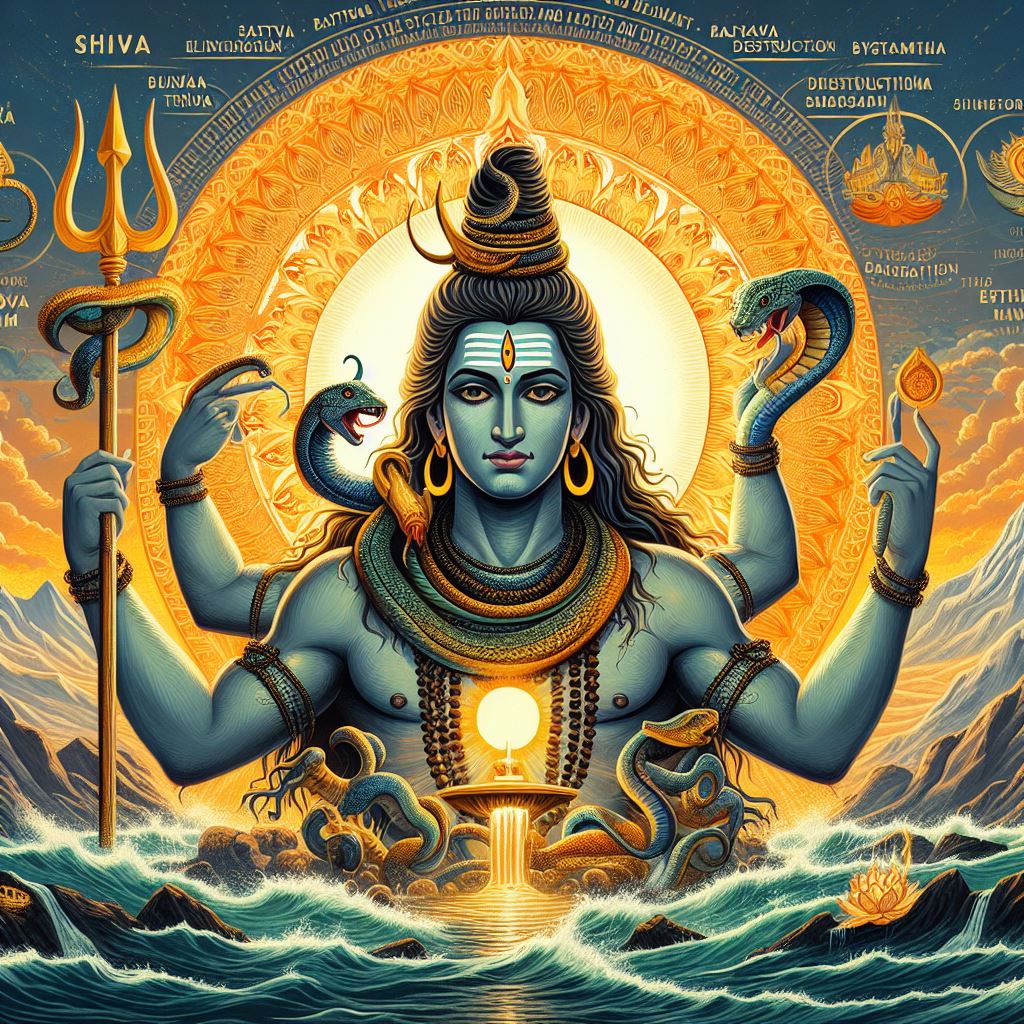
Lord Shiva has a special place in Indian culture and religion. He is not just a deity, but also a lifestyle, a philosophy, and a spiritual guide. Shiva is called Mrityunjaya, which means ‘beyond the last moment’. He is the god of destruction, which is necessary for the creation of the new creation. Surrender to them not only gives us satisfaction in material life but also paves the way for spiritual growth. The idea “Surrender to Shiva, and he will give you everything” is not just a religious statement, but a profound truth of life. Shiva means to join yourself, within your brain, there is a pea-sized pity gland and module whose form is similar to a Shivalinga and the serpent that is wrapped around Shiva is your speech. If you have control over your speech, then it is good, otherwise, it is also like some poison

Meaning of Shiva and His Symbolism:

Shiva means ‘benefactor’. They are Trinetradhars, whose third eye symbolizes knowledge, enlightenment, and destruction. They wear the serpent around their neck, symbolizing the cycle of life and death. Shiva’s damaru depicts the sound of creation and destruction, and the trident symbolizes three gunas – Sattva, Raja, and Tama. The Ganges flowing in their locks teaches us how to calm the difficulties and disturbances of life

Meaning of surrender to Shiva:

Surrendering to Shiva means renouncing one’s ego, selfishness,s and Maya and surrendering oneself to Shiva. This dedication is a symbol of deep faith and faith. When we offer our worries, sorrows, and joys at the feet of Shiva, we attain mental peace and contentment. This dedication helps us understand the truth of our lives and connects us to the true nature of our soul

Result of Dedication:

The most important consequence of surrendering to Shiva is that we go beyond material comforts and attain spiritual satisfaction. True reverence and devotion towards Lord Shiva make us get all the things that are necessary for our life. By the grace of Shiva, we get joy, peace, power, knowledge, and prosperity in life. He takes away all our sufferings and overwhelms us with His divine energy

Story: Shivabhakta Ravana

Ravana, who was a great Shiva devotee, pleased Shiva with his devotion and penance. Ravana performed rigorous penance to please Lord Shiva and eventually Shiva granted him a boon. This story teaches us that if we worship Shiva with a true heart and remain devoted to him, then Shiva fulfills us with all our wishes.

Ways to worship Shiva

1. Meditation and Yoga:

Remembering Shiva through meditation and yoga. It is an important step towards spiritual peace and self-realization.

2. Rudrabhishek:

This is a special puja in which water, milk, curd, ghee, honey, etc. are offered to the Shivalinga. This puja is very dear to Shiva.

3. Mahamrityunjay Mantra:

This mantra is chanted to bring peace, prosperity, and health to life. This mantra is a powerful medium to get the immense grace of Shiva.

4. Keeping your body healthy:

If you are on this earth, it is through your body. If your body system is healthy then Shiva will be happy in himself, you get complete knowledge of living life, it is necessary to understand every aspect of life

Incarnations of Bhagawan Shiva

1. Piplaad:
Helps devotees overcome Shani Dosha.

2. Nandi:
Considered an aspect of Shiva.

3. Veerbhadra:
Destroyed Daksha and his yagna.the fight between ego and real I

4. Bhairav:
Emerged during a fight between Brahma and Vishnu over superiority. Belong to creation and innovation.

5. Ashwatthama:
Born from the poison Shiva consumed during the Samudra Manthan, destined to kill oppressive Kshatriyas.

6. Sharabh:
Part bird and part lion.

7. Grihpati:
Born as the son of the Brahmin Vishwanar.

8. Rishi Durvasha:
Maintains universal discipline.

9. Hanuman:
Aided Shri Rama. This is the incarnation that is dedicated only to the Supreme Mighty Power

10. Brishabh:
Represents righteousness

11. Yatinath:
A peaceful form Journey of the inner soul.

12. Krishna Darshan:
Highlights the significance of religious rituals. Dedicate to love

13. Bhichhuwarya:
Protects all creatures.

14. Sureshwar:
Took the form of Indra to test a devotee.

15. Kiraat:
Tested Arjuna means surrender to Supreme Power.

16. Sunatnartak:
Asked for Parvati’s hand in marriage.

17. Yaksheshwar:
Removed false ego from the gods.

18. Avadhoot:
Crushed Indra’s arrogance. The meaning of surrendering to Lord Shiva is not just limited to religious rituals but it is a way of life, which leads us to freedom and liberation in the true sense. When we dedicate ourselves to Shiva in every aspect of our lives, we attain all the things that bring us perfection and contentment. Surrender to Shiva helps us understand the purpose of our lives and leads us to a deep, meaningful, and prosperous life