A Divine Architectural Metaphor.

Write about a time when you didn’t take action but wish you had. What would you do differently?

The concept of Samayachara worship:


Core Concept:

Samaya chara worship is fundamentally about the fusion of chit Shakti (divine consciousness) with Brahman (ultimate reality).
In this tradition, Shiva and Sridevi are viewed as complementary forces – Shiva as Samaya and Sridevi as Samayaa.

The Five-Fold Unity of Shiva and Shakti

1. Adhishthana Samya (Unity of Abode)

They share the same divine dwelling place or domain.


2. Anushthana Samya (Unity of Action)

Both engage in identical cosmic activities, particularly in the act of creation.


3. Avastha Samya (Unity of State)

They mirror each other in divine states and expressions, such as the dances of Lasya and Tandava.


4. Nama Samya (Unity of Names)

Their names reflect their inherent connection:

– Shiva and Shivaa
– Samaya and Samayaa


5. Rupa Samya (Unity of Form)

They share identical physical characteristics:

– Both have three eyes
– Both are associated with the color red
– Other physical attributes are matched

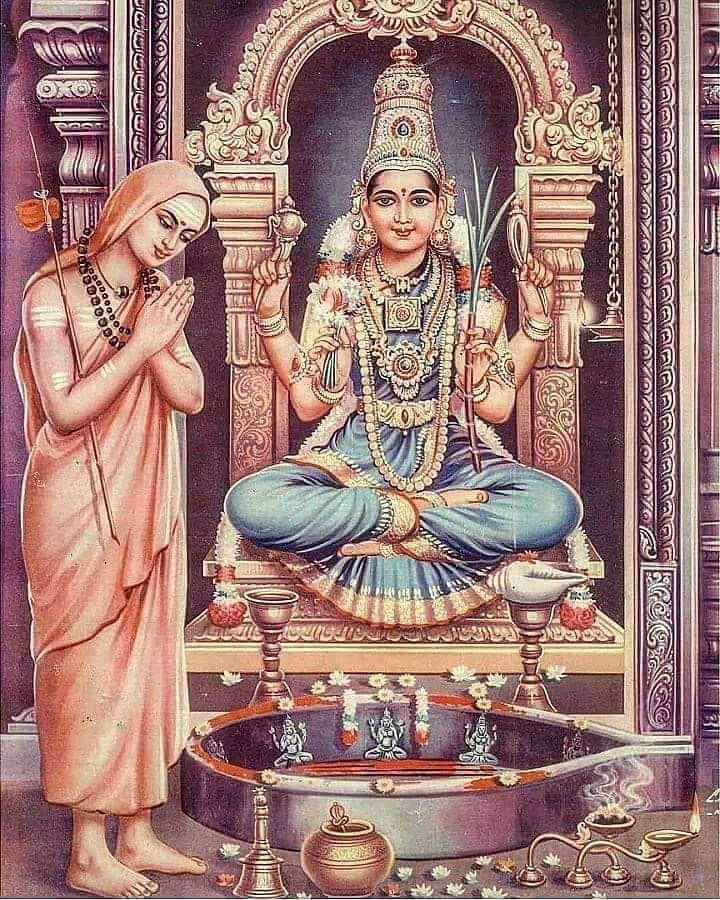
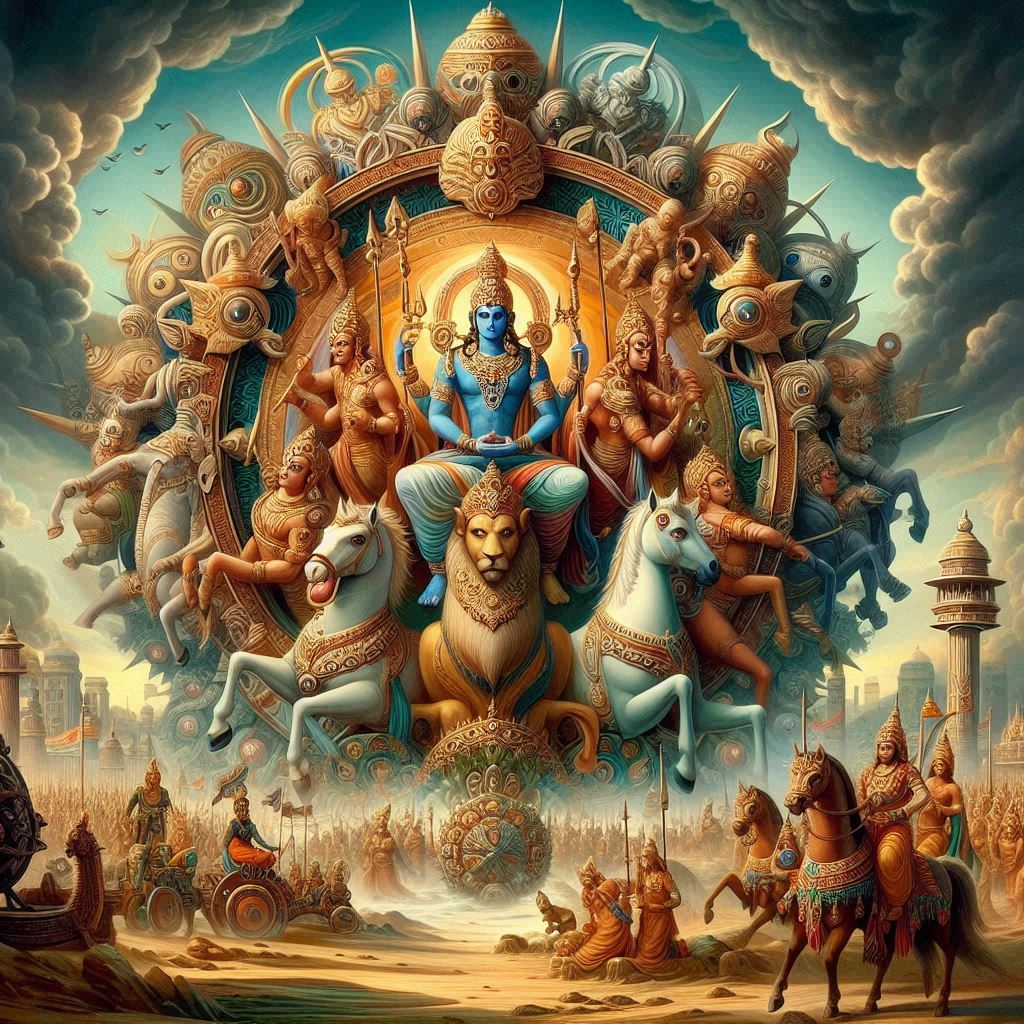
The Sacred Palace of Sricakra: A Divine Architectural Metaphor

In the illustrious city of Sri pattana, a remarkable palace stands, constructed entirely from luminous Cintamani gems. The palace features three distinctive towers named Iccha Sikhara, Kriya Sikhara, and Jnana Sikhara, symbolizing desire, action, and knowledge. With four cardinal doors called Amnaya devas representing the Vedas: Purva, Dakshina, Paschim, and Uttara

The palace embodies sacred geometric precision. At its center, the Bindu Peetha, a powerful seat with four-sided steps, represents multiple divine aspects: Sri Peetha (prosperity), Maha Peetha (greatness), Vidya Peetha (knowledge), and Ananda Peetha (bliss). The entire structure follows the intricate design of Sri chakra, housing all male and female deities of this mystical configuration.

The central cot, resting on four divine legs: Brahma, Vishnu, Mahesana, and Iswara, which is supported by Sadasiva. Leading to this sacred space are 36 steps representing spiritual dimensions, with a foot rest positioned before the cot. A swan like bed adorns the cot, accompanied by two head pillows and one leg pillow, covered by a light red blanket. Upon this sacred throne, Lord Kameswara sits facing east, eternally manifested as a sixteen year old boy with four hands and three eyes, wearing elaborate ceremonial attire. On his lap resides Lalitha Devi, also perpetually sixteen, with a rosy complexion, four hands, and adorned with the moon, her name derived from her ability to please Sadasiva, embodying the principle of divine feminine grace.

A distinct era of cosmic evolution: Mystic of Sanatan knowledge.

Describe a man who has positively impacted your life.

Believe it or not!!!

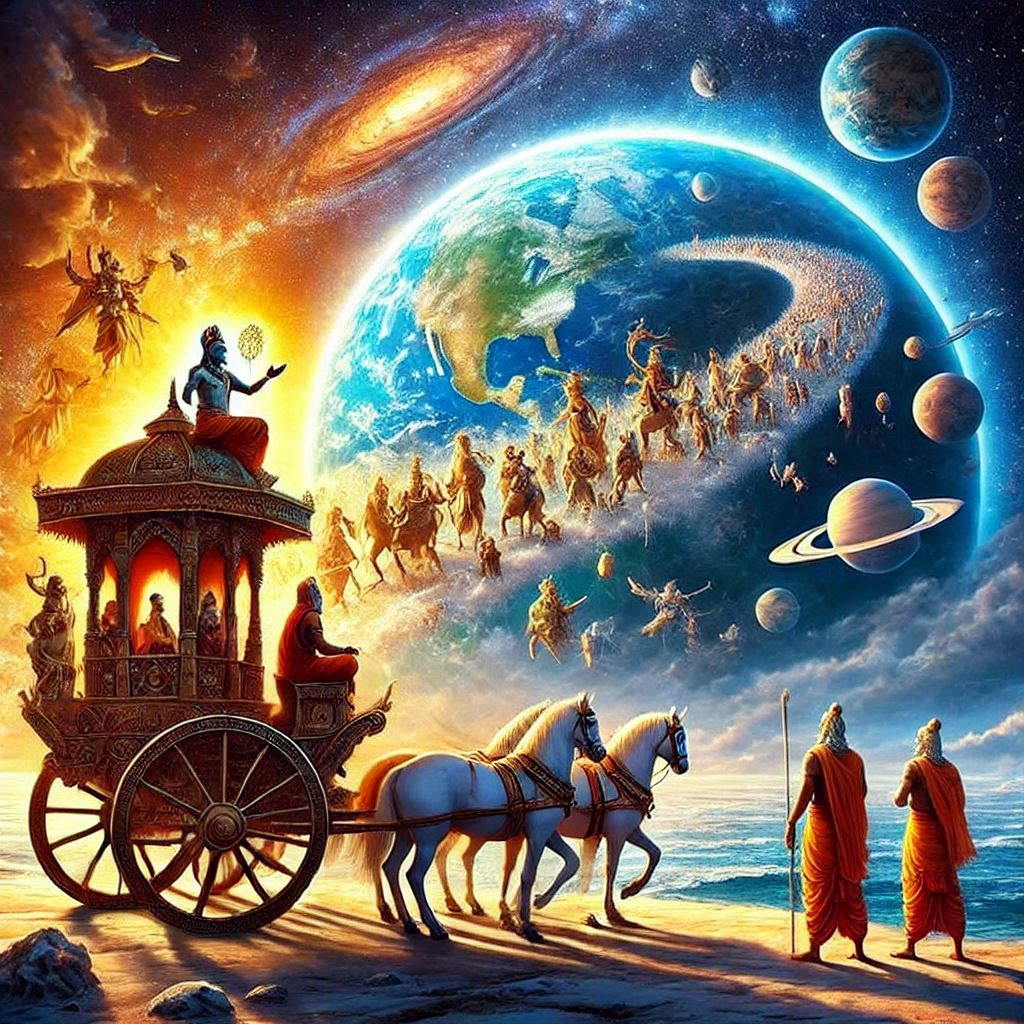
It is described in the Mahabharata that Sanjaya, the charioteer of Dhritarashtra, was bestowed with divine vision so that he could describe the events of the war to him. But, even before the question of war began, Dhritarashtra asked him to describe what the world looked like from space

यथा हि पुरुषः पश्येदादर्शे मुखमात्मनः।

एवं सुदर्शनद्वीपो दृश्यते चन्द्रमण्डले।

द्विरंशे पिप्पलस्तत्र द्विरंशे च शशो महान्।।

Just as a man looks at his face in a mirror, this island (earth) appears in the mainstream. It has two parts of pipal (peepal leaves) and two parts of the great hash (rabbit). Based on this verse, Saint Ramanujacharya made a map, but seeing some leaves and a rabbit, the world made fun of it. Much later, when the picture was turned upside down, reality came out


In the Jai Samhita, geography is described in detail from the 12th verse of the sixth chapter of Bhishma Parva to the 37th verse of the 13th chapter.
Sanjaya says to Dhritarashtra:

सुदर्शनं प्रवाक्ष्यामि द्वीपं ते कुरुनन्दन।

द्विरांशे पिप्पलस्तत्र द्विरांशे च शशो महान्

Inside this circle, two parts of this wheel look like rabbits and two parts look like the leaves of the peepal tree

The Cycle of Creation & Destruction: The Power of 4

1. Satya Yuga:

Good and evil existed in two separate worlds: Devlok and Asurlok.

2. Treta Yuga:

Good and evil lived in the same world, exemplified by Shri Ram and Ravan.

3. Dwapara Yuga:

Good and evil were found within the same families: the Pandavas and Kauravas.

4. Kali Yuga:

Good and evil have become the same person, highlighting the complex nature of morality in this age.


🔸Satya Yuga: The era of purity.

🔸Treta Yuga: The era of righteousness.

🔸Dwapara Yuga: The era of heroism.

🔸Kali Yuga: The era of trials and tribulations.

These cycles shape humanity and the universe, guiding us through the eternal dance of life and time.

The universe will reflect that back to you.

You have three magic genie wishes, what are you asking for?

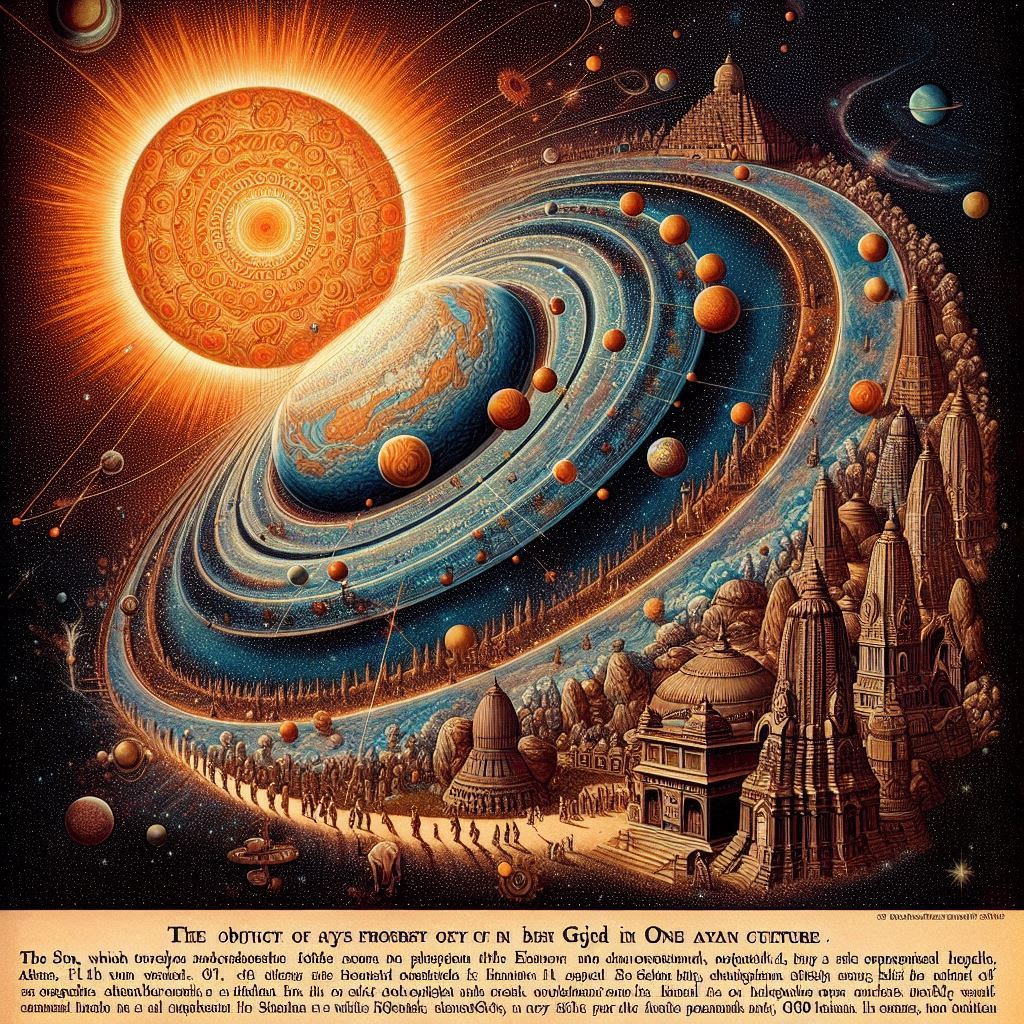
Speed of Sun = 2000 yojanas + 2 kos (Asha yojana) per moment .


The Sun, which travels a distance of nine crores fifty-one lakh yojanas in one Ahoratri at such a rapid speed, is considered to be God in Sanatan culture. No object in this galaxy remains unreasonable; it is the foremost duty of every human being to respect them. One thing is clear from the description so far: the expansion of the solar system is nine crores and fifty-one lakh yojanas, and the orbital path of the earth is also the same. The Earth completes this distance in one Samvatsar, and the Sun completes this distance in one Ahoratra. The speed of the Sun is 20005 Yojanas per moment and the speed of the Earth is 26055 Yojanas per day.

Each body (mah) has two spines… 1 axial spine, and 2 revolution spines.

Each month rotates around its axis and moves bently, walking on a circuitous path. This inclination is considered by modern scientists to be 23 degrees. Just as the Earth has two spines, the Sun has two spines. The Sun rotates on its axis and completes one cycle in one Ahorattra, i.e. 9,51,00,000 yojanas. The Sun moves on its rotational path and revolves around the pole, taking one cycle to complete a cycle. These are the two spines of the Sun. Similarly, Dhruva also has two Meru. All the bodies are comprised of pairs of meru. Thanking these bodies is an important task. 

1.  The backbone that supports the structure of the body. It is also called the spinal cord.

2.  The life cycle of a living entity is also the journey from birth to death. Every living thing, every sun, constellation, star, and moon, is connected by two spines.

It’s a season. Ritaye Namah. Why does the sun move? Why does the earth collapse? Why does it spin? Walking is the sun’s destiny. It is the nature of the earth to revolve. Rotation is the destiny of the planets. The destiny which is narrated through the medium, the same destiny has also tied the planets. Everyone has an activity. They have an impact on mankind. The mood disposition is based on this object

The sun is moving, the earth is moving. They are all God. If the Lord does not act, how can the living entity be engaged in Kriya? Instinct is life. Retirement is death. God is a living being active. Therefore, nature has the status of a mother. Self-actions are religions. Acting according to one’s nature is Swadharma. Nature is pre-attained, from birth, from past birth, from destiny. Disposition cannot be changed. Nature is strong. It is our welfare to do natural actions. There is success in natural actions. Therefore, one should be engaged in natural action.

True infinite

यतः प्रवृत्तिः भूतानां येन सर्वमिदं जगत् ।

स्व कर्मणा तमभ्यर्च्य सिद्धि विन्दति मानव ॥

(गीता १८/४६)

We have our origin from the earth, we have our origin from us. The sun is the earth from the earth, the sun rises from the sky element and the sun is self-evident. Therefore, the sun rotates on its axis and performs its work, and sadhana, the pole traveling in its orbit, worships the sky. The earth worships itself while traveling on its axis and also worships the sun dancing around the sun. We worship ourselves in samadhi (suptatastha) and worship the five bhutas through daily activities. In doing so, the opening of the Surya Siddha, i.e., Anahad Chakra and the flow of infinite love, is a pleasant experience of spiritual life. There is a ritual of sadhana in the root of the earth element, which is the place of Lord Ganesha. Our Lord is the soul (Sun). The Lord of the Sun (Jyoti) is the sky (void. That is why it is said to be ego emptiness. I have very little capacity to put into words this universe and this beautiful Mother Nature.

On reaching the Supreme Stage, the yogi realizes that He is his own God. The goal of everyone’s life is to know oneself and believe in God. The sun is worshipping itself; the earth is doing its sadhana, which is based on tolerance. The creature is meditating. All are self-centered. This self-center is tied to some other center. The second is also tied to a third. Third, there is no end to a fourth, and so on. To make ends meet, we consider someone who is not bound by anyone. Therefore, Shiva is infinite

Sanatan scriptures.

What’s the biggest risk you’d like to take — but haven’t been able to?

Oldest religion texts.

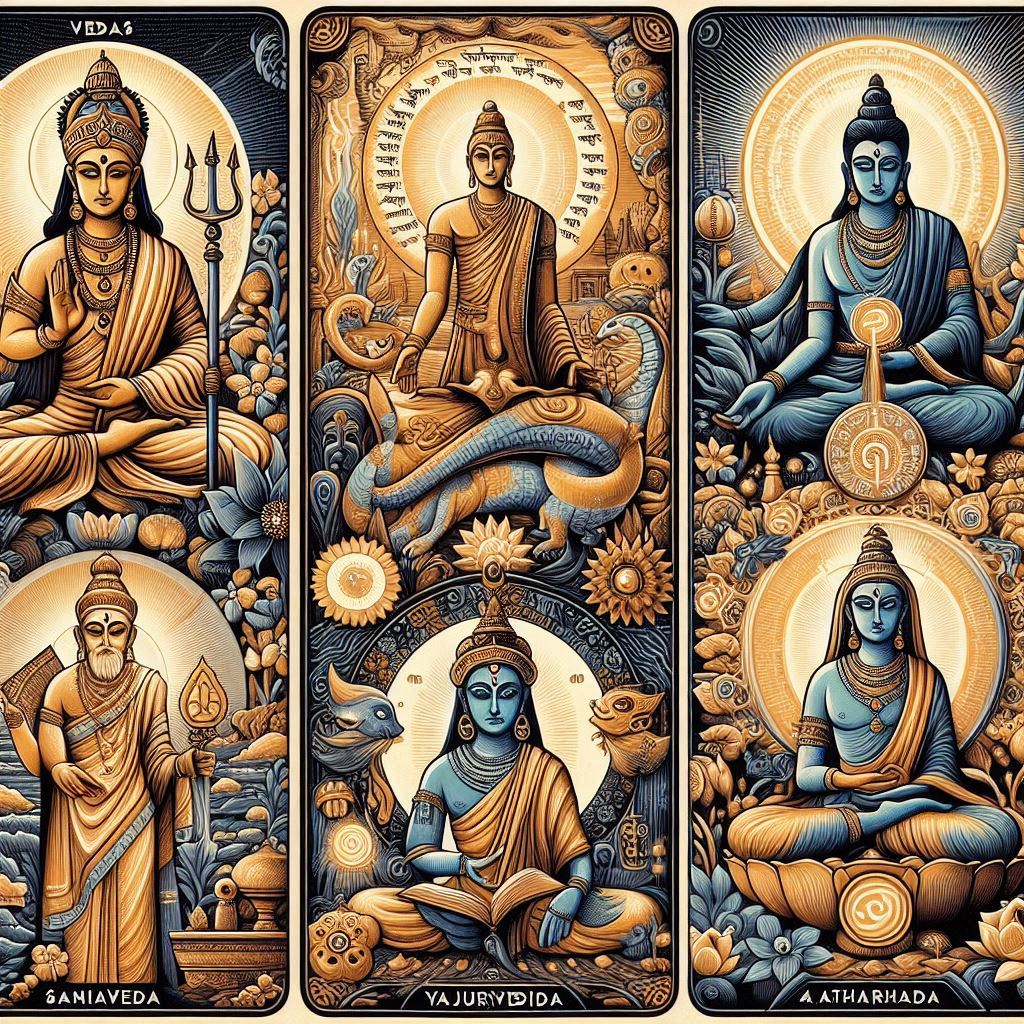
There are four Vedas and 108 Upanishads in Sanatan Dharma. The Vedas are considered to be the oldest religious texts. The four Vedas are as follows:

1. Rigveda

2. Yajurveda

3. Samaveda

4. Atharvaveda

These Vedas, as well as the Upanishads, are considered an important part of the Vedic literature. Profound philosophical and spiritual topics have been discussed in the Upanishads. Vedas and Upanishads are profound and ancient texts of Sanatan Dharma, in which the philosophical and religious principles related to life, universe, and ultimate truth have been described in detail

VEDAS (1,00,000 verses)

Divided & Organized into 4 Vedas by
Krsna Dvaipayana (Vedavyasa)

Whya Vedas .

1. Vedas:

The Vedas are considered as the most ancient and main texts of Sanatan Dharma. The Vedas are considered by the sages as “shruti” (knowledge gained by hearing. These were compiled by Maharishi Ved Vyasa. The purpose of the Vedas is to guide the four major goals of human life (Dharma, Artha, Kama, Moksha. This is Sanatan meaning that which has been going on continuously since time immemorial is in the real form, this is eternal

The four Vedas are as follows:

Rig Veda:

This is the oldest Veda and consists mainly of a compilation of richas (mantras) in the form of praise of the gods. It has around 10,552 mantras, which are used in the worship of various deities, prayers, and yajnas.


🔸Rigveda (21+ Shakhas)

▪️Available 1 Shakha

▪️Lost 20+ Shakhas

▪️Samhita

▪️Brahmana

▪️Aranyaka


Yajurveda:

It describes mantras and methods for sacrifices and rituals. It is divided into two parts: Krishna Yajurveda and Shukla Yajurveda. It mainly deals with ritualistic and ritualistic activities

Yajurveda (101+ Shakhas)

▪️Available 3-4 Shakhas

▪️Lost 97+ Shakhas

▪️Samhita

▪️Brahmana

▪️Aranyaka


Samaveda:

In this Veda, some mantras of Rigveda have been presented in musical form. It is seen by linking it with devotion and music. The mantras of Samaveda are used to accompany music in sacrifices and rituals.

Samaveda (1000+ Shakhas)

▪️Available 3 Shakhas

▪️Lost 997+ Shakhas

▪️Samhita

▪️Brahmana

▪️Aranyaka


Atharvaveda:

This Veda is slightly different from the other three. It describes mantras and methods related to witchcraft, medicine, healing, and social life. There are many mantras in it that throw light on all aspects of a person’s life

Atharvaveda (9+ Shakhas)

▪️Available 2 Shakhas

▪️Lost 7+ Shakhas

▪️Samhita

▪️Brahmana

▪️Aranyaka

The 108 Upanishads:

The Upanishads are called the last part of the Vedas or “Vedanta”. Their purpose is to clarify the search for enlightenment, Brahman, Atma, and the ultimate truth. The Upanishads mainly describe spiritual, philosophical and meditative topics. The doctrines of Vedanta are based on the Upanishads. Although the number of Upanishads is considered to be 108, some of the major and ancient Upanishads are as follows:


1. Total Shakhas: 1180

▪️10-15 Available

▪️Brahmanas

▪️Available 19-20

▪️Lost 1,111+

2. Samhitas :

▪️Available 9-10

▪️Lost 1,121+

3. Upanishads :
▪️Available 108

▪️Lost 1,023+

4. Aranyakas

▪️Available 7

▪️Lost 1,124


1. Ishopanishad:

It mentions the unity of the universe and the soul and considers the impermanence of karma and life.


2. Kathopanishad:

It is based on the dialogue of Yama and Nachiketa, explaining the mysteries of soul, death and salvation.


3. Mandukya Upanishad:

It analyzes the forms of Om and its three sounds. This Upanishad is a major source of Advaita Vedanta.


4. Chandogya Upanishad:

This Upanishad is related to the Samaveda and discusses in detail the Atman, Brahman and the methods of meditation


5. Brihadaranyaka Upanishad:

This is the largest Upanishad and considers the importance of the soul, rebirth, Brahman and knowledge.

Importance of Vedas and Upanishads:

The Vedas and Upanishads are the foundation of Indian religious, philosophical and spiritual traditions. These texts provide guidance on every aspect of human life, such as:

Spirituality:
The ultimate purpose of life is the union of the soul with Brahman (moksha), which is explained in depth in the Upanishads


Religion:
Duties and religious conduct have been described in the Vedas.

Yoga:
The path to purification and salvation of the soul is shown through meditation and yoga.

Karma:
The principle of karma and its consequences have been explained in detail in the Vedas and Upanishads.
Vedas and Upanishads are not only religious texts but also show the philosophical and spiritual path to understand and find solutions to the complexities of human life

Mystery behind MAHABHARATA

What’s something most people don’t know about you?

The Scientific Tradition of Bharat


From the scientific point of view, there has been a tradition of study and research since ancient times in Bharat.

Many Rishis like;
Bhrigu,
Vashistha,
Bharadwaj,
Attri,
Garg,
Shaunak,
Shukra,
Narad,
Chakrayan, Dhundinath, Nandeesh, Kashyap, Agastya, Parshuram, Drona, etc. They spent their entire lives working in different fields. Many different Rishi Maharishis worked in many different fields of aeronautics, astrology, astronomy, chemistry, military science, and all other walks of life.

Brahmastra: The King Of The Astras
V/S Vajra: The Hardest Among All Divine Weapons

First of all, you must know that all our ancient weapons were divided into two categories. According to the Ramayana, Bala Kanda

1. Shastra-

It is a weapon that is handheld or, you can say, a weapon that is used for cutting or wounding, like a sword, lance mace, etc.

2. Astra-

A projectile weapon invoked by reciting hymns like Agneyastra, Pashupatastra, etc. Astra Vidyas were only taught to strict discipline & deserving students, & passed only to the right person. The video was never written down to prevent the misuse of it as they were very powerful.
Among these astras, Brahmastra is considered to be the most powerful astra that has been ever used by anyone. It is the weapon of Bhagawan Brahma, the creator, and like other astras, it is invoked with a special mantra, and then one can use it to destroy anything that is created by Bhagawan Brahma.  The Brahmastra does refer to a special arrow, but an ordinary arrow can also be given the same power using the mantra, and as mentioned in Ramayana, Shree Rama had even used the mantra on blades of grass.
Of the sage Dadhichi. At the request of Bhagawan Shiva, Sage Dhadhichi donated his body. It was originally made for the destruction of the demon Vithrasur.

Bhagawan Vishwakarma had made a weapon with Dadhichi’s bones and Bhagawan Shiva had named the weapon Vajra. Later it was handed over to Bhagawan Indra.

According to Bhagavad Gita 10.28-

आयुधानामहं वज्रं धेनूनामस्मि कामधुक्।
प्जनश्चास्मि कन्दर्पः सर्पाणामस्मि वासुकिः।। 

Here Shri Krishna says to Arjuna that of the weapons, he is the Vajra. So you can imagine the hardness of vajra. 

Properties of the vajra-

Nothing can withstand its splendor, and It shines brightly with the light of a crore of suns, and it resembles the fire that shone at the dissolution of the world. Its fangs extend to a yojana (10 miles) in length, and its tongue, too, is most horrible. It resembles the night of destruction at the end of the world and is covered with 100 knots. Its breadth amounts to five yojanas and its length to 10 yojanas. Its periphery is covered with sharp points; in color, it resembles lightning; a broad, strong handle is fixed to it. Its movements are four in number.

Why Mahabharata???

In Mahabharata, you will only hear the name of the Chakras. But the War of the Mahabharata has a variety of war creations. The side or opposition to fighting the war may be according to your question. The creation of the man means how the troops should be erected in front. It is visible in the sky when it is composed. Like the Eagle’s person, So from the sky, the eagle will appear as a soldier to look at the bird. A waning cycle when seeing chakras from the sky The military creations are visible. Comey knows about certain special creations.


1.  Garuda Singh –

Gauruda You have a picture of a bird. This is the vehicle of the giant bird Lord Vishnu. Soldiers in the war queued up in front of the opposition force this way that is erected by the sky so that the shape of a thundered bird is visible. It is called the Garuda man

In the Mahabharata, it was composed of Bhisham’s grandfather.

2.  The bullying:-

The bullying is a species of the Saras. The issue was the size of a bird. This is the same as the one in the Mahabharata. The creation of the person was by the name.

3.  Tommuch:-

Makar is a charred creature named Capricorn in ancient times. The head of Makar then had horns like crocodiles but goats like goats on the head; The snake was like a body, a fish or peafowl, such as a tail and a panther. Vedic literature is often referred to in the Vedingilla and Capricorn. But possibly The creation of the same means it will not be from Capricorn. Mahabharata was the creation of this issue.

4.  The turtle: The tortoise:-

There is a force in the army. The meaning of Chandra is the same as you understand. Military Creations When it was semi-lunar, it was called a form of circular, pod. Arjun was composed in response to the Garuda
Mandalasa, the meaning of the stratosphere, is a spherical or circular form. The issue was formed in circular form. The aura was made by Bhishya Nathimah in India. The Pandas in response to the Arran It was a distinction of creation of the issue.

5.  Chakras:-

The military making of the chakras is visible as a moving cycle when they see the chakras. It’s a way to look at the wheel in it, But the way out of the exit is not to be noticed. You will see a spiral, just the same way it is.

Creation of this issue in Mahabharata in the cycle:-

After the ruthless killing of Abhimanyu in the Mahabharata war, Arjun was sworn in yesterday. It will be killed before sunset. Then Guru-kānacharya created this issue to save Jayarh. But Lord Krishna He was cleverly removed and struck by the other of him and was killed

Vajra is a kind of weapon It was of two types –

Kulish and Ashani. The three parts above it are made diagonally. The middle part is thin. But it is very weighty. Its shape is like the thunderbolt of Indra Dev. In the Mahabharata, this array was created by Arjuna.

Aurami Array: –

In response to the Vraja Array of Pandavas, Bhishma composed the Aurmi Aryuha. In this array, the whole army was decorated like the sea. Just as waves appear in the sea, the Kaurava army attacked the Pandavas in the same shape. Shringataka Array: Arjuna created the Shringataka Arraya in response to the Aurami array of the Kauravas. This array looked like a building. It is probably called an array with three summits. … Apart from this, mention of the Sarvatobhadra and Suparna Array is also found

Global well- being

What quality do you value most in a friend?

Oh Nature

For the last several years, we have been seeing the heat increasing continuously, this year there is a lot of change in the heat, last year was also hot but this year it has reached 50 degrees in many places in Asia, and the mercury is also around 47 in India’s capital Delhi. Many people are saying that we cut trees due to which we have to see so much heat, we Indians have the habit of blaming everything. But is the temperature increasing due to the cutting of trees? 

Or is it a cycle, in which the role of human beings is very limited? The earth is 450 million years old, it has been 2 lakh years since man came, and it has been 300 years since man planted so-called factories, which is the main cause of global warming. In just 300 years, have we raised the temperature of the earth so much that we will be absorbed in the sea? If so, how many factories would have had to be set up at the end of the last ice age to melt ice? The last ice age came 25000 to 19000 thousand years ago the reason for its end is this cycle, which makes the earth hot or cold, like every 1 lakh years there is some change in the orbital path of the Earth’s Sun, and every 41000 years the axis of the earth tilts from 22.1 degrees to 24.5 degrees,  Apart from this, there are other cycles also. Which affects the winter heat

So planting our trees or not is not going to make any difference in the global warming of the earth, let me tell you a simple figure if you drive 5000 kilometers on a bike per year, then you will have to plant 23 big trees, which will reduce its carbon emission to zero, 70 trees for one AC and 200 trees if you drive a car. This is not possible for all of us, so do not burden yourself with global warming.  Yes, but you can plant trees, even one tree will give shelter to thousands of creatures, and will give shelter to you.

Purify the environment around you, purify your neighborhood, and reduce the temperature there, it does not affect global warming. Anyway, man has not advanced so technologically that he can have a huge impact on global warming, but, certainly, we will one day, our greed is only drying up the rivers and ponds, tomorrow when we dry up the oceans, then it will happen, now we have been able to dig only a few kilometers below the earth.  When we dig and reach the core of the earth, we will destroy it completely. Until then, stop worrying about global warming and enjoy eating fruits in the shade of the tree. Because the people who give us knowledge on global warming go in private jets and yachts and you cannot imagine how many millions of trees are cut in their greed, while the entire forest cannot compensate for the carbon emissions of their one journey

The limitations believe

Belonging to oneself means anchoring one’s identity and self-worth internally rather than externally. It involves understanding that your value is inherent and not contingent on others’ opinions, societal norms, or external achievements. This form of belonging is an intimate knowledge and acceptance of who you are, with all your strengths and flaws.

The Challenge of External Validation

In today’s interconnected world, where social media and societal expectations can heavily influence our sense of self, the pull towards external validation is strong. People often seek approval, love, and acceptance from others, using these external sources as mirrors to reflect their worth. While human connections are vital, an overreliance on them can lead to a fragile self-esteem that is easily shaken by criticism or rejection.


1. Self-Awareness:

Deeply understanding your thoughts, emotions, and motivations. This awareness helps you recognize patterns and triggers that lead to seeking external validation.

2. Self-Acceptance:

Embracing all aspects of yourself, including those you might perceive as negative. Self-acceptance fosters a stable foundation of self-worth that doesn’t waver with external circumstances.

3. Self-Compassion:

Treating yourself with the same kindness and understanding you would offer a friend. This practice helps mitigate self-criticism and promotes inner peace.

4. Authenticity:

Living in alignment with your true self, values, and beliefs. Authenticity requires courage, especially when it means diverging from societal expectations or risking disapproval from others.

When you belong to yourself, you cultivate a sense of inner peace and resilience. This self-belonging provides a stable foundation from which you can navigate life’s challenges and relationships. It allows you to engage with others from a place of wholeness rather than neediness, leading to healthier and more fulfilling connections.

Practice of positive


Mindfulness and Meditation:

These practices can help you connect with your inner self and develop a deeper understanding and acceptance of your thoughts and feelings.

Own golden Book

Writing about your experiences, thoughts, and emotions can provide clarity and insight into your inner world.

Therapy or Coaching:

Professional guidance can support your journey of self-discovery and self-acceptance.

The serious lines:

Learning to say no and setting healthy boundaries protects your sense of self from being overly influenced or drained by others. In a world where finding home in others is often emphasized, the art of belonging to oneself stands as a vital counterbalance. It is an empowering journey that nurtures inner strength and authenticity, allowing you to live a life that is true to your essence. By mastering this art, you create a personal sanctuary of self-acceptance and love, from which all other relationships can flourish healthily and meaningfully.

Peaceful perspective: mindfulness for health.

What jobs have you had?

Food is not life

The most important thing that nature has put in the inner mind of all organisms is survival, meaning the first goal of all organisms is to survive, so we do everything necessary to survive and advance our consciousness with the subconscious mind, and when we do this work, a chemical is released in our brain which is called dopamine and this gives us happiness Is. Meaning Mother Nature has arranged that in whatever work we fulfill our minimum goal, we feel happy. Such as good food, music, etc.
Then the natural question arises that then why do we like such food which is more junk and unhealthy because it makes us sick, so it should not be natural

But no matter how hard we try, we plan the diet, and in the end, the mind keeps running behind the test. The reason for this is also our survival instinct because no matter how much material progress we have made, we are primitive humans who live in caves.
At that time after getting food, there was no guarantee of getting food the next time, and once the food came in front of him, he was forced to eat more and more because who does not know whether he could not get such food tomorrow or not and had to be hungry for many days, and at such times fat is most important because it keeps us alive in the lack of food. We also like sugar more for this reason because it gives us the energy to work immediately.
You can see the small child for this, how much trouble it is to feed him vegetables or something good, the same chocolate, candy, or junk food he likes the first time

But there is also a reason for this because you see that there is a war going on between Ukraine and Russia, there is a war against Israel and Palestine, and the availability of food has decreased due to the horrors of the war, no matter how much progress we have made, but only one bad event can take us back to the primitive age. And long lines for food and starvation can be forced to see the horrors of death.
So no matter how much progress we make materially, it is in our inner mind that if we do not get this food tomorrow, then eat it today, and all our diet plans become zero But what should we do now, and how to convince ourselves that now the quantity of food is available in abundance and we will not die of hunger.
For that, we have to raise our level a little which separates us from other animals, we have to convince ourselves that we have not come to this earth just to survive, our goal is very big. One way for this is Patanjali’s Yoga Sutra, which tells us that we can attain Godhood from the human body, and by moving on different levels, we can move out of the vicious cycle of survival and move forward on the path of self-welfare.

When we do pranayama and meditation, our consciousness gradually rises, then the system of the mind changes, and the pleasure that comes from good food or sex is automatically achieved manifold. Then external things do not affect it, that is why fasting, etc. was included in our traditions. So that we prepare ourselves slowly. If you consume the green leaves of peepal yourself in this series, then in a few days, as a result, the flow of electrical signals in your brain changes slightly, if you continue to progress in this way, then karmic bonds can also end, it supplies oxygen to the body It is not that one should meditate only for the attainment of God, it can also benefit in maintaining our diet plan, this is one of its many benefits. It is our journey from animality to humanity and tells us that our goal is not just to survive but to self-welfare, there are many ways to meditate, and you can choose from them according to you.

Bhagvat Gita said :

असंशयं महाबाहो मनो दुर्निग्रहं चलम्।
अभ्यासेन तु कौन्तेय वैराग्येण च गृह्यते।। 35।।

Sri Bhagavan said, “O Mahabaho! Indeed, the mind is fickle and difficult to be subdued, but O Arjuna, the son of Kunti! It is subdued by practice and detachment. So far, our efforts are on the surface and we try to stop the mind directly for not eating food or to leave a habit while the mind is not in your control

First of all, prayer –

1. Praying to God is the easiest and most suitable means, it increases the Sattva quality. The power of prayer is a tool that gives us inner strength.

2. Desi Indian cow should start consuming milk and ghee. This increases the Sattva quality.

3. Apart from this, the use of fruits and satvik food should be increased Whatever mantra you have received from the Guru, you should chant it or chant the name.

4. One should take 8 hours of sleep, but he should not take eight hours from twelve o’clock in the night to 8 in the morning, but try to get up by 6 o’clock, and slowly start getting up in Brahma Mahurat.

5. After that start doing pranayama and meditation, in pranayama, Anulom-Vilom, Bhastrika Pranayama can be done, after that meditation should be done. Start cow service, spend some time in the cowshed.

This will increase your Sattva quality. You can also start activities like donating to the deserving. Gradually, you will be able to balance sattvic qualities with your tamasic and majestic qualities

Create new positive neuro pathways of ancient knowledge.

How do you feel about cold weather?

Gravity in Vaisheshika Sutra

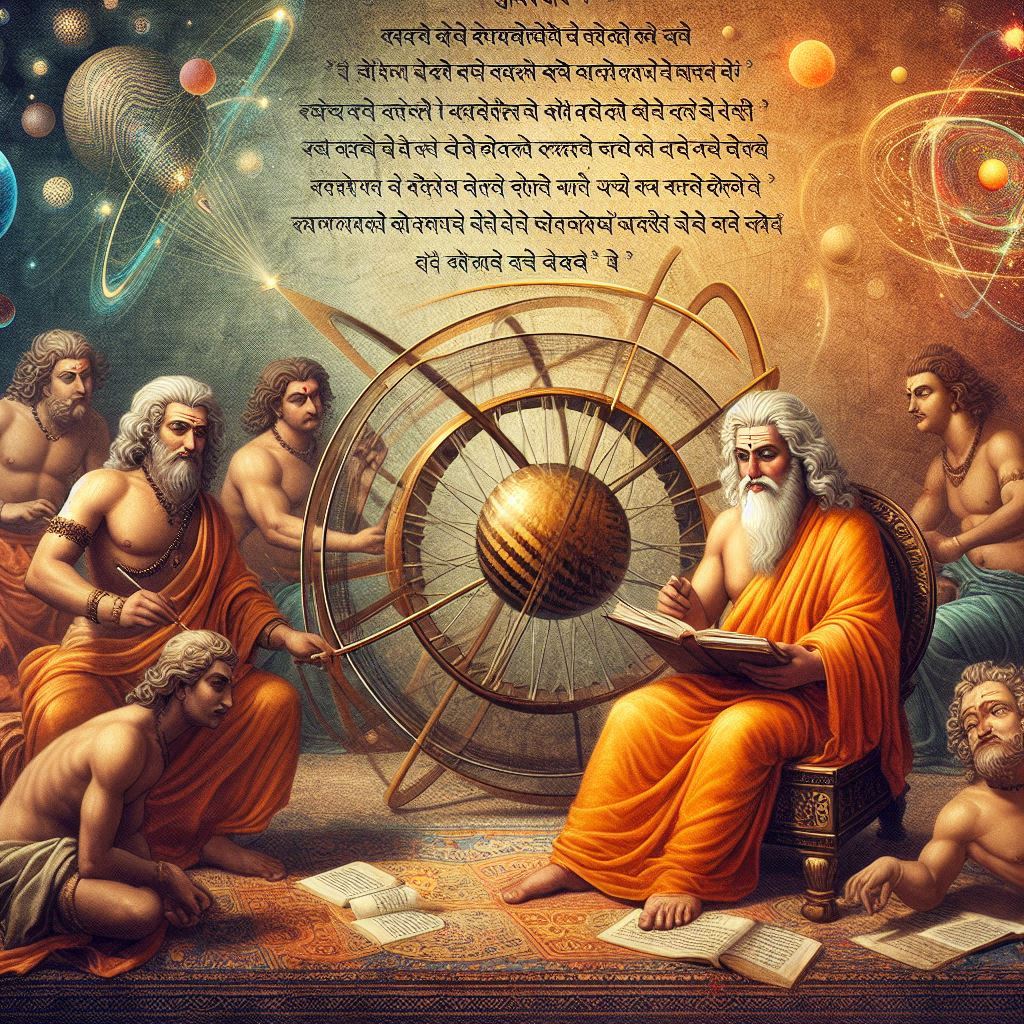
It’s fascinating to explore how ancient Indian philosophies and texts may have addressed concepts akin to modern gravitational theory long before Newton’s time. The Vaisheshika Sutra by Rishi Kanada is particularly intriguing as it predates Newton by over two millennia and contains verses that seem to describe gravitational principles.

1. The Nature of Objects Falling to the Earth:

The Vaisheshika Sutra mentions that objects tend to fall towards the earth due to an inherent property or force. This aligns with the idea that there is an attractive force between the earth and other objects, which we now identify as gravity. This recognition of a force causing objects to fall to the ground is a fundamental aspect of gravitational theory.

2. The Stability and Movement of Celestial Bodies:

The sutras also discuss how the stability and movement of celestial bodies are influenced by this attractive force. This can be seen as an early conceptualization of how gravity governs the motion of planets and other celestial entities, akin to the principles described by Kepler and Newton.

Verse 5.1.7:
Discusses how substances move downward due to an inherent force.

Verse 5.2.4:
Addresses the concept of attraction between substances, hinting at a force akin to gravity.

Interpretation and Comparison:

While these ancient texts don’t provide the mathematical formulations that Newton did, they demonstrate a conceptual understanding of gravity’s effects. This understanding is significant, showing that the idea of gravity as an attractive force was observed and noted by ancient Indian philosophers. In ancient Indian philosophy, the idea of “Gurutva Aakarshana Shakti” captures the essence of gravitational pull. The term “Gurutva” (mass) and “Aakarshana” (attractive pull) together indicate an awareness of the relationship between mass and the force it exerts, reflecting a sophisticated understanding of natural forces.

The exploration of gravitational concepts in ancient Indian texts like the Vaisheshika Sutra highlights a rich history of scientific thought in India. These early discussions on gravity illustrate how ancient scholars were keen observers of nature and sought to understand the forces governing the physical world. While Newton’s laws provided a detailed mathematical framework for gravity, it is remarkable to recognize that the fundamental ideas about gravitational forces were present in human thought long before his time.

आत्मकर्म हस्तसंयोगाश्च । (V.S. 5.1.6)

The action of the body and its members is also in conjunction with the hand.

संयोगभावे गुरुत्वात्पतनम (V.S. 5.1.7)

In the absence of conjunction falling results from Gravity.

Concept of air fall

नोदनाद्यभिषोः कर्म तत्कर्मकारिताच्च
संस्कारादुत्तरं तथोत्तरमुत्तरं च ।। (V.S 5.1.17)

The first action of arrow is from impulse; the next is resultant energy produced by the first action, and similarly the next next shloka-

संस्काराभावे गुरुत्वात्पतनम (V.S. 5.1.18)

In the absence of resultant/propulsive energy generated by the action, falling results from Gravity.
Rishi Varahamihira who is also supposed to be lived in the 5th century BCE, mentioned the

following shloka in his Surya Sidhanta, 12th chapter 32 shloka-

मध्ये समन्तादण्डस्य भूगोलो व्योम्नि तिष्ठति ।
बिभ्राणः परमां शक्तिं ब्रह्मणो धारणात्मिकाम् ॥

This verse conveys that the spherical Earth remains positioned at the center of the universe in space due to a special kind of energy that prevents it from falling away and helps it remain stable. The term ‘energy’ referred to in the previous shloka was further elaborated by Bhaskaracharya, a mathematician who lived in the 12th century AD. In his book Sidhanta Shiromani, Bhaskaracharya provided an explanation for this energy and named it “gurutvakarshan shakti.”

आकृष्टिशक्तिश्च महि तय यत्।
खष्ठं गुरु स्वभिमुखं स्वशक्त्या ॥
आकृष्यते तत्पततीव भाति।
समेसमन्तात् क्व पतत्वियं खे ॥

This verse explains that the energy present within the Earth is the power of attraction, known as “aakrushti shakti”, (according to the Bhaskaracharya).  Due to this attractive force, the Earth pulls objects towards itself, and this power is inherent and natural to the Earth. As a result of this pull, every object on Earth appears to be falling downward. Bhaskaracharya did not stop there; he concludes the shloka with a question: where can this Earth fall down in space? This passage eloquently captures the profound understanding of gravity and celestial mechanics found in ancient Indian texts. Aryabhatta’s poetic reference in the Gitikapada likens the gravitational pull to the way smaller flowers are drawn towards the center of the Kadamba flower cluster, metaphorically depicting the force that ties everything to the Earth’s center.

Vadic mantra = Attributing stability of celestial body.

The cited Vedic mantras further elaborate on this concept, attributing the stability of celestial bodies and their movements to gravitational forces:

Rigveda 8.12.28 and 8.12.30

यदा ते हर्यता हरी वावृधाते दिवेदिवे।
आदित् ते विश्वा भुवनानि येमिरे ।।

speak of the Sun’s radiant energy causing the planets to move in their orbits and remain stable due to the Sun’s attraction.

हिरण्यपाणि: सविता विचर्षणिरुभे द्यावापृथिवी अन्तरीयते।
अपामीवां बाधते वेति सूर्यमभि कृष्णेन रजसा द्यामृणोति॥

describes the Sun as holding the Earth and other heavenly bodies, preventing collisions through its attractive force.

According to Atharvaveda 4.11.1

अनड्वान् दाधार पृथिवीमुत द्यामनड्वान् दाधारोर्वन्तरिक्षम्।
अनड्वान् दाधार प्रदिश: षडुवीर्रनड्वान् विश्वंभुवनमाविवेश॥

uses the analogy of a bull pulling a cart to illustrate how the Sun controls the movements of planets.

The Taittiriya branch of Krishna Yajurveda

मित्रोदाधार पृथिवीमुतद्याम। मित्रः कृष्टी:।

emphasizes the Sun’s role in holding the Earth in space through its attractive power, with the term “Kristheeh” highlighting this force of attraction. These texts reflect a sophisticated grasp of gravitational principles, recognizing the Sun’s critical role in maintaining cosmic order. This ancient wisdom, although fragmented over time, underscores the depth of scientific thought in early Indian civilization.

The Sanatan mortal for you !!

What sacrifices have you made in life?

In Shri Gita Ji, Lord Krishna has said,

आकिञ्चन्ये न मोक्षोऽस्ति किञ्चन्ये नास्ति बन्धनम्।

किञ्चन्ये चेतरे चैव जन्तुर्ज्ञानेन मुच्यते।।

This verse inspires a person to attain salvation through knowledge. It states that only by attaining knowledge can a person recognize his soul and have the means to attain salvation.  “Nothing is adoptable, and nothing is bondage.” And man can be liberated only by knowledge. That is, he gets true knowledge of the ultimate motion. Only then does that man’s confusion, fear, sleep, and laziness disappear.  This verse stimulates a person to attain salvation through knowledge and shows him the path of liberation from bondage. It states that only by attaining true knowledge can a person recognize his soul and have the means to attain salvation

Knowledge has an important place in the pursuit of the salvation of the soul of a person. It is through knowledge that a person comes to know the ideal of his selfishness and the universal truth. In Indian culture, knowledge is considered the path to salvation, which makes a person feel free from bondage.  Knowledge makes a person introverted, leads him to the truth, and makes him feel his true nature. With the attainment of knowledge, a person feels complete, due to which he gets freedom from worldly bondage and attains the height of self-reliance. Therefore, we should always be engaged in the search for knowledge, because knowledge gives us the feeling of true freedom and leads us towards salvation. Therefore, we have established that Spirituality is Beyond Science which keeps giving you the right knowledge on time

The Concept of Matter: A Create Your Zone


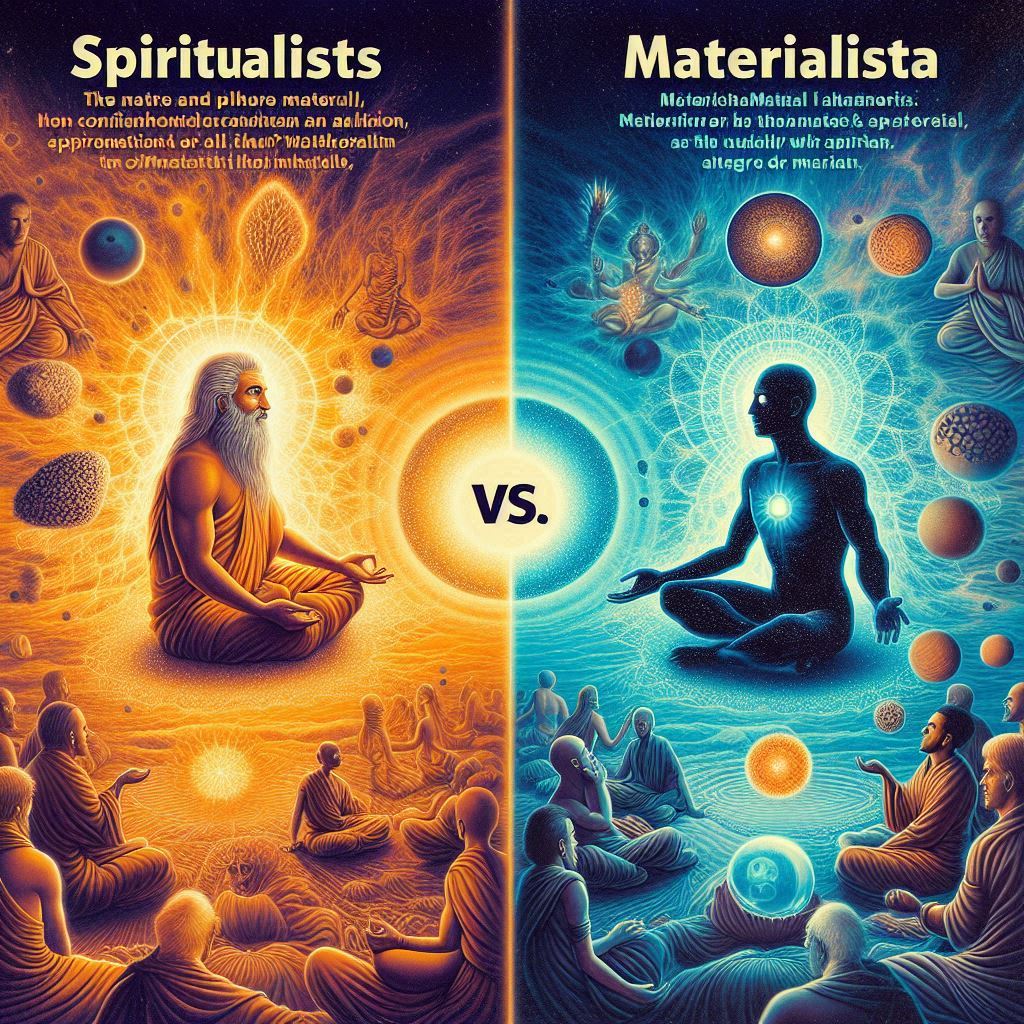
The debate between spiritualists and materialists about the nature and supremacy of matter and Aatma (Energy) is a longstanding one. This discussion intersects with both philosophical and physical perspectives.

1. The Philosophical Divide:
Spiritualists argue that Aatma, or energy, is the true reality, considering matter as an illusion or unreal. On the other hand, materialists assert that matter is the true reality and dismiss Aatma or spiritual energy as unreal.

2. Dynamic Character of Matter:
In the realm of Bhartiya (Indian) thought, some philosophers have postulated that matter is not static but dynamic. This perspective holds that matter possesses the capability to create, sustain, and destroy the universe, a view that aligns with the principles of modern physics.

3. Vaiśeṣika Darshan and Quantum Physics:
The Vaiśeṣika school of philosophy presents a view similar to quantum physics, proposing that the world originated from the combination of atoms, known as Paramāṇukāraṇatāvāda. This contrasts with the Advaita Vedānta belief in Brahmākaraṇatāvāda, which posits Brahman as the ultimate cause.

4. Atomic Combination:
Vaiśeṣika explains that initially, two atoms (paramāṇus) combine to form a dyadic compound (dvyaṇuka). Three dyadic compounds then form a triadic one (trasareṇu), leading to the creation of gross objects. This raises the question: how do unconscious atoms combine without a conscious force?

5. Sānkhya Perspective:
The Sāṁkhya philosophy offers an answer by suggesting that atoms possess intrinsic energy, enabling them to combine. This self-contained energy leads to the natural conjunction and disjunction of atoms, facilitating both creation and dissolution.

In essence, both philosophical and scientific traditions explore the dynamic and self-organizing nature of matter, albeit from different perspectives. This interface between philosophy and physics reveals a profound dialogue on the nature of reality.

Surya Namaskar: The  Consciousness science.

Describe something you learned in high school.

Observation and Learning from Nature:

We are in the midst of a worldwide Yog revolution.  For many, it is about health and well-being but that is only a portal that leads to the understanding of the self and its relationship with the body. Although the roots of Yoga lie in the Vedas, most read Patanjali’s Yog-sutra for a systematic exposition of the nature of the mind. The text is logical and it questions the naive understanding of the world. According to it, there is a single reality and the multiplicity we see in it is a consequence of the projections of our different minds. Therefore to obtain knowledge one must experience reality in its most directness.

Clock of twelve 🕛

Sun is the largest source of energy. For this reason, the ancient sages used to worship the sun. ‘Surya Namaskar’ means bowing to the Sun i.e. Sun Salutation. If you are starting yoga, then the practice of ‘Surya Namaskar’ is the best for this. It gives you the benefit of 12 yoga asanas simultaneously and that is why it is also called the best yoga asana. Yoga, exercise and physical movement are not only important to keep the body healthy but also to keep the mind fit. By practicing the 12 steps of Surya Namaskar every day, the mind becomes active and concentrated.  When should Surya Namaskar be performed Surya Namaskar is best if done at sunrise. This asana should be done on an empty stomach early in the morning while looking at the sun. The reason for this is that along with positive energy, the brightness of the morning sun provides many benefits to health.


Surya Namaskar is made up of 12 yoga asanas

1• Pranamasana

Stand straight facing the sun and join both legs, keeping the waist straight. Now bring the hands near the chest and make a state of bowing by joining both palms.

2. Hasta Uttanasana – (Raised Arms Pose)

Stand in the first position and raise your hands above the head and keep it straight. Now move the hands backwards in the state of bowing and bend the waist backwards.

3. Padahastasana – (Standing Forward Bend)

Now exhale slowly and touch the toes of the feet with hands while bending forward. At this time your head should meet the knees. 

4. Ashwa Sanchalanasana (Equestrian Pose)

Breathe slowly and stretch the straight leg backwards. The knee of the straight leg should meet the ground. Now bend the other leg from the knee and keep the palms straight on the ground. Keep the head towards the sky.

5. Dandasana (Staff Pose)

Now while exhaling, keep both hands and feet in a straight line and come to the position of push-up.

6. Ashtanga Namaskara – Eight Limbed pose or Caterpillar pose

Now while breathing, join your palms, chest, knees and feet to the ground. Stay in this position and hold the breath. 

7. Bhujangasana (Cobra Pose)

Now place the palms on the ground and tilt the head back towards the sky as much as possible while joining the stomach to the ground.

8. Adho Mukha Svanasana – (Downward-facing Dog Pose)

It is also called Parvatasana. For its practice, keep your legs straight on the ground and raise the hip upwards. While exhaling, keep the shoulders straight and the head inwards.

9. Ashwa Sanchalanasana (Equestrian Pose)

Breathe slowly and stretch the straight leg backwards. The knee of the straight leg should meet the ground. Now bend the other leg from the knee and keep the palms straight on the ground. Keep the head towards the sky.

10. Padahastasana – (Hand Under Foot Pose)

Now exhale slowly and touch the toes of the feet with hands while bending forward. At this time your head should be met with the knees

11• Hastuttanasana (Raised Arms Pose)

Stand in the first position and raise your hands above the head and keep it straight. Now move the hands backwards in the state of bowing and bend the waist backwards. During this time you will make the shape of a half moon. This asana is also called Ardhachandrasana.

12. Pranamasana – The Prayer Pose

Stand straight facing the sun and join both legs, keeping the waist straight. Now bring the hands near the chest and make a state of bowing by joining both palms. .

SPIRITUAL RESPONSIBILITY.

The Vedic texts claim to be Atmavidya, “know real I ” or “consciousness science” and they also provide a framework to decode its narrative, establishing its central concern with consciousness.  In the Vedic view, the reality is unitary at the deepest level since otherwise there would be chaos.  Since language is linear, whereas the unfolding of the universe takes place in a multitude of dimensions,  language is limited in its ability to describe reality. Because of this limitation, reality can only be experienced and never described fully. All descriptions of the universe lead to logical paradoxes.

People used nature as a way to find inspiration and establish spiritual connections. The interdependence of all life and the notion that the individual (atman) and the universe (Brahman) are one are central themes in many Bhartiya philosophies.  Agriculture:  In an agrarian society, existence depends on an awareness of the environment. For the community’s sustenance, Gurukuls imparted agricultural skills, such as crop production and the science of seasons.  Observation and Learning from Nature:  Natural phenomena were frequently employed as metaphors and symbols in the teaching of a variety of subjects. It was thought that one of the best ways to teach wisdom was by studying nature