Pay attention to system

Describe a positive thing a family member has done for you.

The atomic habits.

Your results are a measure of your habits. Your earned wealth is a backward measure of your financial habits. Your weight is proof of your eating habits. Your knowledge is a backward example of your learning habits. What you repeat is what you get. Atomic Habits, a successful book by James Clear, is the most comprehensive guide on how to change your habits and get better every day. This brief note based on the book is written in two parts. Part one helps us understand the importance of our habits and why they matter. More importantly, it provides answers to a series of how to Which naturally come in terms of forming good habits and breaking bad habits.  In the second part of the note, six important ideas, concepts, and principles are summarized that will help the reader form the habits he wants

Part One – What?  Why?  How come

Part One – What?  Why?  How come

– What is a habit?
– Why do habits matter?
– How do habits work?
How to start a new habit?
– How to create better habits?
– How to break bad habits?
– How to enjoy habits that are hard?

What is a habit?

Habits + Deliberate Practice = Perfect”


Habits are mental shortcuts. A habit is a routine or behavior that is performed repeatedly and most of the time automatically. When you face a problem repeatedly, your brain starts doing the process of solving it. Your habits are a set of automated solutions that solve the problems you face regularly. The ultimate aim of habits is to solve life’s problems with as little energy and effort as possible. A habit is a behavior that has been repeated enough times to become automatic. If you find yourself struggling to form a good habit or break a bad habit, it’s not because you’ve lost your ability to improve. This is often because you have not yet crossed what James Clear calls the plateau of latent potential.  When you finally break the plateau of latent potential, people will call it an overnight success.  Habits are the compound interest of self-improvement The advantage of habits is that we can do anything without thinking. The downside is that we stop paying attention to small mistakes. Reflection and review is a process that allows you to be mindful of your performance over time.  The more firmly we hold on to an identity, the harder it becomes to move on.

Why do habits matter?

Identification -> processes -> results

Habits form our identity.  Our actions define who we are.  Our habits are a reflection of our identity.  The more we repeat a behavior, the more we strengthen the identity associated with that behavior. 

1. Changes in your results.  This means changing your results, for example, losing weight.

2. Edit your processes.  This means changing your habits and systems: for example, developing a daily exercise routine and diet

3. Change your identity.  It means changing your beliefs: changing the way you see yourself and those around you.  For example, if you exercise regularly, you are reinforcing the identity of someone fit and healthy

With outcome-based habits, the focus is on what you want to achieve.  With identity-based habits, the focus is on who you want to be.  James Clear argues that the best way to change your identity is to focus on changing your habits.  By starting with small, easy habits, we can gradually create a new identity that is more aligned with our goals.  True behavior change is identity change.  You can choose and start a habit because of motivation, but you will stick to it only when it becomes a part of your identity.  The real reason habits matter is not because they can give you better results (although they can), but because they can change your perceptions of you

How do habits work?


Hints -> longing -> feedback -> rewards

The main components of habit formation are:

1. Signal: It prompts your brain to start a behavior.  It’s a little bit of information that predicts the reward.

2. Craving: It is the motivation behind every habit.  Without the will, we have no reason to act.

3. Feedback: It’s the same habit you play;  It can take the form of a thought or action.

4. Reward: The ultimate goal of every habit

Habit formation is the process by which a behavior becomes progressively more automatic through repetition.  How long you’ve been doing a habit isn’t as important as how many times you’ve done it. You can do something three times in thirty days or three hundred times.  Frequency will always make a difference. Habits are attractive when we associate them with positive emotions and unattractive when we associate them with negative emotions

How to start a new habit?

After [current habit], I will take [new habit].’

One of the best ways to create a new habit is to identify the current habit you already do every day and then top your new behavior on top.  This is called habit stacking.  The two most common signs are time and place.  Creating an intention to implement is a strategy you can use to associate a new habit with a specific time and place.  Habit stacking is a strategy you can use to associate a new habit with an existing habit

The formula for adding a habit is:

After [the present habit], I will take [the new habit].’

The environment plays a crucial role in shaping human behavior. By making small changes in the context, significant changes can be observed in behavior over time. The key to creating new habits is to pay attention to the signs in your environment that promote good habits. Gradually, your habits become associated with the entire context, making it easier to form new habits. If you’re trying to change your habits, consistency is key. Taking small steps, even if they aren’t significant, will help you reach your goal eventually. It’s essential to choose small, healthy options that will help you achieve your goals in the long run. Goals are good for setting direction, but systems are best for making progress. Systems focus on the mechanisms that lead to the desired outcomes, making it easier to achieve the desired results.

Surya Namaskar: The  Consciousness science.

Describe something you learned in high school.

Observation and Learning from Nature:

We are in the midst of a worldwide Yog revolution.  For many, it is about health and well-being but that is only a portal that leads to the understanding of the self and its relationship with the body. Although the roots of Yoga lie in the Vedas, most read Patanjali’s Yog-sutra for a systematic exposition of the nature of the mind. The text is logical and it questions the naive understanding of the world. According to it, there is a single reality and the multiplicity we see in it is a consequence of the projections of our different minds. Therefore to obtain knowledge one must experience reality in its most directness.

Clock of twelve 🕛

Sun is the largest source of energy. For this reason, the ancient sages used to worship the sun. ‘Surya Namaskar’ means bowing to the Sun i.e. Sun Salutation. If you are starting yoga, then the practice of ‘Surya Namaskar’ is the best for this. It gives you the benefit of 12 yoga asanas simultaneously and that is why it is also called the best yoga asana. Yoga, exercise and physical movement are not only important to keep the body healthy but also to keep the mind fit. By practicing the 12 steps of Surya Namaskar every day, the mind becomes active and concentrated.  When should Surya Namaskar be performed Surya Namaskar is best if done at sunrise. This asana should be done on an empty stomach early in the morning while looking at the sun. The reason for this is that along with positive energy, the brightness of the morning sun provides many benefits to health.


Surya Namaskar is made up of 12 yoga asanas

1• Pranamasana

Stand straight facing the sun and join both legs, keeping the waist straight. Now bring the hands near the chest and make a state of bowing by joining both palms.

2. Hasta Uttanasana – (Raised Arms Pose)

Stand in the first position and raise your hands above the head and keep it straight. Now move the hands backwards in the state of bowing and bend the waist backwards.

3. Padahastasana – (Standing Forward Bend)

Now exhale slowly and touch the toes of the feet with hands while bending forward. At this time your head should meet the knees. 

4. Ashwa Sanchalanasana (Equestrian Pose)

Breathe slowly and stretch the straight leg backwards. The knee of the straight leg should meet the ground. Now bend the other leg from the knee and keep the palms straight on the ground. Keep the head towards the sky.

5. Dandasana (Staff Pose)

Now while exhaling, keep both hands and feet in a straight line and come to the position of push-up.

6. Ashtanga Namaskara – Eight Limbed pose or Caterpillar pose

Now while breathing, join your palms, chest, knees and feet to the ground. Stay in this position and hold the breath. 

7. Bhujangasana (Cobra Pose)

Now place the palms on the ground and tilt the head back towards the sky as much as possible while joining the stomach to the ground.

8. Adho Mukha Svanasana – (Downward-facing Dog Pose)

It is also called Parvatasana. For its practice, keep your legs straight on the ground and raise the hip upwards. While exhaling, keep the shoulders straight and the head inwards.

9. Ashwa Sanchalanasana (Equestrian Pose)

Breathe slowly and stretch the straight leg backwards. The knee of the straight leg should meet the ground. Now bend the other leg from the knee and keep the palms straight on the ground. Keep the head towards the sky.

10. Padahastasana – (Hand Under Foot Pose)

Now exhale slowly and touch the toes of the feet with hands while bending forward. At this time your head should be met with the knees

11• Hastuttanasana (Raised Arms Pose)

Stand in the first position and raise your hands above the head and keep it straight. Now move the hands backwards in the state of bowing and bend the waist backwards. During this time you will make the shape of a half moon. This asana is also called Ardhachandrasana.

12. Pranamasana – The Prayer Pose

Stand straight facing the sun and join both legs, keeping the waist straight. Now bring the hands near the chest and make a state of bowing by joining both palms. .

SPIRITUAL RESPONSIBILITY.

The Vedic texts claim to be Atmavidya, “know real I ” or “consciousness science” and they also provide a framework to decode its narrative, establishing its central concern with consciousness.  In the Vedic view, the reality is unitary at the deepest level since otherwise there would be chaos.  Since language is linear, whereas the unfolding of the universe takes place in a multitude of dimensions,  language is limited in its ability to describe reality. Because of this limitation, reality can only be experienced and never described fully. All descriptions of the universe lead to logical paradoxes.

People used nature as a way to find inspiration and establish spiritual connections. The interdependence of all life and the notion that the individual (atman) and the universe (Brahman) are one are central themes in many Bhartiya philosophies.  Agriculture:  In an agrarian society, existence depends on an awareness of the environment. For the community’s sustenance, Gurukuls imparted agricultural skills, such as crop production and the science of seasons.  Observation and Learning from Nature:  Natural phenomena were frequently employed as metaphors and symbols in the teaching of a variety of subjects. It was thought that one of the best ways to teach wisdom was by studying nature

Ramayana: The cosmos and the connectome.

What book could you read over and over again?

Ram – Ram – Ram

2 × becomes 5 × 2 × 5 × 2 × 5 = 1000.

By reading Ramayana with a true heart, the right path of life starts appearing
Life, definitions, beliefs, circumstances, everything changes according to time. If nothing changes, then the values of life, values and the struggle of life on earth as a human being make an identity of its own. It is this struggle that tests man’s patience, his honesty, his truthfulness and the relationships around him. There are hard times where life seems only dark One has to choose, pause and think and act with restraint.
If a person has knowledge of Ramayana then everything is easy. If you ever read it, every problem will seem small. There is a solution to every problem in life, just take the time to read it sometime. If you have not been able to read till date, then try to read it now. To inspire our future generation to read Ramayana. Friends, family, relatives, explaining to everyone that Ramayana has the ability to get out of all the situations of the world. I am writing this because this is the need of the hour, 80% of the total population of this earth is immersed in despair, living life as a burden In Ramayana, there is a story of God himself incarnating on earth in human form. And every moment of his entire life teaches so much to a human being that, the more difficult this short life journey seems, the easier it will become. There is a story of Lord Rama in Ramayana. The story of his brothers’ dedication. It is the story of Shri Ram’s dignity and sacrifice. Their mother’s long wait and dignity for her children is presented. It is a story about thinking of words or words as bigger than your soul.  There is a story of smiling even in Virah. The story of the end of evil and the king who lived the life of a saint. Only by reading Ramayana, man starts seeing all the paths of life.Ramayana is the essence of life.
Ramayana is the basis of life.


In recent years, several highly respected theoretical physicists and scientists from various fields have published papers, articles, and books…
these works have provided compelling technical and mathematical arguments that suggest the Universe is not just a computational or information-processing system, but a self-organizing system that evolves and learns in ways that are strikingly similar to biological systems. For example, scientists have recently emphasized that the physical organization of the Universe mirrors the structure of a brain.

One chant of Rama name is similar to chanting the entire Vishnu Sahasranama (1000 names of Vishnu) and if you say three times Ram-Rama-Rama – it is equivalent to saying 3 x 1000 Lord Shri Vishnu’s name (Vishnu Sahasra Namam) – Oh Parvati you will get more benefit than those Brahmins who chant Vishnu Sahasra Naam daily

According to Sanskrit texts there is a theory in which sounds and letters are linked to their corresponding numbers. According to

“RA” denotes the number 2
(YA – 1, Ra – 2, LA – 3, VA- 4 )

“Ma” represents the number 5
(PA – 1, FA – 2, BA- 3, BHA  – 4, MA- 5)

Thus-
Ram – Ram – Ram
2 × becomes 5 × 2 × 5 × 2 × 5 = 1000.

The glory of Shri Ram’s name has been sung throughout the scriptures, there is a verse in the Padma Purana

जप्तः सर्वमंत्रांश्च सर्ववेदांश्च पार्वती।

तस्मात् कोटिगुणं पुण्यं रामनामनैव लभ्यते ॥

(श्री पद्म पुराण, उत्तर खंड 281.34-35)

There is no doubt that the power that belongs to God is greater than that of the name of God. The waves of chanting the name go deep into our inner being. With this, the mind and soul become pure, power and power start to burn, the intellect starts developing, all sins are destroyed, the desired results are obtained, all sufferings are removed, troubles are eradicated, liberation is achieved, God-realization, fear is removed, but all that is needed is to take the name of God with a sincere heart and a pure mind

Hanuman Chalisa teaches to control the mind and soul’

Who is the most confident person you know?

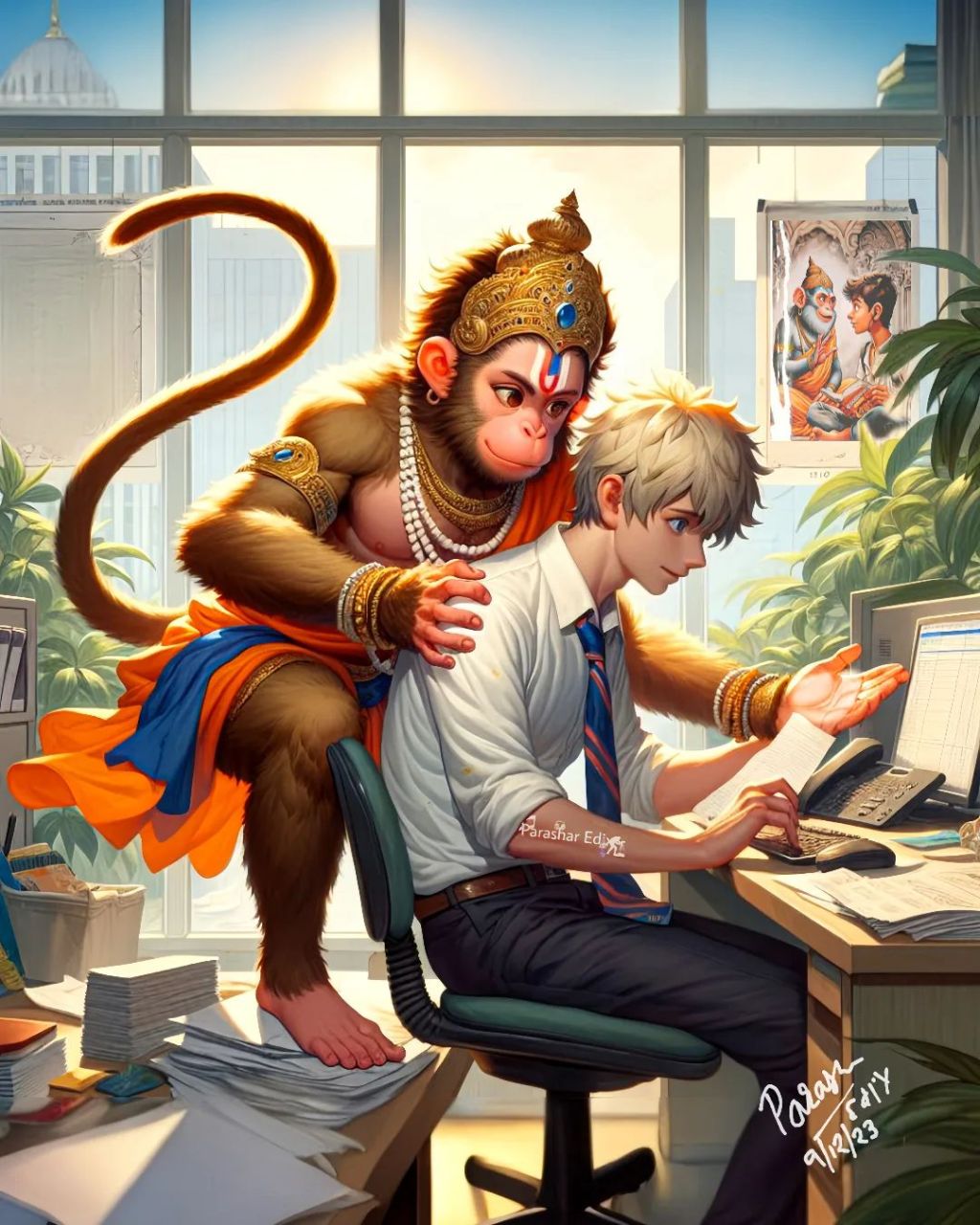
Lord Hanuman ji

Our daily routine starts with reading Shri Hanuman Chalisa. But do you know that there are 40 chaupaiyas in Shri Hanuman Chalisa, they are written in the order which is the order of life of a normal human being. The sequence begins with thoughts. Your whole life is based on your thoughts, so life should be lived in a proper way

Maharishi Tulsi Das Ji started attaining Lord Shri Ram Ji by making Mahabali Shri Hanuman Ji his Guru. If you are just reading Hanuman Chalisa, then it is giving you inner strength, but if you understand the threads of life hidden in its meaning, then you can achieve success in every field of life. Shri Hanuman Chalisa is the first Chalisa written in the Sanatan tradition, all the remaining Chalisa were written only after this. There are many formulas of success of Shri Hanuman Chalisa from beginning to end. Let’s know what changes you can bring in your life with Hanuman Chalisa. First of all, you have to accept the change in life, the most powerful energy you have to surrender


श्रीगुरु चरन सरोज रज,
निज मनु मुकुरु सुधारि।

I cleanse the mirror of my mind from my Guru’s blessing. The importance of the Guru is written in the first line of the first couplet of the Chalisa. If you don’t have a guru in life, no one can take you forward. Only the Guru can show you the right path.
That is why Tulsidas has written that I clean the mirror of the mind from the dust of the Guru’s feet. In today’s era, the Guru can be our advisor as well as an officer. Parents are called the first gurus.  The thing to understand is that it is important to respect the guru, that is, the elders than you. If you want to move forward on the path of progress, then respect elders with humility.


कंचन बरन बिराज सुबेसा,
कानन कुंडल कुंचित केसा।

Your body color is bright like gold, dressed well, your ears are coiled and your hair is groomed. In today’s era, your progress also depends on how you live and look. The first impression should be good.  If you are very talented but do not live well, then this thing can affect your career. Therefore, always keep good living and costumes


बिद्यावान गुनी अति चातुर,
राम काज करिबे को आतुर।

You are knowledgeable, a mine of virtues, you are also clever. They are always eager to do Rama’s work.
It is very important to have a good degree in today’s era. But Chalisa says that just having a degree will not make you successful. Along with acquiring knowledge, you will also have to increase your qualities and bring cleverness to the intellect. Hanuman has all three qualities, he is a disciple of Surya, virtuous and clever


प्रभु चरित सुनिबे को रसिया,
राम लखन सीता मन बसिया।

Whatever your priority, which is your work, you should not only be interested in speaking about it but also in listening.  It is very important to be a good listener. If you don’t have the skill of listening, you can never be a good leader


सूक्ष्म रुप धरि सियहिं दिखावा,
बिकट रुप धरि लंक जरावा।

Where, how to behave yourself in what situation, this art can be learned from Hanumanji.
When Sita met in the Ashoka Vatika, he met her in the shape of a small monkey, while when Lanka lit, he took the form of a mountain.
Often people are not able to decide how they want to look in front of whom.

तुम्हरो मंत्र बिभीसन माना,
लंकेस्वर भए सब जग जाना।

Understanding whom, where, and what advice to give is very essential. Advice given to the right person at the right time does not only benefit him but also benefits you somewhere.


There is no doubt that the power that belongs to God is greater than that of the name of God. The waves of chanting the name go deep into our inner being. With this, the mind and soul become pure, power and power start to burn, the intellect starts developing, all sins are destroyed, the desired results are obtained, all sufferings are removed, troubles are eradicated, liberation is achieved, God-realization, fear is removed, but all that is needed is to take the name of God with a sincere heart and a pure mind. Hanuman Chalisa teaches that the mind is the doer and the mind is the consumer. The vibrations generated in the mind are created only because of our karma. Nowadays, the root of all problems in a very busy, very modern, and lonely life is the disturbance of the mind. Nowadays such diseases have arisen that the body is not detected in the examination. All these are due to the mind, so it is necessary to provide positive energy to the mind. The practice of Hanuman Chalisa connects this divine energy to our consciousness and when this power flows in the mind, the flow of many thoughts stops in it. The mind wanders in the astral world, due to which it finds a way to attain the original purpose of life. This is the path to Self-realization, and through continuous spiritual practice he finally becomes one with the Supreme Consciousness

The answer NO

Are you superstitious?

What happens after the death of a person,

Bhagvad geeta, chapter 8, verse 16 –

आब्रह्मभुवनाल्लोकाः पुनरावर्तिनोऽर्जुन |
मामुपेत्य तु कौन्तेय पुनर्जन्म न विद्यते ||

Meaning- इस जगत् में सर्वोच्च लोक से लेकर निम्नतम सारे लोक दुखों के घर हैं, जहाँ जन्म तथा मरण का चक्कर लगा रहता है | किन्तु हे कुन्तीपुत्र! जो मेरे धाम को प्राप्त कर लेता है, वह फिर कभी जन्म नहीं लेता.

Purpose of Reincarnation:

According to Sanatan, the purpose of reincarnation is to provide opportunities for the atman to learn, grow, and evolve spiritually. Each life offers valuable lessons and challenges that help the soul progress toward self-realization and attaining Moksha. Samsara (संसार) is the process of passing one body to another throughout all species of life. Consciousness pervades all living beings, but it is only in human form that its active utilization is possible. Samsara, in essence, represents a transitory existence marked by impermanence, change, and the repetitive process of reincarnation or rebirth. It encompasses the complete sequence of earthly lives experienced by the atman. It is well-known that the atman is entrapped within the continuous “cycle” of life and death. Infinitely, the atman transcends from one embodiment to another, embodying the fundamental concept of saṃsara or reincarnation. According to Hinduism and Sanatan, the belief in the cycle of birth, death, and rebirth is known as reincarnation. Upon the death of the physical body, the individual’s soul, known as the atman, is believed to detach from the body and enter a new one.


The specific body the atman enters is believed to depend on various factors, including:

State of mind at the time of death: It is believed that the state of mind at the moment of death can influence the future birth. For example, a person who dies with a peaceful and virtuous state of mind may be reborn into a more favorable situation, while someone who dies with a disturbed or negative state of mind may experience a less desirable rebirth.

Unfulfilled desires :

Hinduism teaches that unfulfilled desires can carry over from one life to another. If a person has strong attachments or unfulfilled desires, it may impact their next birth. The nature of these desires can influence the circumstances and experiences in the subsequent life.

Karmic record :

Karma, the law of cause and effect, plays a crucial role in determining one’s future birth. The actions, intentions, and deeds performed in previous lives contribute to an individual’s karmic record. Positive actions and intentions lead to positive karma, while negative actions and intentions result in negative karma. The accumulated karma influences the circumstances and conditions of the next incarnation.

As per Shrimad Bhagavatam 7.2.41 :

“With time, every being receives a material body as per his corresponding actions.” There may be a question regarding whether the aatma immediately takes on a new body after death.
If a person dies an unnatural death, such as suicide or an accident, or has unfulfilled desires, it is believed that their atman may experience a different state or dimension known as loka, before reincarnation. The term “Pret Aatma” is often used to refer to the soul in such a state. It is believed that until the unfulfilled desires are resolved or the necessary conditions are met, the atman may not proceed to its next birth.

According to Shree Garud Puran 2.22.8

“One who dies by hanging, also through poison and weapon, one who commits suicide and also dies by cholera, etc. becomes a pret (ghost).” On the other hand, if a person dies a natural death with no unfulfilled desires, and if that individual does not attain moksha (liberation) for some reason (will explain when I will write on moksha), it is generally believed that their atman will go through the cycle of reincarnation. The reincarnation will be based on the karma of the person. Depending on the karma, an atman can take any of the following six forms of life-

◆ Aquatics:

This category includes beings that reside in water, such as fish, aquatic mammals, and other marine creatures.

◆ Reptiles and Insects:

This category comprises reptiles, insects, and other small crawling creatures.

Human:

Human life is considered the most privileged and valuable form of life in Hinduism. It is believed to provide the greatest potential for spiritual growth and realization.


Bhagavad Gita chapter 2, verse 27-

जातस्य हि ध्रुवो मृत्युर्ध्रुवं जन्म मृतस्य च |
तस्मादपरिहार्येऽर्थे न त्वं शोचितुमर्हसि ||

जिसने जन्म लिया है उसकी मृत्यु निश्चित है और मृत्यु के पश्चात् पुनर्जन्म भी निश्चित है | अतः अपने अपरिहार्य कर्तव्यपालन में तुम्हें शोक नहीं करना चाहिए


Samsara is a painful recurring cycle of-

Birth—> death’

disease—>old age—>

death—>Re-birth.

In Sanatan, the concept of heaven and hell is not seen as permanent destinations but rather as temporary realms of existence. The ultimate goal in Sanatan is to attain moksha, liberation from the cycle of birth and death.  Unlike Hinduism and Sanatan, religions like Islam and Christianity do not emphasize the belief in reincarnation. They generally teach that individuals have only one life on Earth, and after death, the soul is believed to go to either heaven or hell based on their actions and beliefs during their earthly life. Heaven is seen as a place of eternal bliss and closeness to God, while hell is viewed as a realm of eternal punishment.

Vocalization + Intention = Healing.

What are three objects you couldn’t live without?

Knowledge and you??

Knowledge is everywhere, in many forms, manifesting itself in the diverse nature of action. Nature presides over knowledge through its ingredients. The sages have presented knowledge in formulaic form, in figurative language, and in code style. How do we receive it? It is up to us. How capable is our intellect to absorb this knowledge, how effective is our education? This is how we know our abilities. Pure knowledge is Brahman in itself. Knowledge is not the monopoly of any one organism. Knowledge is for everyone. Knowledge is only in the possession of Brahma and Saraswati, the institutions of knowledge. The supreme god of knowledge is Shiva. All knowledge is contained in it. Knowledge is not ours. It is of nature. By the grace of nature, we become the possessors of it. It is necessary to thank Mother Nature, the giver of knowledge. Who are we to give knowledge? Nature gives knowledge to all of us through us. The more our receptive power, the more knowledge we receive and retain


1. Cutting off the tongue and offering it to the deity = that is, no wrong words come out of the mouth. Worshiping the Ishta by observing silence or expelling the tongue, doing penance.

2. Cutting off the head and offering it to the deity = canceling the ego = bowing the head = taking refuge. Surrender 100%.

3. Cutting off the leg and dedicating it to the Goddess = stopping running away = Worshiping the Ishta by remaining stable in one place = to be distinguished in immovable samadhi.

4. Offering to the Deity with eyes out = turning away from the outer world = being introverted = looking within = closing the outer eyes = gaining insight

5. Sacrifice of life = stoppage of the movement of breath = to be unconscious = to keep oneself in ultimate peace. Sacrifice your inner anger.

6. Drinking nectar = immersing in knowledge = increasing concentration

7 . To reside in Kashi = to attain knowledge and stay in it = to implement knowledge in life.

9. To live in Ayodhya = to live a life free from conflict.

10. To obtain the philosopher’s stone = to prove the harshest fire god who drinks the juice.

11. To remain in yoga sleep = to live a life free from all dualities or to be equanimous

Everything is energy vibrations.

“Sound is the carrier wave of consciousness” – Steven Halpern


By projecting the intent into sound, various experiences and effects can be created. For example; Two people can potentially make the same sound with different intents, and two can manifest different effects. One person can make a sound and project therapeutic energy into it, while another person can make the same sound with the opposite experience depending on the intent From our perspective, the intention to use sound healing as a tool may be the most important and powerful part of the formula. Here’s a good formula for reference.

Vocalization + Intention = Healing.

If vocalization is the physical equivalent of sound, visibility is the spiritual equivalent of sound, and together they form the result of sound.
Thus, equally another formula;

Vocalization + Visualization = cosmic medicine

Self Inspection

You get some great, amazingly fantastic news. What’s the first thing you do?

Know real I

If a man wants to make his life divine, noble, ideal, and great, then he should introspect every day before sleep and look into his innermost to see what faults and mistakes he has made throughout the day. Think about what you should have done. Catch mistakes, atone for them, take punishment yourself, and try not to do it in the future. No matter how clean, decent, and successful a person may outwardly be with money, strength, and clothes if he is dirty, weak, depressed, and unhappy in his conscience, he will fall. That’s what everyone is going through. The biggest challenges of 2024 that are coming are those associated with a selfish nature. Those who are becoming selfish today

A person is more unhappy due to mental grief-pain-work, anger, greed, and attachment than the sorrow of others. Today the style of thinking is reversed. One sees the faults of others but not of oneself. No matter how much one reads and writes, unless words and actions are one, the age of sages cannot be brought down to earth. A person exaggerates himself to another to gain fame, but in the long run, this is the cause of his ridiculous downfall Today the fear of parents, teateachersnd society has ended. Therefore, crime has increased a lot. One person grieves hundreds of thousands for his action, but the introspection himself catches the errors, and the wrong habits, and corrects and removes them. The most important thing for a spiritual person is to read his mind. The seeker must give up the temptation of praise, desire for fame, egoistic reaction, etc

If the conscience is right, then all work will be successful. The object that accompanies you in your next life is the conscience. Worldly tools will remain here. In the Vedas, it is said, ‘Kritam Smara’ – look at the deeds you have done. Internal surgery has to be done on your own. Constantly see whether lust and anger of lust are the same as they were before or have diminished somewhat. Compare your life with the sages and divine men, whether our life is like good men or animals. There is no peace and happiness without internal creation. In the next births, only the sanskaras of good deeds will go with you as property, nothing else. The person hides his faults. But nothing is hidden from God. God knows everything If one defect comes, many defects will enter along with it, and if one virtue comes, many virtues will come along with it. One defect is due to the arrival of a bidi-cigarette, then alcohol, clubs, gambling, sleeping late, indolence, laziness, lies, deceit, tribulation, riots, and many other defects enter the person one after the other. By adopting one virtue, getting up early in the morning, bathing, exercising, Satsang, Veda recitation, evening, then getting involved in worldly tasks on time, etc. many qualities are entered. Only those with pure knowledge can avoid faults. Those who do not give up the evil even after knowing the good and do not adopt it even after knowing the good are failures. They are accumulating the things that are going to be left out, the bank balance of that religion is zero

Swarna bhashma.

What’s your favorite candy?

Swarna Bhasma is an important medicine of Ayurveda and chemistry, which has been used in Ayurveda for many centuries, it plays the role of a catalyst that enhances the properties of other medicines you take. At the same time, gold plays an important role in the prevention of diseases like cancer, gold has played an important role in the beginning of Ayurveda because its use makes many medicines work better than before, then we have experienced, that gold plays an important role in beauty products

Although it has many benefits, some benefits are important which I have written about.

1. Enhances Physical and Mental Strength:

Swarna Bhasma helps increase physical and mental strength. It is also useful in reducing stress and improving mental clarity.

2. Boosts Immunity:

Swarna Bhasma strengthens the immune system, thereby protecting against various infections and diseases.

3. Alleviates Aging Symptoms:

Swarna Bhasma can help reduce the signs of aging, such as weakness and memory loss

4. Beneficial for Heart and Nervous System:

It can enhance the health of the heart and nervous system, as well as be helpful in the treatment of cardiovascular diseases and neurological disorders.

5. Metabolic Benefits: Swarna Bhasma can help balance metabolism and aid in body weight management.

6. Skin Benefits:

Its anti-inflammatory and anti-aging properties promote skin health and beauty.

The use of Swarna Bhasma is especially important in Ayurvedic medicine, and there are many benefits of taking it in proper method and quantity.
This is our favorite candy which is precious in qualities

100% water 💦

What’s your favorite thing to cook?

Chemistry: Some important principles related to chemistry are found in the Vedas. These include the origin of water, the importance of water, the properties of water, the distinctions of water, the various metals created by water, their mixture, their diverse uses, salts, water, and the use of gemstones as medicine. etc

Origin of Water: Atharvaveda says that water has both Agni (Oxygen) and Soma (Hydrogen), here it should be kept in mind that in the Vedas, the words Agni, Mitra, Vaishvanar Agni, and Matrishva, etc. have been used for oxygen. For hydrogen, the words Soma, Jal, Aap, Salil, Varuna, etc. have been used. In a mantra of Atharvaveda, it is said that Matrishva Vayu (Oxygen) enters water.

The Rig Veda says that Vaishvanara fire is present in water.


1. अग्नीषोमौ बिभ्रति आप इत् ताः ।

2. अप्सु-आसीन् मातरिश्वा प्रविष्टः ।
~ (अथर्व० 3.13.5 अथर्व० 10.8.40)

3. वैश्वानरो यासु-अग्निः प्रविष्टः, ता आपः ।
~ (ऋग्० 7.49.4)

Sutra of Water: In a mantra of Rigveda, the formula of water has been given that water is obtained by the combination of Mitra and Varuna.

मित्रं हुवे पूतदक्षं वरुणं च रिशादसम् ।
(ऋग्० 1.2.4)

For the attainment of water, I take the friend of sacred energy (oxygen) and Varuna (hydrogen) which destroys blemishes. In the mantra, oxygen and hydrogen are indicated by the words Mitra and Varuna, but there is no clear indication of their quantity. According to science, water is obtained by placing 2 molecules of hydrogen gas and 1 molecule of oxygen in a vessel and passing an electric wave in it

This point has been explained in the four mantras of the Rigveda (Rigs 7.33.10 to 13). These mantras say that in a Kumbh, the sand semen of Mitra, and Varuna, particles were poured in the appropriate quantity at the same time, and from that Agastya and Vasishta Rishi were born. For this purpose, a flow of electricity (Vidyut jyotih) was released. Agastya and Vasishta were born from the mind of Urvashi (Vidyut), that is, both of them are the sons of Manas of Urvashi.

The mantra clearly states that water (Vasistha) originated from Mitra and Varuna. It has also been clarified that unless they are created fickle by electric current, water will not form. The mantras indicate Kumbh and (Test-tube). Therefore, Agastya is said to be born of Kumbhaj or pot. The word Urvashi means electricity, as it pervades the Uru (vast area). In the mantras, there is a clear instruction of Urvashi and Vidyut Jyoti along with Mitra (Oxygen) and Varuna (Hydrogen) (Electric current). It also means to say Manasputra that not from Urvashi’s stomach but by coming in contact with her, the semen of Mitra Varuna came out and he turned into water. Among the mantras, the names Agastya and Vasistha stand for water.

विद्युतो ज्योतिः परि संजिहानं मित्रावरुणा यदपश्यतां त्वा ।
तत् ते जन्म उतैकं वसिष्ठ,।। (अगस्त्यो)

उतासि मैत्रावरुणो वसिष्ठ।
उर्वश्यां मनसोऽधि जातः ।।

अप्सरसः परि जज्ञे वसिष्ठः ।
द्रप्स स्कन्नं पुष्करे त्वाददन्त ।।

कुम्भे रेतः सिषिचतुः समानम् ।
ततो जातमाहुर्वसिष्ठम् ।।

(ऋ० 7.33.11 to 13)

In the mantras, the placing of two gases in one place, transmitting electricity, testing in a vessel, the origin of water, and the propagation of this sutra by Agastya Rishi are also clearly indicated

That is why Agastya is called Kumbhaja (born from the pot) and Vasistha is called Maitravaruna (son of Mitra-Varuna).

Mitra- Varuna Vrishtikar:

This process of origin of water in space goes on continuously, due to which rain occurs. In Yajurveda and Shatapatha Brahmana, it has been explained how the water of the sea, etc. evaporates and goes up into the sky through the air. There, when oxygen and Neptune (hydrogen) interact with electricity, clouds are formed and they cause rain. If there is no contact between Mitra and Varuna, then there will be no clouds and no rain. In Yajurveda and Shatapatha Brahmana, clouds are said to be a subtle form of water (bhasma)

So learn to respect water, it is not just a combination of hydrogen and oxygen, it is alive, its life. It should be taught during school days, it is our misfortune that there is no awareness in the world on this subject

The lottery of solar energy

What would you do if you won the lottery?

Fuel that tha sun uses to produce energy according ved..

The Universe is a really vast and complex place that, in many ways, we still don’t understand.
But let’s have a look at the possibilities in the vast Universe and our understanding of it. We exist on this relatively tiny rock called Earth, floating around a relatively average star, the sun, and with the help of modern technology, we’ve only just begun to explore even a tiny part of the space that surrounds us. Vedas or science do not talk about multiverses, if science does so it is just an assumption for a particular theory like a hologram or parallel universe. But yeah Vedas and science do know about multi universes. Our Scriptures describe infinite different universes, they have described many universes and parallel universes within, earlier science was not capable of grasping it, but now they accept the possibilities of parallel universes within the universe (read hologram theory).

According to Vedic physics, space inside our universe is multidimensional. There are 64 main dimensions and each dimension is further divided into many sub-dimensions. Since the inhabitants of the earth can only perceive three dimensions, their senses have no access to many other realms of universal reality. Therefore, we are unable to perceive many other planets and their inhabitants. Furthermore, there are other planets that we can perceive but at the same time, we cannot see their inhabitants. According to Vedic physics, different planetary levels have different time scales. The relativity of time is elaborately described in the Vedic literature.

The Sun’s Surface is Described as a Honeycomb with the Golden Light of Honey.

Modern Scientists Proving Upnishads Right Where;


A recent picture of the Sun’s surface taken by the largest solar telescope of NASA Shows that the Sun’s surface looks like a honeycomb. But Chandogya Upanishad in its third Adhyaay mentions something similar; the Sun as ‘honey of the gods’ (देवमधु).


असौ वा आदित्यो देवमधु तस्य
द्यौरेवतिरश्चीनवंशोऽन्तरिक्षमपूपो मरीचयः पुत्राः ॥ ३.१.१

Meaning: The sun over there is honey to the gods. Heaven is the crossbeam, the mid-region is the beehive, and the rays are the eggs.

Fuel that tha sun uses to produce energy according ved..

Why we should read veda,puran? If we r students of science ?

until the year 1938 that Western scientists finally figured out the mechanism of Solar energy generation. According to the Vayu Purāņa (2.38.141-142), udaka (and its Sanskrit synonyms vāri, vṛṣți, ambhas, arṇava and apa) is the fuel that the Sun.

tasmādudakam sūryyasya tapato’ti hi kathyate

nāvṛṣṭyā tapate sūryo nāvṛṣṭyā pariviṣyate

nāvṛṣṭya paricinvanti vāriņā dīpyate raviḥ

tasmādapaḥ piban ya vai dipyate ravirambare


It is said that hydrogen (udaka) is the source of the Sun’s heat. When there is a lack of hydrogen (vṛṣṭi), the Sun will neither be hot, nor able to shine, nor able to cause evaporation of water. Sun shines in the sky because of consuming hydrogen (apaḥ) (Vāyu Purāņa 2.38.141-142). These verses are also found in the Visņu, Brahmaṇḍa, Kurma and other urāņas. The Sanskrit word udaka, and its synonyms, are generally translated as water, but we interpret them as hydrogen in this context because:

(1) Since the Purāņas recognized that the Sun maintains an enormous energy output for billions of years, it is clear that the mechanism of Solar energy generation can’t be based on water itself.

(2) The Puranic date for the formation of the Sun is stunningly accurate (as shown in previous sections).

(3) The Purāṇas accurately describe the Sun’s future expansion into a Red Giant and its ejection