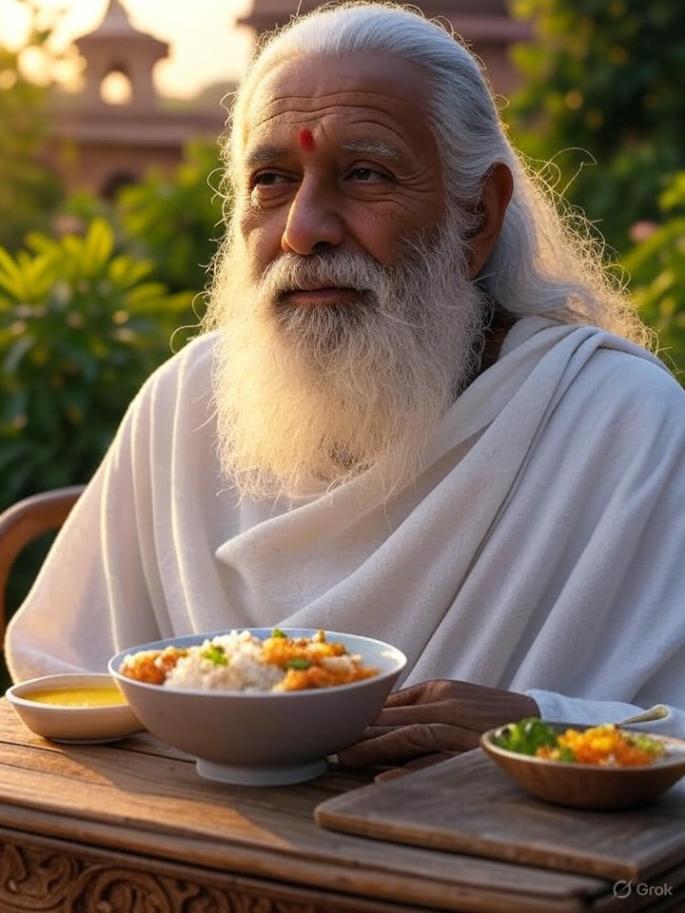

अहं वैश्वानरो भूत्वा प्राणिनां देहमाश्रितः।

What’s the hardest decision you’ve ever had to make? Why?

Do We Really Know the Right Way to Eat?


The 8 Timeless Ayurvedic Rules Most People Break Every Day

We eat every day, yet very few of us truly understand how to eat.
Thousands of years ago, Maharshi Charaka explained the correct method of eating—simple, spiritual, and rooted in deep biological wisdom.
But today, almost 99% of people break the very first rule without even realizing it.

At Dakshinamurthy Ayurveda Pvt. Ltd., we believe that before any treatment begins, lifestyle and diet must align with nature.
Ayurveda teaches us that food is not just fuel—it is energy, consciousness, and medicine.

Let’s revisit the eight golden rules of eating, with the spiritual depth they deserve.

1. “Ushnam” — Eat Warm, Fresh Food

Warm, freshly prepared food carries prana, the subtle life force.
Reheated, frozen, or processed foods lose this vitality and become heavy for the body and dull for the mind.

Nature creates everything fresh—why should our meals be any different?


2. “Snigdham” — Include Healthy Oils (Ghee, Natural Fats)

Our body is made of seven tissues, and six of them require unctuousness to stay nourished.
A little ghee or natural oil supports digestion, skin health, mental calmness, and longevity.

But just like a lamp cannot burn without a strong flame, oil cannot digest without strong digestive fire.


3. “Matravat” — Eat the Right Quantity

Ayurveda says:

50% solid food

25% liquids

25% left empty


When you eat the right amount, the body feels light, steady, and alert—never sleepy or heavy.

Eating with awareness is an act of self-respect.


4. “Jīrne” — Eat Only After the Previous Meal Digests

When undigested and fresh food mix together, toxins (ama) are formed.
This leads to bloating, acidity, gas, and chronic metabolic issues.

Digestion is not just a process—it’s a sacred transformation turning food into consciousness.


5. “Deshe Deshe” — Eat in a Calm Environment

Food absorbs the energy around you.

Eating while scrolling your phone, watching TV, or in a stressful environment disturbs both the mind and the digestive system.

A peaceful space creates a peaceful stomach.


6. “Sarvopakaranayuktam” — Include All Six Tastes

Ayurveda teaches that every meal should include:

Sweet

Sour

Salty

Pungent

Bitter

Astringent


A balanced plate leads to a balanced mind.

At Dakshinamurthy Ayurveda Pvt. Ltd., we follow this ancient principle while creating authentic Ayurvedic formulations.


7. Neither Too Fast, Nor Too Slow

Eating too fast increases Vata and disrupts the natural rhythm of digestion.
Eating too slowly makes food cold and heavy.

Chewing 32 times brings sensory pleasure, mindfulness, and effortless digestion.
Your stomach doesn’t have teeth your mouth does.


8. Eat with a Quiet, Grateful Mind

“अजल्पं, अहसनं, तन्मना भुञ्जीत”


“Ajalpam, Ahāsanam, Tanmanā Bhunjīta”
Eat without talking, laughing, or distraction.

Food turns into your breath, your strength, your thoughts.
Honor it.
Bless it.
Be present with it.

This is not just eating this is a spiritual practice.

Ayurveda and the Bhagavad Gita are deeply intertwined they both describe the human being as a sacred meeting point of body, mind, and divine consciousness. The Gita reminds us that true healing begins within. In Chapter 15, Verse 14, Lord Krishna declares: “Aham Vaishvanaro Bhutva Praninam Deham Ashritah”

“I become the Vaishvanara fire within the bodies of all living beings, and with this digestive fire, I digest the four kinds of food.” Ayurveda calls this same force Jatharagni, the sacred digestive fire that governs health, vitality, and mental clarity. When this inner fire is strong, our body transforms food into energy and consciousness; when it weakens, disease takes root. The Gita also teaches principles that mirror Ayurvedic wisdom moderation in food, steadiness of mind, and the discipline of sattvic living. Together, they show that eating is not just a physical act but a spiritual one, where the divine fire within meets the nourishment provided by nature.


Why Dakshinamurthy Ayurveda Believes in These Ancient Rules

At Dakshinamurthy Ayurveda Pvt. Ltd., we don’t just make Ayurvedic products
we carry forward a lineage of healing where food is the first medicine and lifestyle is the real treatment.

Whether it’s our authentic herbal formulations or our health-focused content, our mission is simple:

Bring ancient Ayurvedic wisdom back into modern life pure, practical, and powerful.

When you eat right, nature becomes your healer.

Amar Bel (Cuscuta reflexa): The Hidden Ayurvedic Treasure

How are you feeling right now?


In Ayurveda, nature has gifted us countless healing plants, but some remain underrated despite their powerful benefits. One such wonder is Amar Bel (Cuscuta reflexa) — also known as Akhand Lata, Swarn Lata, and Aksh Bel.

This golden parasitic plant may look unusual, but it is a storehouse of medicinal properties. Ayurveda describes Amar Bel as a natural healer that balances Pitta and Kapha doshas, helping the body restore its inner harmony.

At Dakshinamurthy Ayurveda Pvt. Ltd., we believe that such ancient herbs are timeless solutions for modern health challenges.

🌱 Health Benefits of Amar Bel

1️⃣ Liver Care – Natural Detox for the Liver

Amar Bel juice or decoction improves liver function.

Especially useful in jaundice and other liver-related disorders.
✨ It helps the liver flush out toxins and boosts overall vitality.


2️⃣ Digestive Health Booster

Relieves indigestion, constipation, and acidity.

Keeps the stomach light and increases appetite.
💡 Perfect for those struggling with sluggish digestion.


3️⃣ Skin Healing Power

Paste or juice works wonders for eczema, itching, and ringworm.

Purifies the skin and protects against infections.
🌸 A natural alternative for clear and glowing skin.


4️⃣ Strong & Healthy Hair

Oil prepared from Amar Bel strengthens the roots and reduces hair fall.

Controls dandruff and adds shine to the hair.
✨ An Ayurvedic beauty secret for lustrous hair.


5️⃣ Supports Diabetes Management

Helps regulate blood sugar levels naturally.

Beneficial for people with diabetes when taken under Ayurvedic guidance.


6️⃣ Reproductive Health & Vitality

Improves male and female reproductive health.

Enhances sperm quality and quantity.
🔥 A traditional remedy for strength and fertility.


7️⃣ Blood Purifier

Cleanses the blood and removes toxins.

Effective against skin and blood-related disorders.
🌿 Purification from within brings health outside.


🌿 How to Use Amar Bel

✅ Decoction (Kadha): Boil leaves in water. Useful for digestion and liver disorders.
✅ Juice: Extract fresh juice and drink on an empty stomach.
✅ Oil: Massage into scalp for hair health and shine.
✅ Paste: Apply directly on skin for eczema, itching, or fungal infections.


⚠️ Note of Caution

While Amar Bel is safe in many traditional uses, it should always be consumed under the guidance of an Ayurvedic doctor for correct dosage and safety.

🌍 Ayurveda vs. Today’s Health Challenges

In today’s world, lifestyle diseases like diabetes, liver disorders, skin problems, infertility, and stress-related conditions are increasing rapidly. Modern medicine often manages the symptoms but struggles to provide long-term balance.

This is where Ayurveda stands strong. With a holistic approach, herbs like Amar Bel work at the root cause, detoxify the body, and restore natural harmony.

At Dakshinamurthy Ayurveda Pvt. Ltd., our mission is to bring back this divine legacy of healing and offer safe, natural solutions for today’s new health challenges.

Amar Bel is not just a wild parasitic plant — it’s a hidden Ayurvedic gem that supports liver health, digestion, skin, hair, and even reproductive wellness. With the wisdom of Ayurveda and dedication of Dakshinamurthy Ayurveda Pvt. Ltd., we can face today’s rising health challenges with confidence — naturally and holistically.

Ayurveda diet

8 Ayurvedic Diet Rules by Maharishi Charak That 99% People Ignore – Transform Your Health Today!


Food is not just sustenance; it’s the foundation of our health. Thousands of years ago, the great sage Maharishi Charak, a pioneer of Ayurveda, laid down timeless dietary principles that can prevent diseases and promote holistic well-being. Yet, shockingly, 99% of people unknowingly break the very first rule of healthy eating! According to Ayurveda and yoga expert Ashish Chaudhary, following these 8 golden rules of eating can transform your health and prevent chronic illnesses. Let’s dive into these ancient secrets and discover how to eat the right way to live a vibrant, disease-free life.


Why Does Food Matter So Much?

Food is both medicine and poison it can either nourish your body or become the root cause of ailments. By adopting Maharishi Charak’s Ayurvedic dietary principles, you can ensure that every bite you take supports your physical, mental, and emotional health. Let’s explore these 8 rules and how they can revolutionize your eating habits.


1. Ushnam: Always Eat Fresh and Warm Food

The first and most critical rule is Ushnam, which means eating food that is freshly cooked and warm. Unfortunately, most of us break this rule by consuming processed, frozen, or reheated meals.
Why it matters: Freshly prepared food retains its prana (life energy) and is easier to digest. Reheating food stored in the fridge can reduce its nutritional value and lead to health issues like bloating, indigestion, and even chronic diseases.

Pro Tip: Cook small, fresh meals daily and avoid relying on packaged or leftover foods. Your body deserves the warmth of freshly made meals!


2. Snigdha: Include Healthy Fats in Your Diet.

The second rule, Snigdha, emphasizes the importance of including healthy fats like ghee or oil in your meals. The human body is composed of seven dhatus (tissues), six of which require lubrication to function optimally.

Why it matters:
Healthy fats aid digestion, nourish tissues, and balance the body’s energies. However, overconsumption without proper digestive fire (Agni) can lead to Kapha imbalance.

How to do it right:
Pair your meal with a small amount of ghee or sesame oil. Sip lukewarm water during meals to aid digestion, as Ayurveda recommends taking three sips of warm water for optimal food breakdown.


3. Matra: Eat in the Right Quantity

The third rule, Matra, is about eating in moderation. Overeating or undereating can disrupt your body’s balance, leading to discomfort and poor digestion.
How to find the right portion: Your stomach should feel satisfied but not heavy. You should feel comfortable sitting or moving after a meal, with no bloating or lethargy.

Ayurvedic Formula:
Fill your stomach with 50% solid food, 25% liquid, and leave 25% empty for digestion. Practice mindful eating by staying calm and doing a few rounds of Anulom-Vilom (alternate nostril breathing) before meals to enhance awareness.


4. Jirnam: Eat Only After Digesting the Previous Meal

The fourth rule, Jirnam, stresses the importance of allowing your previous meal to fully digest before eating again. Eating too soon can mix undigested food with new food, causing digestive issues like gas, bloating, and acidity.

Why it matters:
Undigested food creates toxins (Ama) in the body, leading to imbalances in the doshas (Vata, Pitta, Kapha).

How to follow it:
Wait at least 3-4 hours between meals, depending on your digestive capacity. Listen to your body for signs of hunger rather than eating out of habit.


5. Ishta Desha: Eat in a Calm and Pleasant Environment

The fifth rule, Ishta Desha, emphasizes the importance of your dining environment. A peaceful and clean space enhances digestion and promotes mindfulness.
Why it matters: Eating in a chaotic or stressful environment can disrupt your body’s ability to process food effectively.

How to create the right ambiance:
Choose a quiet, clutter-free space for meals. Avoid distractions like phones or TVs, and focus on the act of eating.


6. Ishta Sarvopakarnam: Include All Six Tastes in Your Meal

The sixth rule, Ishta Sarvopakarnam, advises including all six tastes (sweet, sour, salty, bitter, pungent, and astringent) in your meals to ensure nutritional balance.

Why it matters:
Each taste corresponds to specific nutrients and supports different bodily functions. A balanced meal nourishes both body and mind.

How to achieve it:
Incorporate a variety of foods like grains, vegetables, spices, and fruits to cover all six tastes. For example, add turmeric (bitter), lemon (sour), and jaggery (sweet) to your meal.


7. Na Ati Shighram: Don’t Eat Too Quickly.

The seventh rule, Na Ati Shighram, warns against eating too fast. Gulping down food can lead to improper digestion, increased Vata dosha, and issues like hiccups or indigestion.

Why it matters:
Chewing food thoroughly (Ayurveda recommends 32 chews per bite) allows enzymes in saliva to break down food, making it easier for your stomach to process.

How to slow down:
Put down your spoon or fork between bites, and avoid distractions like phones or screens. Savor each bite with gratitude.


8. Mindful Eating: Eat with Awareness and Gratitude

The final rule, Ajalpan Ahasan Tanmana Bhunjitam, encourages eating with full awareness, gratitude, and focus. Avoid talking, laughing, or multitasking during meals.

Why it matters:
Mindful eating ensures proper digestion and fosters a deeper connection with your food. It also aligns with the traditional wisdom of our elders, who advised silence during meals.

How to practice it:

Take a moment to appreciate your food before eating. Chew slowly, focus on the flavors, and express gratitude for the nourishment it provides.


Why These Rules Are a Game-Changer

By following Maharishi Charak’s 8 Ayurvedic dietary rules, you can prevent common health issues like indigestion, obesity, and fatigue while promoting longevity and vitality. These principles are not just ancient wisdom—they are practical, time-tested guidelines that align perfectly with modern health needs.


Start Your Ayurvedic Journey Today!

Ready to transform your relationship with food? Begin by incorporating one or two of these rules into your daily routine and gradually adopt all eight. Your body will thank you with improved energy, better digestion, and a stronger immune system.


Quick Tip: Start with the Ushnam rule by eating freshly cooked meals for one week and notice the difference in how you feel. Join the Conversation: Share your experience with these Ayurvedic principles in the comments below or on social media using #AyurvedicDiet.
For more health and wellness tips rooted in Ayurveda, subscribe to our blog and follow us.  Stay tuned for more ancient wisdom to live a healthier, happier life!

The planting

What positive events have taken place in your life over the past year?

अश्वत्थमेकम् पिचुमन्दमेकम्न्यग्रोधमेकम् दश चिञ्चिणीकान्।कपित्थबिल्वाऽऽमलकत्रयञ्चपञ्चाऽऽम्रमुप्त्वा नरकन्न पश्येत्।।

Ashvatthamekam pichumandamekam
Nyagrodhamekama dasa chinchinikaan.
kapitthabilvā’malakatrayāncha
pañcā’mramuptvā nārakāṇa paśyet||


AshvatthaH = Peepal (absorbs 100% carbon dioxide)
Pichumandah = Neem (absorbs 80% carbon dioxide)
NygrodhaH = Banyan tree (absorbs 80% carbon dioxide)
Chinchini = Tamarind (absorbs 80% carbon dioxide)
KapitthaH = Kavit (absorbs 80% carbon dioxide)
BilvaH = Bael (absorbs 85% carbon dioxide)
Amalaka = Amla (absorbs 74% of carbon dioxide)
Amrah = Mango (absorbs 70% carbon dioxide)
(Upti = planting)

Whoever cares for these trees and takes care of them, negative energy does not come near him. Positive energy increases your enthusiasm and enthusiasm.  Due to not following this lesson, we are suffering from many diseases in the form of this situation today. Today asthma is very much troubled by viruses, pollution, and climate change is accelerating new transformation. Therefore, all the measures necessary have to be accepted by man at a personal level. Dependency on the government is laziness. We can still correct our mistake. If the citizens of Western countries do not change their lifestyle, then they should be prepared for big losses, it is also accepted as a warning, then there is no harm. Understanding and following the rules of diet is the need of the day

The problem of drought is increasing due to the closure of trees like peepal, banyan, and neem. All these trees increase the amount of oxygen in the atmosphere. Also, reduces the temperature of the earth. There was a tradition of worshiping trees in Indian spiritual culture, today’s modern illiterate people consider this method as superstition and immediately started planting eucalyptus trees on both sides of the road by keeping their distance from these trees in the circle of culture. Eucalyptus grows quickly but these trees are planted to dry out marshy land. These trees cause the water level of the earth to fall. In the last 40 years, the environment has been damaged by planting eucalyptus trees in abundance.

In the scriptures, Peepal has been called the king of trees.

मूले ब्रह्मा त्वचा विष्णु शाखा शंकरमेवच।
पत्रे पत्रे सर्वदेवायाम् वृक्ष राज्ञो नमोस्तुते।।

The tree in whose root it is to build, nurture, and eliminate all these qualities and all the energies reside on the leaf and leaf of that tree, salutations to the king of such trees, Peepal, in the coming years, if a peepal, bad, neem, etc. tree will be planted at every 500 meters apart, Only then will this world be pollution free. Basil plants will have to be planted in homes. We need to start a campaign from today itself to get plenty of natural oxygen in our future.

The biological clock

What is one thing you would change about yourself?

Our human body is a science in itself, the research that happens outside is first made in our own body, so it is important to understand the science of the human body. The science of the human body is far ahead of the education we study engineering at the university. The purpose of spirituality beyond science is to make you realize proper knowledge. Do we live this life with full awareness? No!! We only see our body on a physical level, we have forgotten it Therefore, you should try to make your lifestyle pure. Sleeping at night is also an art, during 11 to 3 pm, more of your blood circulation is focused towards the liver, when the liver receives more blood, its size increases, this is the crucial time when your body goes through the process of releasing the stored toxin. Your liver also neutralizes and eliminates the toxins collected by the body throughout the day. Therefore, there is no separate machine in the body, this working system is made in our body itself.

If you go to bed at 11 o’clock, you have four full hours to detoxify your body. If you sleep at noon, then 3 hours. If you sleep at 1 o’clock, then 2 hours. If you sleep at 2 o’clock, you get only one hour to clean the toxic substances. Do you sleep after 3 p.m.? Unfortunately, you have no time left to detoxify the body. If you continue the routine in the same way, over time these toxins begin to accumulate in your body. Over time, cancer emerges like many diseases, so think about how much you contribute to the formation of the disease and stay healthy.

Have you ever been up late? Have you felt that you feel very tired the next day, no matter how many hours you sleep? By not giving the body full time to detoxify, you also go away from many important functions of the body. Between 3 and 5 in the morning, the center of blood circulation is your lungs. At this time you should breathe fresh air and exercise. You should fill your body with good energy, at this time the air is very fresh and full of beneficial ions. So this is a good time to do pranayama and there is science behind it.  Between 5 and 7 a.m., the center of blood circulation is towards your large intestine You should go to the restroom at this time. All the poison should be removed from your large intestine. Prepare your body for the nutrients it absorbs throughout the day. Between 7 and 9 in the morning, the center of blood circulation is your stomach or stomach. You should eat breakfast at this time. This is the most important meal of the day. Make sure it contains all the essential nutrients. Not having breakfast in the morning causes many health-related problems in the future. Follow your natural routine by following your body’s natural biological clock

Before eating

What are your family’s top 3 favorite meals?

Many young people fill their stomachs by eating it, the changing lifestyle has made this Chinese food an important part of our day-to-day life.
Be it children or adults, people of every class eat it with great passion. But did you know that what is used to make these dishes delicious is called Ajinomoto…
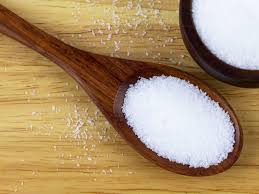
The spice of driving the mind crazy… It is also called brain broom which is in the form of white crystals. It is a chemical called monosodium glutamate (M.S.G.) which people know as Ajinomoto. It enhances the taste of the food in which it is added… Ajinomoto is a chemical that confuses the tongue after touching it and sends false messages to the brain. Due to this rotten or tasteless food also feels good. The use of this chemical disrupts the network of neurons between the organs of the body and the brain, which has far-reaching consequences. Monosodium glutamate was discovered by a Japanese scientist, Kikunai Ikeda, in 1908. Kikunai Ikeda was working at Tokyo Imperial University at the time.


The professor’s wife often made a popular Japanese stock (soup) ‘Dashi’ from seagrass called kelp. He noticed that Japanese broth made from seagrass Katsuobushi and Kombu (kelp) has a peculiar taste. … Which is different from sweet, salty, sour, and bitter taste. Professor isolated glutamic acid (Ajinomoto) from sea-grass Laminaria japonica, Kombu, by aqueous extraction and crystallization method the special flavor of this salt was named Umami. … Which became famous as a fifth flavor. … Which means pleasant taste. Professor Ikeda named this discovery monosodium glutamate and took a patent in Japan under the name of MSG. In 1909, together with the Suzuki brothers, they opened a company called Ajinomoto for its commercial production. It was commercially produced for the first time this year. The debate over whether Ajinomoto is safe for humans began when a Chinese restaurant syndrome decided not to use it because of the dishes in which Ajinomoto was used. After eating them, their customers started falling ill and the biggest thing was that the symptoms of all the sick customers were also the same. After this incident, the Medico Academic Industry also started writing about the side effects of MSG.

Ajinomoto-rich food should not be eaten during pregnancy. Consuming excessive amounts of MSG during pregnancy can be fatal for the unborn baby.  Ajinomoto is a type of salt.  It increases blood pressure, which hinders the delivery of the right amount of food to the child and affects the neurons of the child’s brain Due to this the development of the child in the womb is not fully done and the baby can be born mentally weak. Its consumption has also been found to cause headache, flushing, sweating, nausea (dizziness and vomiting), and weakness and in some studies, excessive consumption of it can cause brain damage and eye problems in children. MSG is a neurotransmitter, which stimulates brain cells. Stimulated neurons can cause insomnia-like conditions.

Excessive intake can also cause problems like a sudden increase in heartbeat and stretching of chest muscles. Ajinomoto can cause pain in the muscles and knees of the feet. It weakens the bones and reduces the amount of calcium taken by the body By consuming it, the amount of insulin in the body increases and its intake increases the level of glutamate in the blood. For this reason, there is a very serious effect on the body. Ultimately, it acts like an addiction. Once you eat it, you want to eat it again and again, and eating it causes harm